


It’s only her second play, but Grace Chapple’s stunning adaptation of E.M. Forster’s 1908 novel, A Room with a View, establishes the young playwright as a mature voice with a recognisable style and set of concerns.
Never Closer, Chapple’s critically lauded debut about a group of long-term friends struggling to relate to each other in the middle of Northern Ireland’s Troubles, introduced us to a writer with a distinctly literary sensibility and a sensitive eye for the drama of connections: the tragedies, histories and doubts that haunt them.
Turning to Forster’s delightfully strange portrait of desire on the precipice of modernity, A Room with a View shows Chapple honing this interest to a sharper point, bringing out the absurdities of love at the heart of the novel without suffocating them in heavy-handed or self-conscious attempts to modernise its language or story.

Nathalie Morris in A Room with a View. Photo © Brett Boardman
It’s a hard novel to adapt. Largely plotless, Forster’s weird and wonderful prose ambles along with its motley crew of loveable and aloof characters, sidelining conventional drama in favour of close attention to the quirks and frustrations of Lucy Honeychurch’s (Nathalie Morris) first experience of desire, and the self-doubt, classism and classist people that stop it from turning into love.
We’re in Florence, Italy, at the turn of the 20th century. Lucy and her chaperone, Charlotte Bartlett (the hilarious Hayley McElhinney), are settling into a room without a view at the Pension Bertolini. Lucy is bright-eyed but self-conscious; her adolescent lust for life is barely disguised by an Edwardian civility she naively performs for the sake of her escort, who hides her own self-consciousness beneath a pompadour and a pompous attitude.
Incensed by their cruddy accommodation, Bartlett strides to the window – the set, designed by Zoë Atkinson, includes four towering Italian windows – and raises a blind. Instead of the Florentine skyline, she sees a sign in bold letters: ‘NO VIEW’. It’s the first of many moments of tongue-in-cheek metatheatre in this production: a combination of British pantomime and Victorian farce that brings out Forster’s keen eye for the absurdities of repressive 19th-century upper-class values.
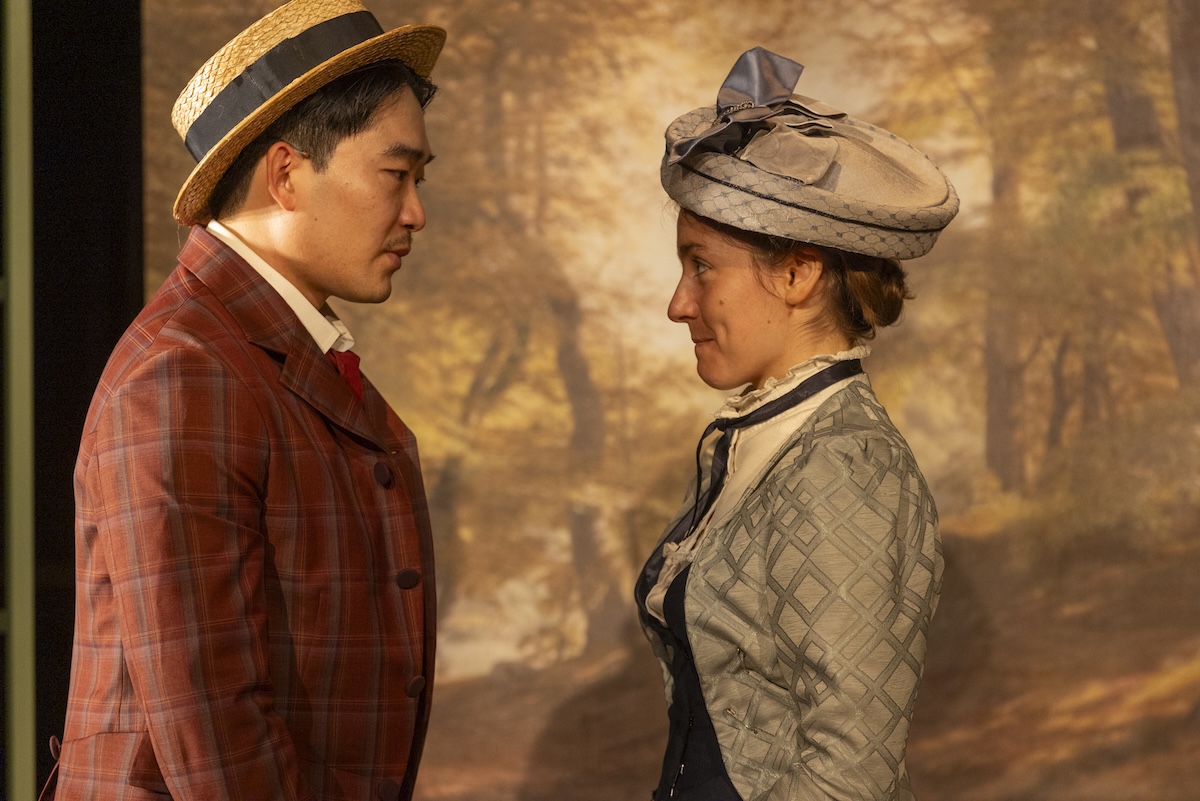
Charles Wu and Natalie Morris in A Room with a View. Photot © Brett Boardman
Once Lucy and Miss Bartlett successfully ‘pas-ag’ their way into changing rooms with the outspoken socialist, Mr Emerson (Patrick Williams), and his brooding son, George (Luke Wiltshire), we follow Lucy as she denies her feelings for George and encounters various larger-than-life characters eager to confuse or help her. The author, Miss Lavish (Kate Atkinson), teaches her how to get lost in Florence. The friendly clergyman, Mr Beebe (a standout Tom Conroy), reminds her of the lustful powers of playing Beethoven.
When Lucy returns to England, she has a douchey fiancé, Cecil (Charles Wu), a loving mother, Mrs Honeychurch (Atkinson), and a rambunctious brother, Freddy (a perfectly showy role for Tomáš Kantor), ready to poke at her star-crossed connection with George.
It’s a testament to Chapple’s skill as a writer that she does not answer the novel’s thin plot with more drama, or more plot, but rather lets this talented cast propel the show’s two-and-a-half-hour runtime by revelling in these endearing oddballs and the simple comedy of their lives.
Chapple tackles each character’s anachronisms with care and chagrin. Fourth-wall address has been connected to contemporary feminist theatre ever since Phoebe Waller-Bridge’s Fleabag. Closer to home, MTC’s smash-hit musical, My Brilliant Career, comes to mind: a show that gave its lead character, Sybylla Melvyn, the power of narrating her own story to match her bombastic confidence.
Lucy is more aloof and unsure about what she wants than Sybylla. Her self-doubt, immediately recognisable to anyone who has been young or in love, makes her a uniquely slippery lead character.
While Morris, who is astounding in her subtle use of physicality, endears us beautifully in the few moments of direct address she’s afforded at the beginning of the show, her inner thoughts become almost completely withheld from us as she continues to resist her connection to George. Those surrounding her – mostly her wanky fiancé, Cecil, played with hoity glee by Wu – talk on her behalf, underlining the nascent feminism of Forster’s politics, even one hundred years ago.
Chapple’s adoring eye for Forster’s love for Lucy and these characters is matched by a design approach keenly aware of the novel’s tense juxtapositions. With its sparse set pieces – a chaise longue here, a simple piano and projector screen there – Atkinson’s design initially seems to recall the minimalistic approaches to adaptation popularised by British director Jamie Lloyd or our own Simon Stone.
But Atkinson’s restraint is as playful as it is subversive. Each window pane doubles as a mirror while also hiding various prospects that the actors pull down in pantomime style to signal new settings: Florentine frescoes, British woodland.
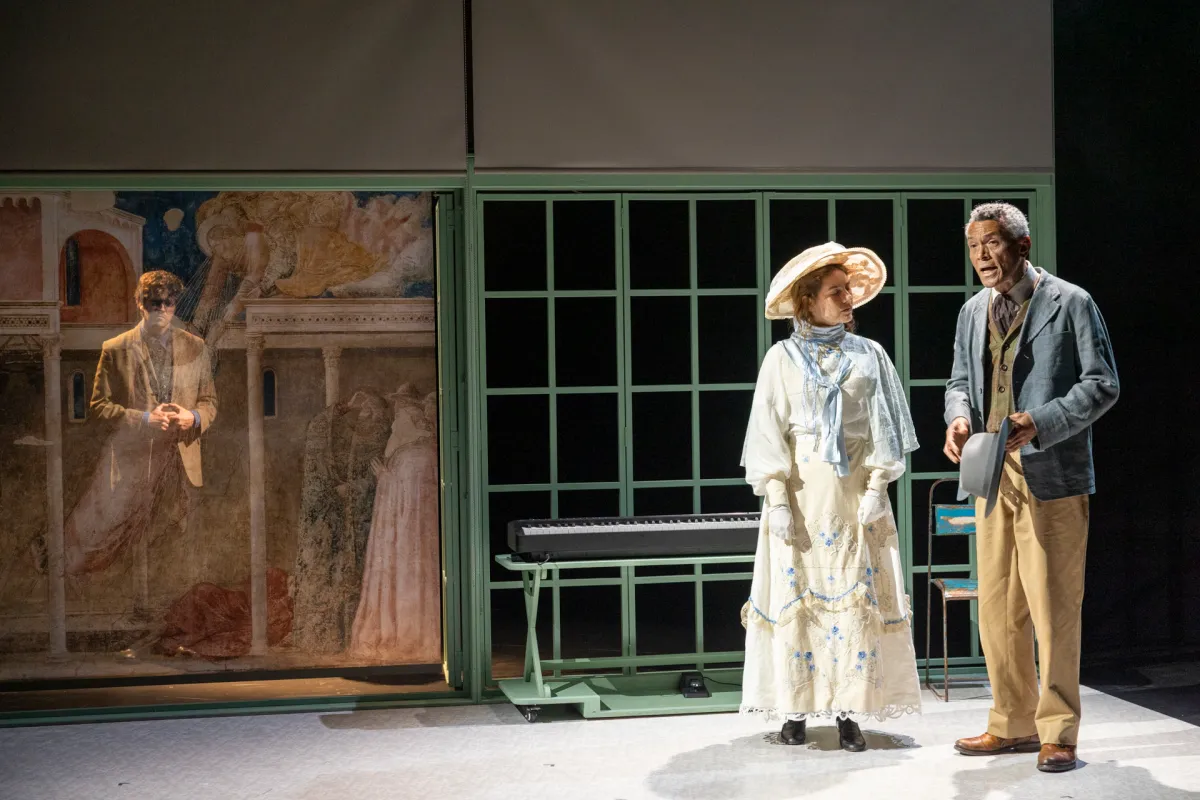
Natalie Morris and Patrick Williams in A Room with a View. Photot © Brett Boardman
Alongside Chapple’s faithful script, these subtly creative design flourishes capture one of the strange feelings central to the novel. Lucy’s coming of age reflects a 20th-century world in transition: not quite Edwardian, but not quite modern; not completely urbane, but no longer Romantic.
Chapple keeps the Edwardian flourishes and pastoral descriptions in Forster’s prose largely unchanged. But Atkinson’s set is starkly modern: sparse and coolly artificial. When George and Lucy steal their first kiss in a field of violets in rural Italy, the landscape is evoked with a lush but subtle wash of purple and green from lighting designer Amelia Lever-Davidson.
Meanwhile, Madeleine Picard’s soft score shifts elegantly from atmospheric ambience – all fluvial legato and strings that sound almost like synths – to bouncier, more period-specific flourishes. The effect is delightfully dissonant: a challenging feeling of liminality from two warring styles that evokes Lucy’s similarly warring impulses.
Director Hannah Goodwin brings it all together expertly, massaging these contrasts and smoothing their more alienating edges by bringing moments of youthful humour (and full-frontal nudity) out into the audience without ever over-exaggerating them. That’s the key to this production’s incredible success: the fact that its comedy does not resolve these moments of dissonance but endears us to the characters who are trying to navigate them.
Some bits go longer than they need to, but there is a cumulative effect that leads to an affecting conclusion, in which this dissonance challenges the happiness of a happy ending. Though love prevails, it belies a series of lost connections: whether Franky and Mr Beebe, who, in a parallel to Forster’s repressed homosexuality in life, cannot be together; or Miss Bartlett, who, rather than being the pompous Edwardian meddler in Lucy’s affairs, is revealed as her strongest supporter, with a tragic past of her own.
Lucy’s love for George is as heartfelt as ever, but it is Chapple’s eye for the constellations of different forms of love that orbit her, as well as a team uncompromising in its commitment to showcasing them, that makes this production a startling testament to love’s unknowable forces, and one of my favourites this year.
A Room with a View plays in the Sumner, Melbourne until 19 December.








Comments
Log in to start the conversation.