Nathan Maynard’s script on the conflict over Tasmanian Aboriginal identity is anchored by several almost shouted monologues from Calen Tassone as Boyd, the respected but uncompromising Indigenous caretaker of the lands around Oyster Bay.
Boyd’s attentions towards his pregnant wife, Nala (Jessie Ward), are interrupted when the Aboriginal Land Council of Tasmania engineers the repatriation of “King Billy” William Lanne’s remains for an on Country cremation presided over by Boyd.
Gracie (Aimee Honor) arrives suspiciously with a cover story about researching the monster who dismembered Lanne in 1869. Gracie shares a past with Nala, drinking goon in public parks. Boyd’s cousin Daniel (Jarrad Inman), recently returned to Country, courts Gracie.
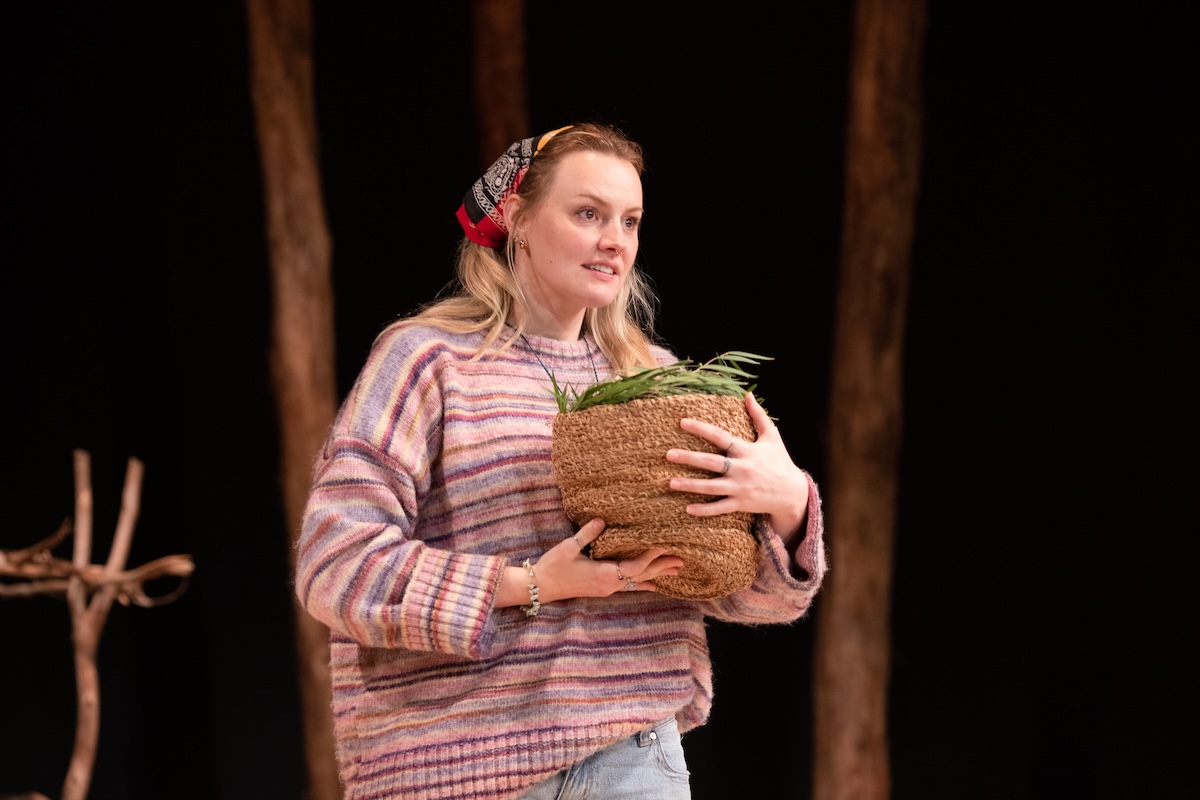
Aimee Honor in Yirra Yaakin Theatre Company’s At What Cost? Photo © Daniel J Grant
Unspecified in the script is that, until 2016, a different standard of proof was applied in Tasmania to access Aboriginal services than in other states. Now, as in all states, Aboriginal definitions are “not to be applied rigidly and require neither archival nor historical records”. Those who “self-identify” using a form are “able to access Indigenous-specific Commonwealth programs”. The legislation notes, however, that “confirmation of Aboriginality is a separate process … undertaken by Aboriginal people themselves within their own communities and by Aboriginal community organisations”.
At What Cost? is loaded with dense but often unstated allusions to these details of Tasmania’s history and law. Lanne was, for example, the husband of Trukanini, the latter falsely referred to as “the last Tasmanian Aboriginal [sic]”. Moving photographs of the two are now widely celebrated. It was, moreover, to Oyster Bay and Bruny Island (just beyond the bay) that Trukanini, Lanne and others were sent.
Maynard mounts an impassioned attack on the 2016 legislation. It is thrilling to have this issue tackled on stage. In Boyd’s eyes, Palawa are being attacked by “tick a box” fakes.
But Boyd isn’t significantly challenged. Daniel’s sexual interest in Gracie undermines his defence of her, and he loses authority when he sucker-punches Boyd from behind, knocking him unconscious. Nala more convincingly argues for a “strategic” compromise to allow some outsiders to attend Lanne’s cremation.

Calen Tassone in Yirra Yaakin Theatre Company’s At What Cost? Photo © Daniel J Grant
Gracie herself is a straw figure, one reviewer noting that he had to try “not to curl my lip at her”. She claims that she feels “culturally unsafe”, despite showing up in Community unannounced just before Lanne’s return.
It is worth remembering that the desecration of Lanne was even more obscene than what is related on stage. Gracie claims descent simply because she whispered to her dying mother that she “always knew” Lanne was her grandfather, and her mother “smiled”.
Gracie pleads, “Does it matter if I don’t know how … or … where … my connection is? Can’t I just know within my spirit?” Yes, it does matter, and at the very least she should check with mob.
Versus Gracie’s dubious reliance on “spirit”, Boyd and Nala are connected to the materiality of Tasmanian Aboriginality. The performance begins with Nala weaving an Indigenous basket, one of which she presents to Boyd to place Lanne in. Nala gives Gracie a string of iridescent shells, like those Palawa have long made.
Boyd has a beautiful kangaroo-skin cloak, onto which he carefully places Lanne’s body before building the funeral pyre. Fibre, shells, wood, skin and, as Boyd puts it, blood and suffering make one Aboriginal in his eyes.
While others in Tasmania may not agree, At What Cost? elevates this material identity above nebulous desires.
Yirra Yaakin Theatre Company‘s production of At What Cost? concluded on 1 August.

Comments
Log in to start the conversation.