


“Jacky” was an interchangeable name used in the 1800s for Aboriginal guides, trackers and police who, by cultivating working relationships with whites, tended to do better than their compatriots.
Playwright Declan Furber Gillick asks us who the “Jackys” of today are. Unusually for a play about Australian race relations, Gillick puts sex and queerness at the heart of this question.
Jacky is a drop-dead gorgeous black man (played by gravel-voiced Ian Moopa Wilkes), originally from a mission up north, who has now made a successful career in Sydney as a male escort to a white clientele.
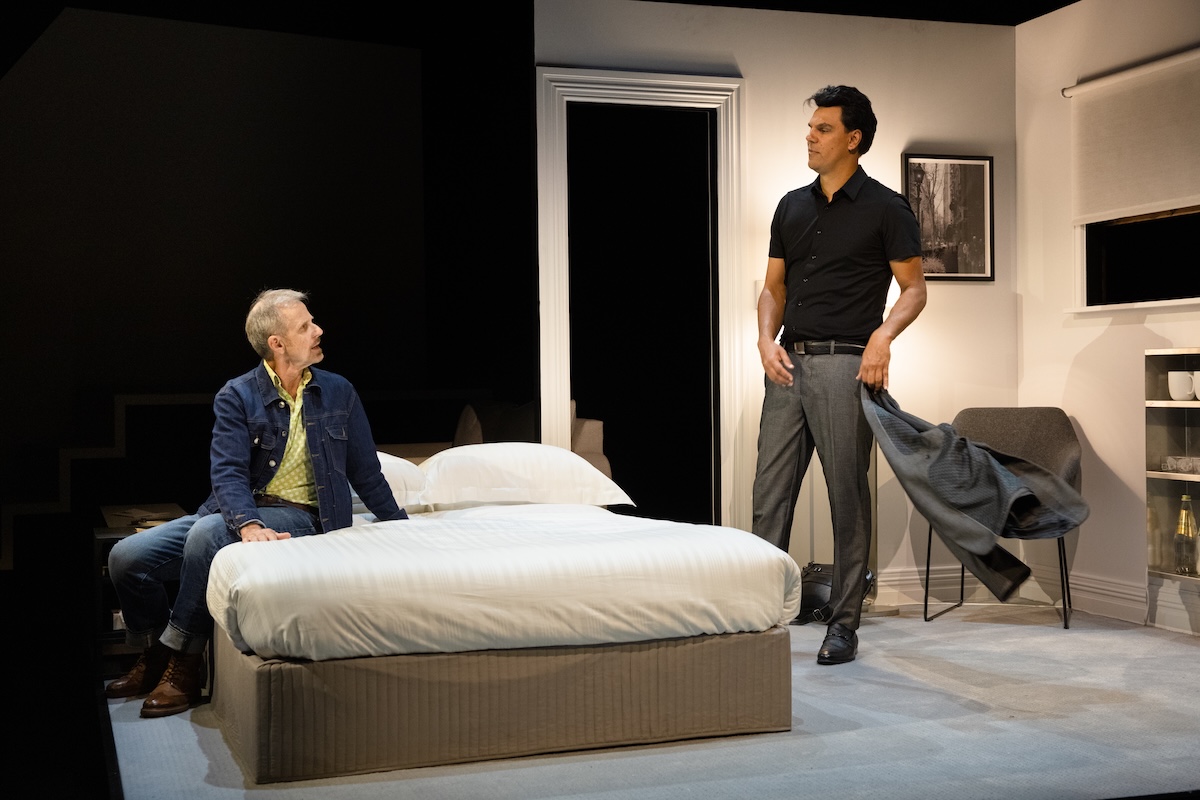
Steve Turner (left) and Ian Moopa Wilkes in Jacky. Photo © Daniel James Grant
His latest client is Glenn (Steve Turner), recently divorced from his wife because of his overwhelming obsession with “big black cock”. The pair soon engage in American plantation fantasies, with Glenn playing the master taking advantage of Jacky, the powerful slave.
Jacky, however, has other challenges. His no-hoper brother Keith (Rueben Mongoo) has come south to get straight, but spends much of his time lazing around Jacky’s flat and leaving “dirty marks” across its immaculate surfaces. Jacky wants to buy his flat, but without a long-term contract, banks won’t lend him the money.
Enter apparent white friend Linda (Amy Matthews), who offers to get Jacky into a recruitment program – but only if she can secure money from donors whose corporations rip out Country.
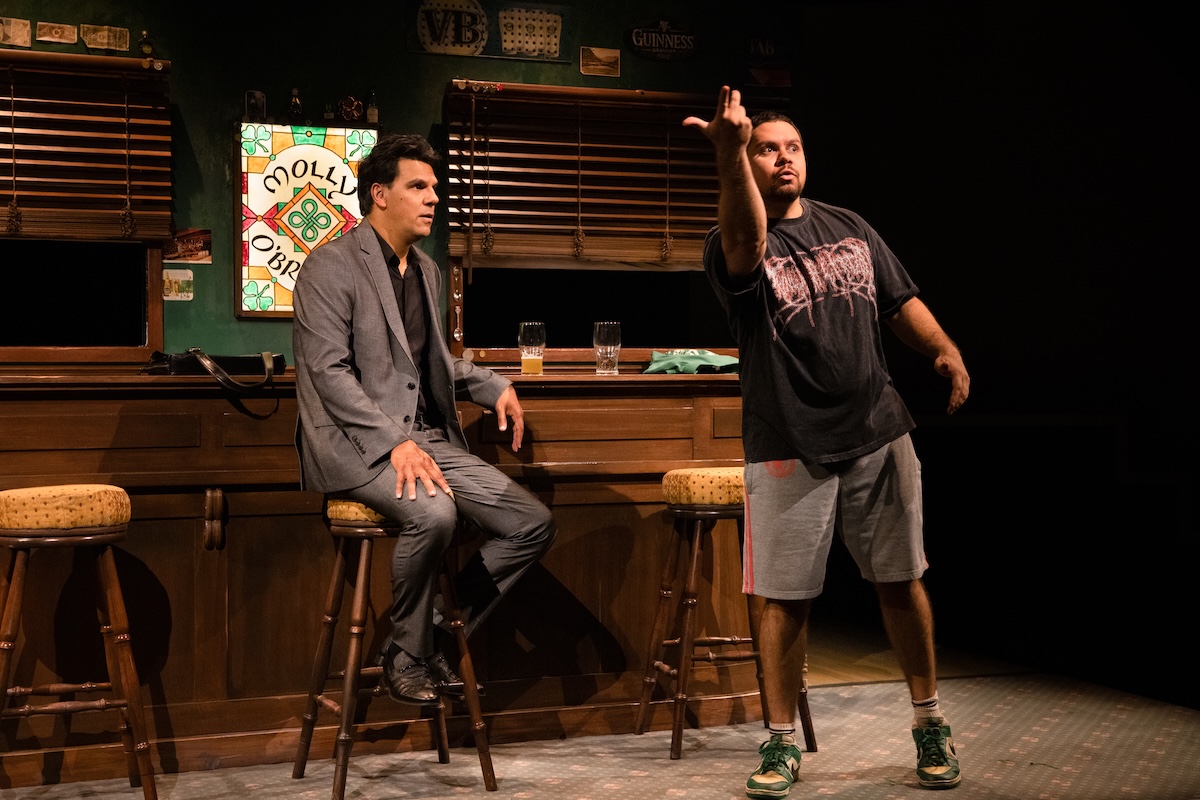
Ian Moopa Wilkes (left) and Rueben Mongoo in Jacky. Photo © Daniel James Grant
In his program note, Gillick observes that, for Karl Marx, the worker’s sale of their body – that is, the sale of their direct or indirect physical labour – to the capitalist, who extracts profit and value, lies at the heart of capitalist exploitation.
“Capital is not a thing,” Marx said, “but a social relation between persons, established by the instrumentality of things”, which sets us apart from each other except through financial transactions.
Jacky is therefore a grotesque burlesque of interracial capitalist oppression, depicting characters unable to see how their personal, emotional and “social relations” have been “established by the instrumentality of things” for profit.
Ironically, it is only Keith, because he has given up on shit jobs in the city, who is able to expose the self-flagellation and self-improvement rituals that Jacky regards as apparently wise and supposedly necessary.

Amy Matthews, Steve Turner and Ian Moopa Wilkes in Jacky. Photo © Daniel James Grant
Gillick’s depiction initially suggests that Australian race relations are at such a low ebb that even in their perverse forms, they can only be played out through a pantomime of US models and fantasies. But Jacky finally recoils when Glenn’s fantasy of dominating not just a black man but an Aborigine is named in one of their bedroom fantasies.
Also biting is the scene in which Jacky prostitutes himself more metaphorically by dancing to satisfy mining donors. If Western Australia’s theatre companies do not look good and hard at this moment, they should.
Jacky’s shame is that of all of us in the WA arts, who unselfconsciously suckle at the teat of unscrupulous mining corporations.
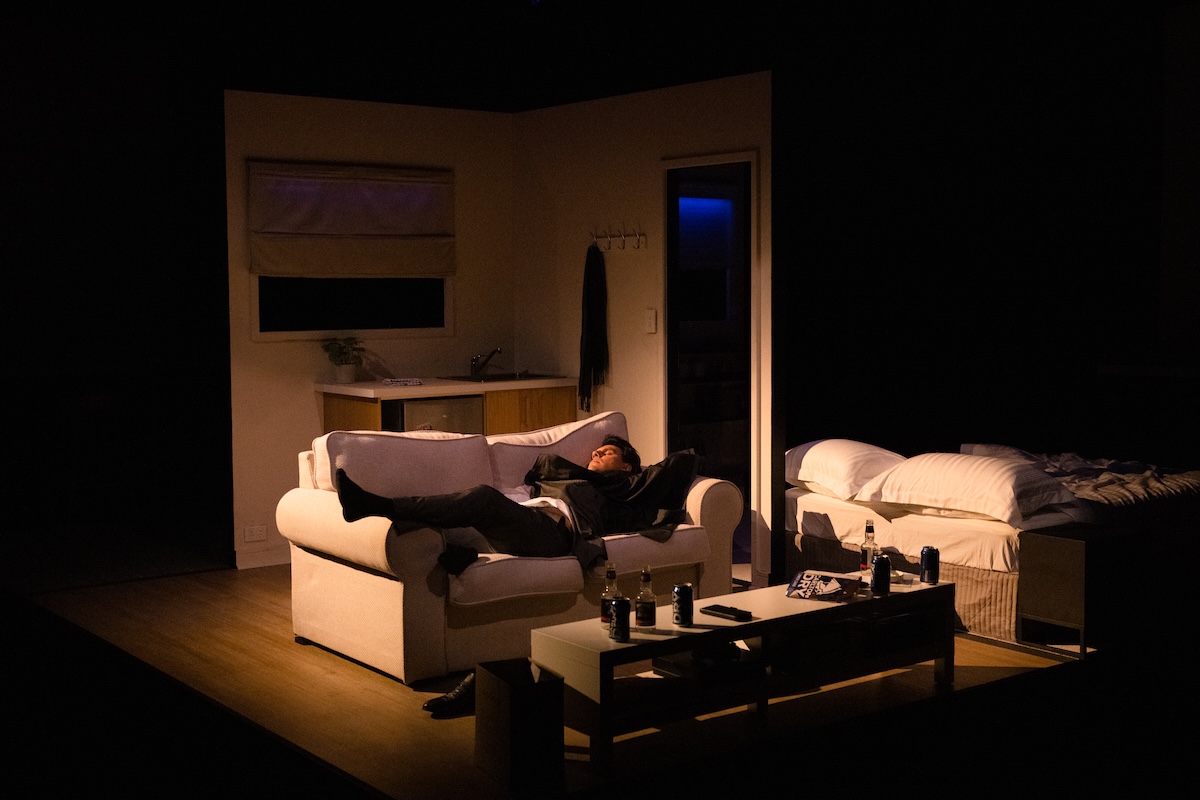
Ian Moopa Wilkes in Jacky. Photo © Daniel James Grant
The most striking aspect of this production is the contained and compartmentalised set by Sophie Fletcher, placed upon a small revolve.
Both the flat and the apartment Jacky uses for liaisons are characterised by a blazing Ikea whiteness set against black flooring and panels. The revolve itself is a direct borrowing from Bertolt Brecht’s Mother Courage (1949), where each revolution of the stage alluded to the inhuman forward grind of capitalism. Even if Jacky’s characters believe themselves to be free, the audience literally sees them going around in circles in a capitalist Sisyphean hell – as, indeed, are we all.
Jacky finally gives up and agrees to go back up north with Keith, though earlier descriptions of the precarious employment of their mother and sister suggest that relations of power and employment are just as dehumanising there.
This was above all the image Jacky left me with: a proud, apparently successful black man obsessively cleaning his glowing white flat as the systems within which he is imbricated inexorably turn onwards.
Black Swan State Theatre Company & Yirra Yaakin Theatre Company presents Jacky at Subiaco Arts Centre, Perth until 8 November.






Comments
Log in to start the conversation.