And so we arrive at the final concert in a series during which Czech pianist Lukáš Vondráček and the West Australian Symphony Orchestra under Principal Conductor Asher Fisch offered us a magisterial view of Beethoven’s five piano concertos.
As with the previous two concerts, The Maverick and The Master, an earlier work is juxtaposed with one from later in Beethoven’s career. In this case, his Symphony No. 1 in C major, Op. 21, premiered in Vienna in 1800; and his Piano Concerto No. 5 in E-flat major, Op. 73 “Emperor”, premiered in 1811.
Before that, however, another overture, this time the Overture in C major, Op. 115, “Namensfeier”, which even Beethoven himself considered a minor work and which we may, while acknowledging the excellence of the performance on this occasion, happily move on from.
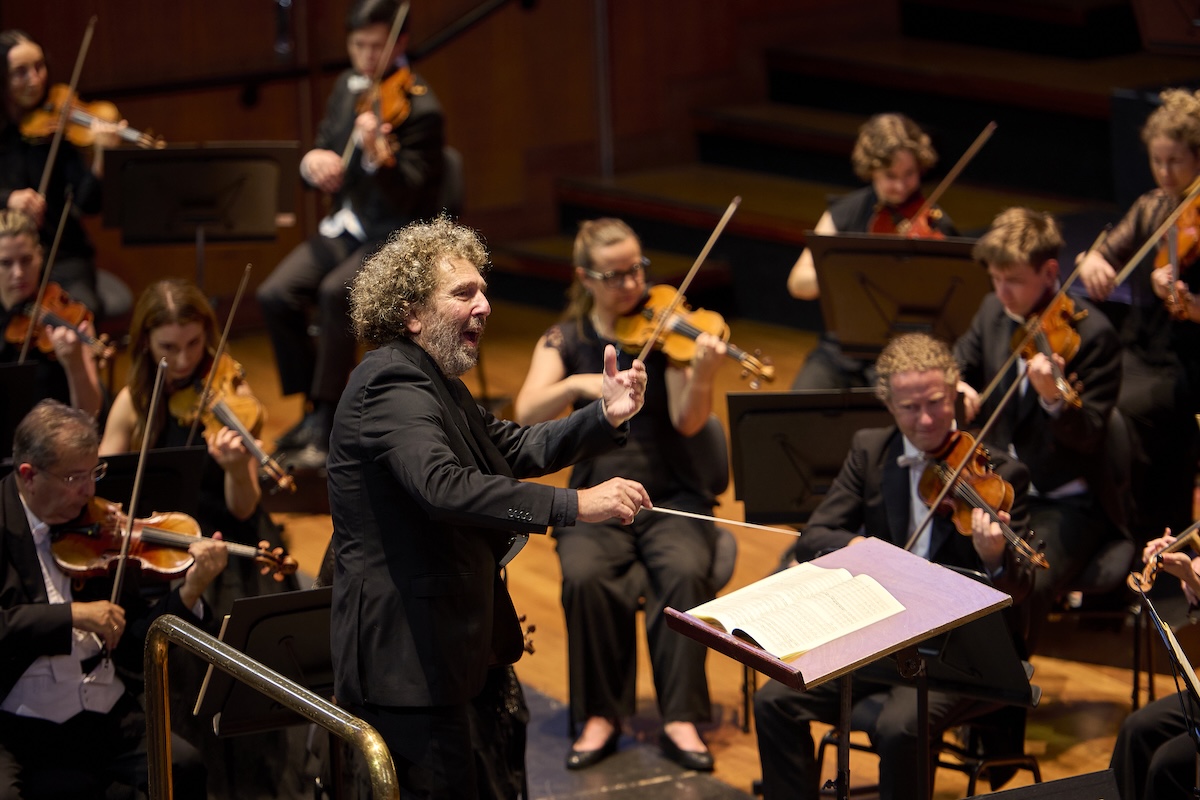
Asher Fisch conducts the West Australian Symphony Orchestra in Beethoven: The Emperor. Photo © Court McAllister
Fisch and WASO understand the First Symphony is part Classical, part Romantic but all Beethoven. Thus, in the first movement, the ambiguities and tensions generated by the composer’s subversion of Classical tonal etiquette – the so-called “Wrong Key” opening, for example – and the thematic punchy vs lyrical arguments carrying into a vivid development section are handled with a deliciously refined abandon.
Fisch and WASO proceed to move with stately step through an F major Andante cantabile con moto whose learned textures and subtle timpani sound very well indeed in the often hard to manage acoustic of the University of WA’s Winthrop Hall. Nothing stately about the following Minuetto, a true symphonic Scherzo in all but name, whose contrasting rustic energy and pastoral insouciance, under Fisch’s supremely assured yet jocund direction, recall the more cheeky aspects of the first movement like a joke retold in different guise.
In like fashion, Fisch and WASO capture the bang and stutter of the final movement’s introduction to perfection, as though trying to get a vintage limo started, before launching into crisp, ebullient Allegro molto e vivace in which the WASO winds in particular cover themselves in glory.

Lukáš Vondráček and the West Australian Symphony Orchestra – Beethoven: The Emperor. Photo © Court McAllister
After the interval, Vondráček takes his place at the Steinway for Beethoven’s Piano Concerto No. 5, the grandiloquence of the first movement’s bold opening gestures from orchestra and soloist yet again setting up the main points of contrast and tension to follow.
As witnessed in the previous two concerts, Vondráček’s approach to Beethoven is characterised by a muscular intensity on the one hand and an extreme tenderness on the other, and indeed such an approach is ideally suited to this most this most noble and heroic of the composer’s concertos.
Therefore, in this opening Allegro, Vondráček, Fisch and WASO combine forces in such a way as to portray a battlefield upon which soloist and orchestra ostensibly vie for dominance but in reality delineate the three contrasting themes’ journey with supreme collective artistry. Although if it were a real contest between piano and orchestra, the former would win, such is Vondráček’s capacious tone, abundant virtuosity and interpretative courage.

Asher Fisch, Lukáš Vondráček and the West Australian Symphony Orchestra. Photo © Court McAllister
The following Adagio un poco mosso transports us back to the atmosphere of the Piano Concerto No. 4, Vondráček singing like a nightingale whose solitary voice rings out over a valley of muted colours exquisitely painted by the orchestra.
And if the Rondo’s bursting into rambunctious life feels just for a second like a rude awakening from nocturnal somnolence, its impertinence can be more than excused by the ensuing display of unbridled virtuosity not just from Vondráček but from the orchestra, whose valedictory enthusiasm boils over into near-mania.
A fitting finale, then, to a hugely satisfying journey through one of classical music’s most significant achievements, with some of the finest guides in the business.

Comments
Log in to start the conversation.