Musica Viva’s Artistic Director Paul Kildea invited three musicians familiar in various guises to audiences throughout Australia to form a dream-team, one-off piano trio for a six-concert tour.
Pianist Aura Go, violinist Kristian Winther and cellist Timo-Veikko Valve have each carved out successful careers in their own right, but listening to this recital it is difficult to believe that they haven’t been playing together for years, so strong is the chemistry between them.
Winther, as well as leading the Australian String Quartet for a brief, troubled time, has appeared in several collaborations, including one for Musica Viva Australia in 2022 performing Kurt Weill’s challenging Violin Concerto alongside the Signum Saxophone Quartet. He and Go have known each other since high school and performed together as emerging artists.
Valve, of course, is best known as Principal Cello for the Australian Chamber Orchestra, but he and Go have collaborated often, including on an ABC Classic recording of Ludwig van Beethoven’s cello sonatas.
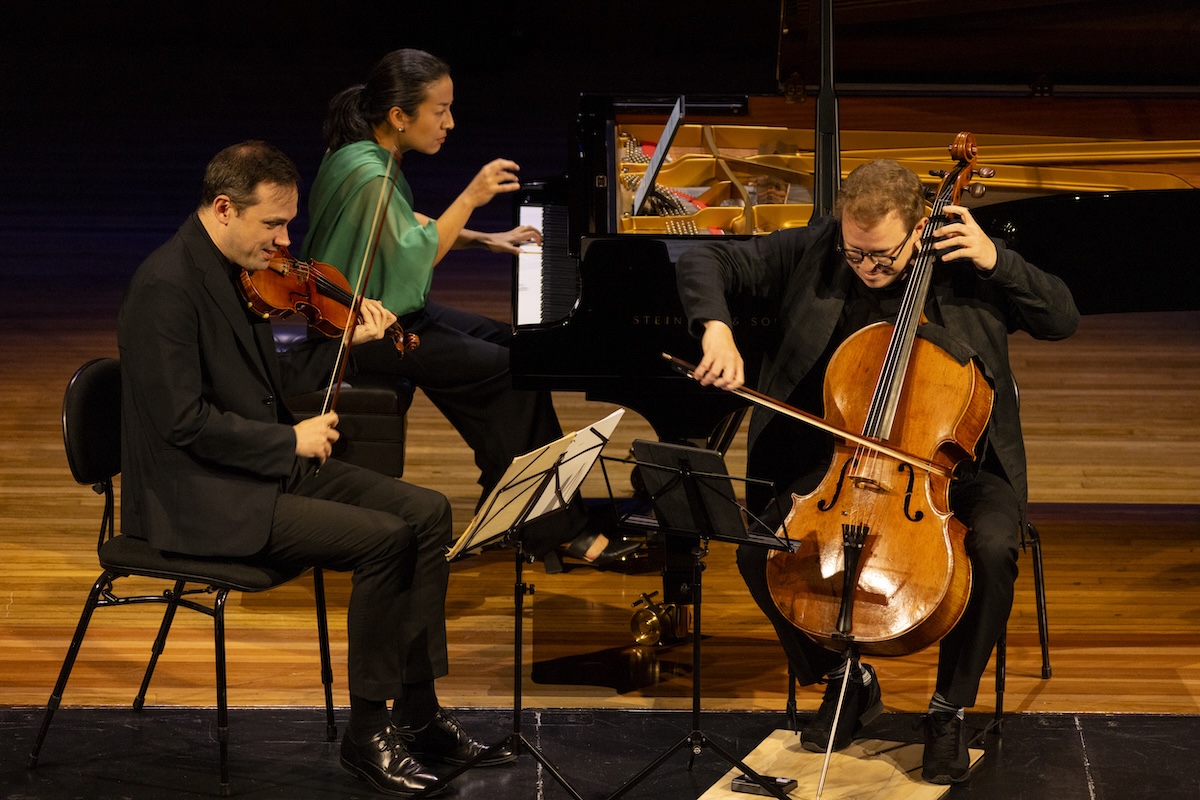
Beethoven’s Ghost: Aura Go, Timo-Veikko Valve and Kristian Winther. Photo © Peter Stoop
This was the second concert of the tour and already the cohesion, sensitivity and technical command were all in place. The program included two litmus tests for fine performance – Beethoven’s Piano Trio Op. 70 No. 1, ‘Ghost’, and Maurice Ravel’s trio from 1914. Both were superbly performed and enthusiastically received by the large Sydney audience.
Beethoven’s trio gets its name from the remarkable second movement and the three notes played with spectral remoteness by the violin and cello in unison, answered by a tremulous piano.
This followed the comparative good humour and liveliness of the first movement, which had established Go’s intelligent and sparkling pianism as the perfect foil to Winther’s electric adventurousness and Valve’s full and heartfelt expressiveness.
The slow middle movement built tension with great control, pierced by Go’s spine-tingling arpeggios.
The final movement was like a burst of sunlight as the pressure was released.

Beethoven’s Ghost: Kristian Winther and Timo-Veikko Valve. Photo © Peter Stoop
The first half closed with the world premiere of Melbourne composer Melody Eötvös’s third piano trio, Regnans, commissioned by Musica Viva Australia. It takes its title from the Latin name for the mountain ash, Eucalyptus regnans, the tallest flowering plant in the world and a “royal of our ecosystem”.
One of its remarkable features is that it needs fire to regenerate, its seedlings germinating in the fire’s aftermath. She describes her new work as “a meditation on rulership that is not founded on domination but instead revels in endurance”.
Over its 10 minutes, it evokes the violence and sense of loss of a fire, but there is also a beautiful strength and feeling of affirmation as one of the early melodies returns defiantly at the end. The cello is prominent over the piano’s grumbling bass in the opening section, before the violin joins in and the strings vie in a folk-influenced duo over Go’s dancy rhythms.
Both works in the second half were written at the time of the Great War. Lili Boulanger’s D’un soir triste (Of a Sad Evening) was one of the last works of her tragically short life. It was written as a piano trio and her sister, Nadia Boulanger, had to complete its orchestration as Lili lay dying of intestinal tuberculosis.
There’s a funereal feeling to the piano chords and brooding cello solo, and after the violin joins and the march-like trudge builds, the mood changes to a beautiful, quiet Debussyan section before the tolling chords return.

Beethoven’s Ghost: Aura Go. Photo © Peter Stoop
Ravel’s trio – which Valve considers “possibly the ultimate chamber work ever written” – was a powerful and challenging work with which to end the concert. It has so many colours and textures, and there is challenging interplay between the three instruments. The opening movement unfolded beautifully, passionate and wistful by turns, with the players attentive to detail.
The skittish second movement, Pantoum, was a little too full-blooded for this listener and at times Valve’s playing tended to overpower.
The Passacaille, however, was beautifully wrought, with each player bringing intelligence and sensitivity to this slow-walking movement before the powerful intensity of the final movement and its extended trills brought the house down.
Musica Viva Australia presents Beethoven’s Ghost at Adelaide Town Hall on 9 May; Melbourne Recital Hall (12 May) and Winthrop Hall, Perth on 14 May. For bookings and more information, visit musciaviva.com.au

Comments
Log in to start the conversation.