




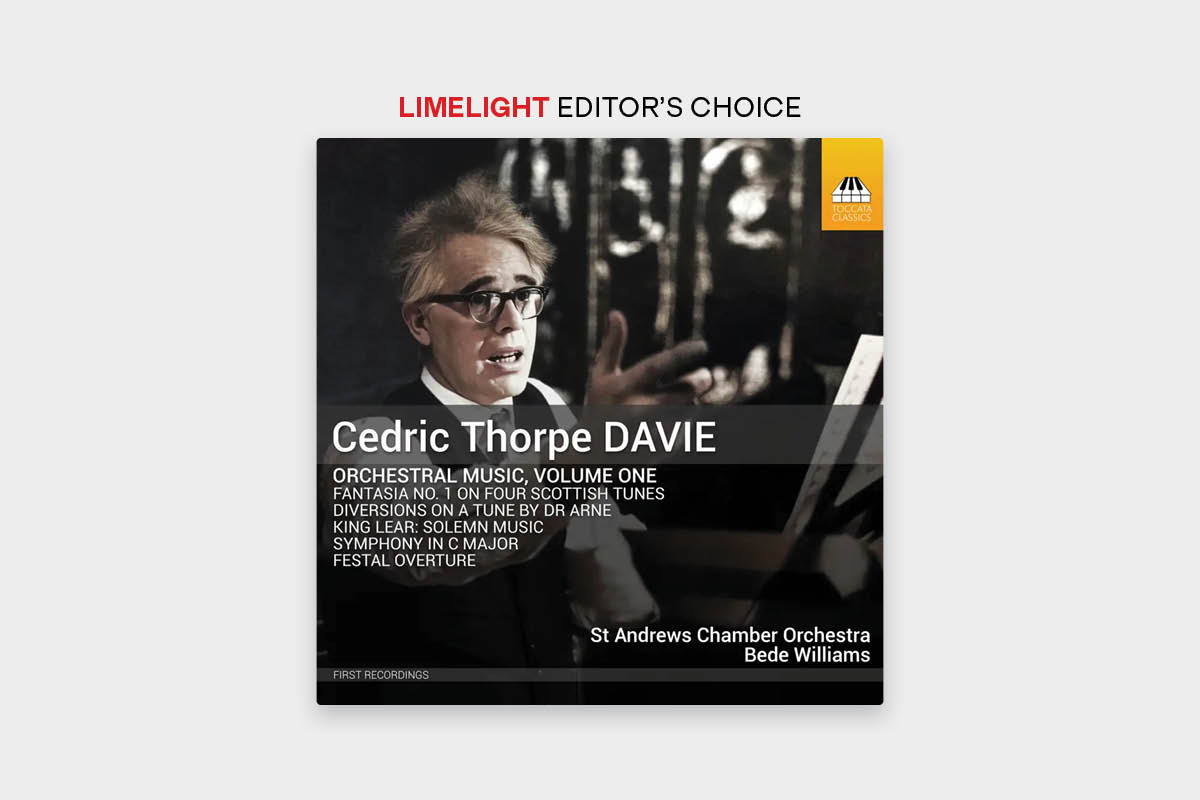
Given his pedigree, it’s remarkable that we are only rediscovering Cedric Thorpe Davie now. Born in Lewisham in 1913, he studied at the Royal College of Music under Vaughan Williams and Gordon Jacob. Traveling in central Europe, he became a student of Kodály. Returning to the UK, he resisted the lure of London to become a key figure in the 20th-century Scottish musical renaissance. A prolific and immediately appealing musical talent, he composed over 200 works across multiple genres, including chamber music, opera (Gammer Gurion’s Needle, 1936) and operetta.
He’s perhaps best remembered, however, for over 20 film scores written for Disney and other major studios (by a curious coincidence, Davie was a cousin of British film-music conductor and arranger Muir Mathieson). These included Rob Roy: The Highland Rogue (1953) starring Richard Todd, 1955’s The Dark Avenger (a late-career historical vehicle for Errol Flynn), The Green Man (1956) with Alastair Sim and Kidnapped (1960), Disney’s adaptation of the Robert Louis Stevenson classic. Appointed Master of Music at the University of St Andrews in 1945, he served there until 1978, dying in Kirkcudbrightshire in 1983.
This new disc on the pioneering British Toccata label is the first in a proposed series exploring his major orchestral works and from start to finish it’s a winner. It opens with the Festive Overture, commissioned by Walter Susskind to open the inaugural concerts of the
newly renamed Scottish National Orchestra. Grand and tuneful, it’s a classic slice of British orchestral pageantry that could easily have been written for a coronation.
Both Constant Lambert and Barbirolli conducted Davie’s only symphony, written in 1945 and second-prize winner in the Daily Express Symphony Competition. It was premiered at the Royal Albert Hall by the London Philharmonic under Lambert and is a real find (all these works are premiere recordings). It’s a bold work in C major, rather Sibelian in some ways, and with plenty of instrumental colour and thematic variety. Bede Williams has its measure, and his St. Andrews Chamber Orchestra responds incisively.
The Diversions on a Tune by Dr. Arne is another discovery, perky, even quirky, though not without its profundities. Commissioned by the National Youth Orchestra of Great Britain it was a great success when it premiered at the Proms in 1954 under Sir Adrian Boult. A work packed with orchestral invention, it comprises nine variations on a theme borrowed from Arne’s opera Thomas and Sally, a work even more forgotten than Davie’s Diversions. Again, Williams and his players give the music room to breathe allowing its manifold moods and colours to shine. It ends in a thoroughly infections Highland fling.
The brief, elegiac Solemn Music was extracted from a score Davie composed in 1950 for King Lear, staged in Stratford and directed by Sir John Gielgud and with Anthony Quayle in the title role. Composed for strings, it opens by quoting Dowland’s Flow My Tears.
Finally, the 1937 Fantasia No. 1 on Four Scottish Tunes is a more substantial work than its title might suggest, running to nearly 15 minutes and interweaving its material in a far more sophisticated way than a mere potpourri. Along the way, it manages to be both solemn and high-spirited, easily holding the attention thanks to Davie’s sonic imagination. Like everything here, it has been well recorded and engineered at the University of St Andrews, with a natural resonance and a tangible immediacy. Anyone even vaguely interested in the byways of 20th-century British music should add this to their collection while eagerly awaiting the arrival of Volume 2.
Composer: Cedric Thorpe Davie
Works: Orchestral Works Volume 1
Performers: St. Andrews Chamber Orchestra, Bede Williams
Label: TOCCATA TOCC0593








Comments
Log in to start the conversation.