


Whenever John Ma plays any of the Baroque stringed instruments on which he is astoundingly proficient, he gives the impression that there is nothing else he’d rather be doing.
His unbridled enthusiasm for his art is part of what makes Apeiron Baroque a unique institution, alongside the scholarship, proficiency, curiosity and organisation of co-Artistic Director Marie Searles (harpsichord).
The second thing Searles and Ma continue to achieve with reliable regularity is assemble collaborators who remind audiences that Australian artists are capable of delivering Baroque musical performances at world-class level.
Thirdly, drawing on their own research and the expertise of collaborators, Apeiron continues to successfully present interesting composers and works from the period that few have ever heard of.
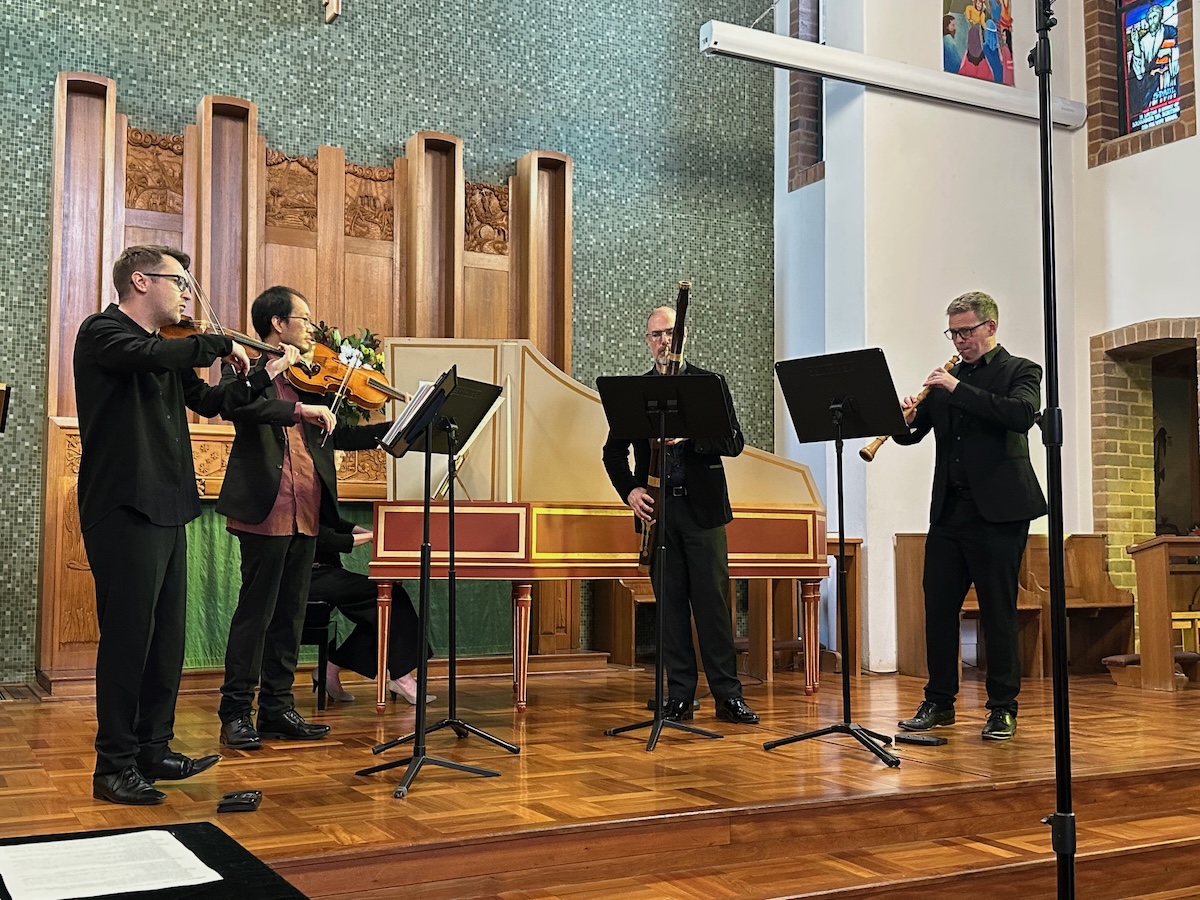
Apeiron Baroque, Wesley Music Centre, Caberra. Photo © Michael Wilson
In this concert, guest artists Adam Masters (Baroque oboe), Tim Willis (violin) and Ben Hoadley (Baroque bassoon) combined in a collaboration of rare beauty and precision. Musical spirit and technical accomplishment created something much greater than the sum of its parts.
Commencing with Dario Castello’s Sonata Decima a3 was an excellent way to introduce the timbre and virtuosity of the bassoon, which over the course of the afternoon carried solo, melodic and continuo lines across the program.
Flowery cadences from the violins were a prelude to the bassoon punching through in lyrical style, enlivened by some unexpected and complex tempo changes, perfectly executed.
Johann Graun’s Trio for violin, oboe and continuo in F major introduced Masters on his gorgeous period oboe with Tim Willis on violin.
Graun was a virtuoso violinist himself, noted for some very long compositions. This charming work in two movements was not one of those, and again the players were all perfectly together during some surprising syncopated passages.
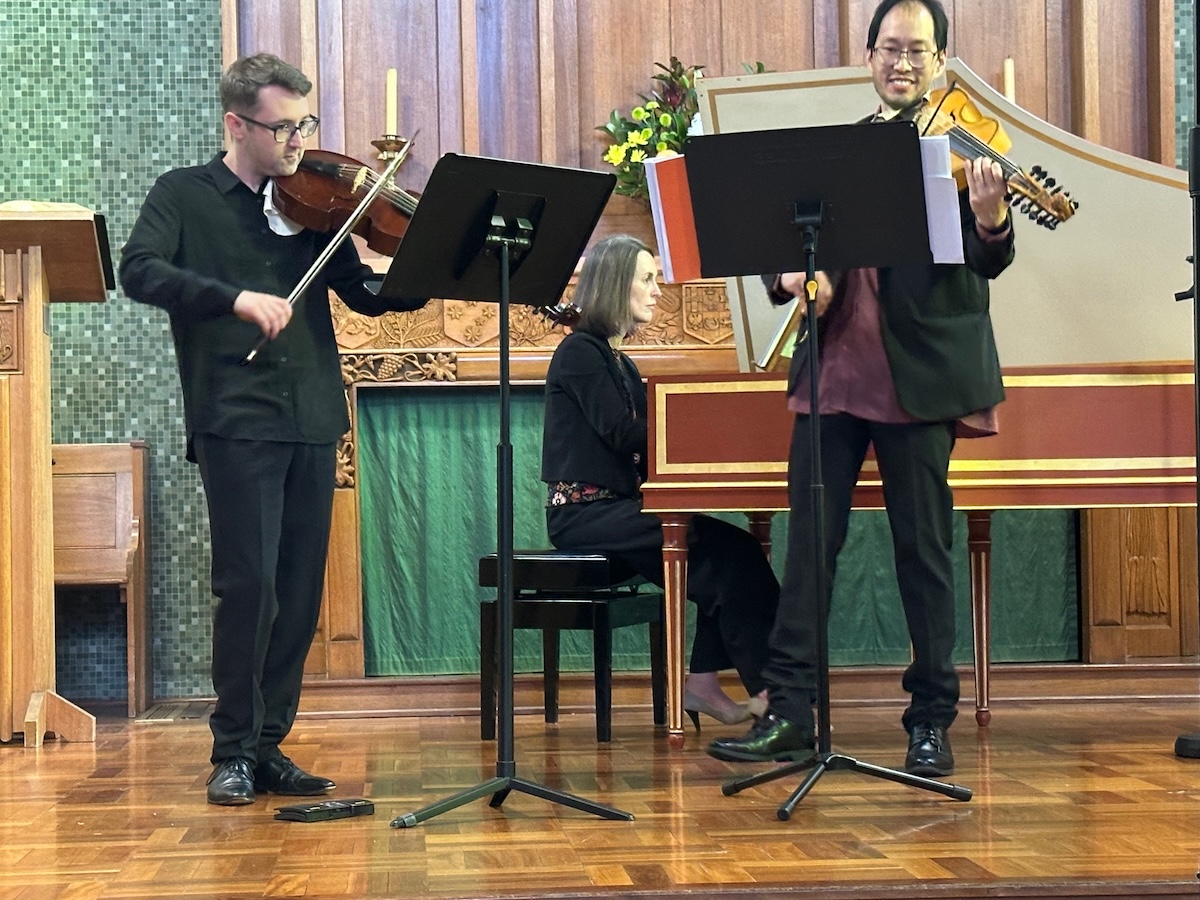
Apeiron Baroque, Wesley Music Centre, Caberra. Photo © Michael Wilson
The famously vain Pietro Locatelli’s Sonata da Camera in D minor is perhaps one of the works of a lesser-known Baroque composer which could remain lesser-known, with some weird progressions and contrapuntal techniques in the final minuet. The players nevertheless had great fun in its execution.
At the other end of the spectrum, Johann Janitsch’s Quadro in G minor ‘O Haupt voll Blut und Wunden’ (O sacred head sore wounded) is a sophisticated, substantial and emotion-filled work which would be worthy of J S Bach (and utilises a Bach chorale in the third of its four movements). This was the highlight of the program, written with a level of raw grief following the death of Janitsch’s young son, and was performed by all players with glorious matched tone, phrasing, swells and diminuendos. There are several cadences where one instrument doesn’t resolve: perhaps deliberately emblematic of heartbreak.
Johann Pez’s First Sonata from Duplex Genius was another highlight, with the two violins and harpsichord in an extended recitative-style opening before the bassoon joined in ensemble.
To finish, Henricus Albicastro’s Adagio from Concerto a 4 in C minor provided a gentle, summery pavane featuring a majestic oboe solo from Masters.




Comments
Log in to start the conversation.