




Young Melbourne writer Jean Tong explores the humanity that emerges from the workplace’s inhumanity in their new play directed by Katy Maudlin.
Do Not Pass Go sees Penny and newcomer Flux working in isolation on seemingly pointless tasks, such as cutting ribbons, collating coloured paper, even pumping up an inflatable only to let the air out again and pack it away. It’s all pointless, yet they are under pressure, as more and more boxed tasks silently emerge from a chute.

Belinda McClory and Ella Prince in Do Not Pass Go. Photo © Pia Johnson
Penny is very efficient and dedicated. Flux takes time to master the tasks, and is just working to live. In fact they’re working to pay for gender-affirming surgery, as they reveal to the initially conversation-averse Penny.
In an intense, soulless work environment that as the play’s Monopoly-inspired name suggests is akin to jail, they increasingly share insights about themselves, and become more like each other.
The finely calibrated, sensitive duet of Belinda McClory (Penny) and Ella Prince (Flux) brings the script’s moments of wry humour, connection, disconnection and anxiety to life.
In MTC’s intimate secondary theatre, the Lawler, their glances, their silences say as much if not more than the dialogue about these characters and their stuttering workplace friendship.
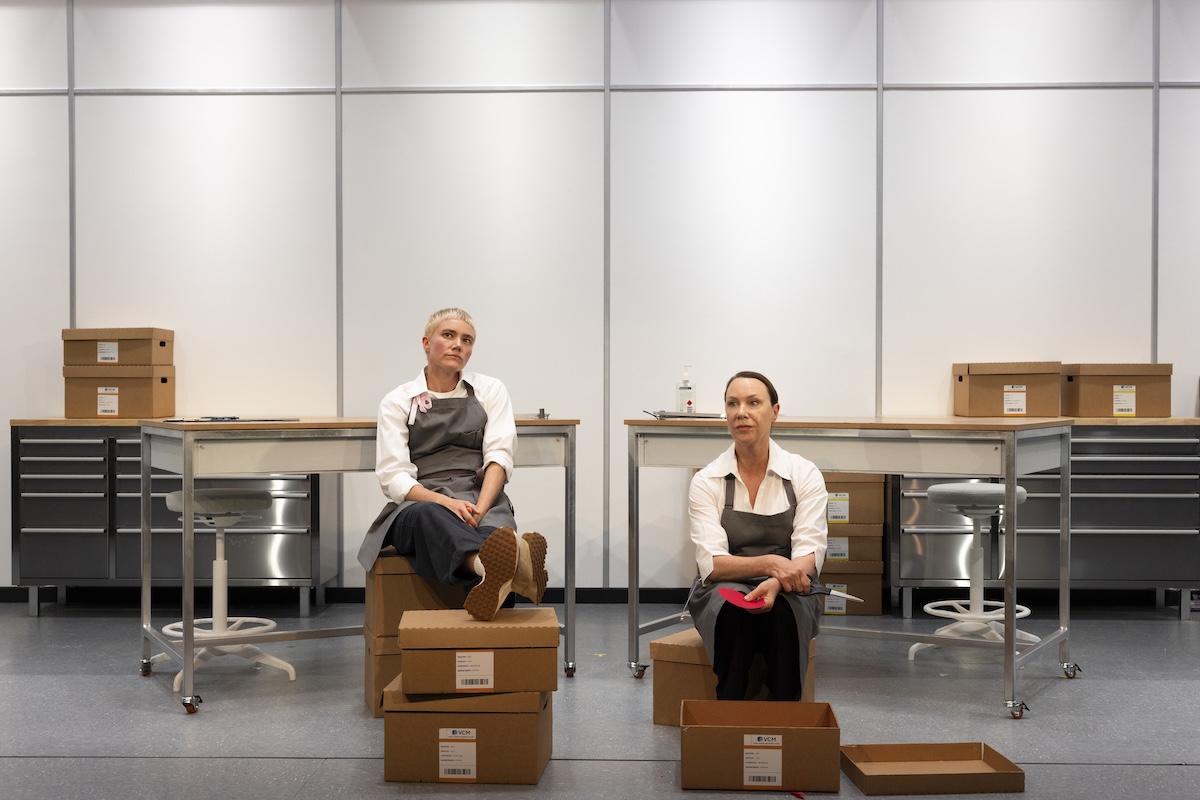
Ella Prince and Belinda McClory in Do Not Pass Go. Photo © Pia Johnson
McClory is initially robotic in her posture and movements, and defensively chilly in manner, but she slowly, awkwardly loosens up and reveals Penny’s human worries and needs.
There are hints of clowning about Prince’s interpretation of Flux at first. They are loose-limbed, and movements and facial expressions are sometimes exaggerated, but that’s toned down as the character’s doubts rise to the surface and overflow.
Jacob Battista’s mostly uniform black-white-grey costumes and single lab-like set in particular encapsulate the Do Not Pass Go workplace’s sterility and focus on efficiency.
Within a white oblong box he has placed metal drawers and workbenches and, stage right, the chute and a computer monitor that are the silent, faceless links to the rest of the organisation. The space is increasingly filled with brown storage boxes that are symbolic of a dreary, regimented, unrelenting job.

Belinda McClory and Ella Prince in Do Not Pass Go. Photo © Pia Johnson
Harrie Hogan’s lighting is mostly cold white, but warms to enhance connection. Between scenes, the workplace’s squares of overhead light blink in patterns that suggest there’s a soul in the machine, as does Marco Cher’s composition. Their sound design is restrained, foregrounding the performances and silences.
Perhaps it’s Do Not Pass Go’s condensed 80-minute runtime, but the rapid evolution of Penny, Flux and their relationship isn’t entirely convincing, and the false ending didn’t ring true for me.
Nevertheless, this gently satirical exploration of the workplace and heartfelt representation of an unlikely friendship is engaging and thought-provoking, in no small part because the cast and creatives interpret Tong’s script with such insight and sensitivity.
Do Not Pass Go is at The Lawler, Melbourne, until 28 March.








Comments
Log in to start the conversation.