


An astonishing output of more than 70 operas is credited to Gaetano Donizetti, the Bergamo-born composer whose legacy is celebrated each November in an international festival marking the anniversary of his birth on 29 November 1797.
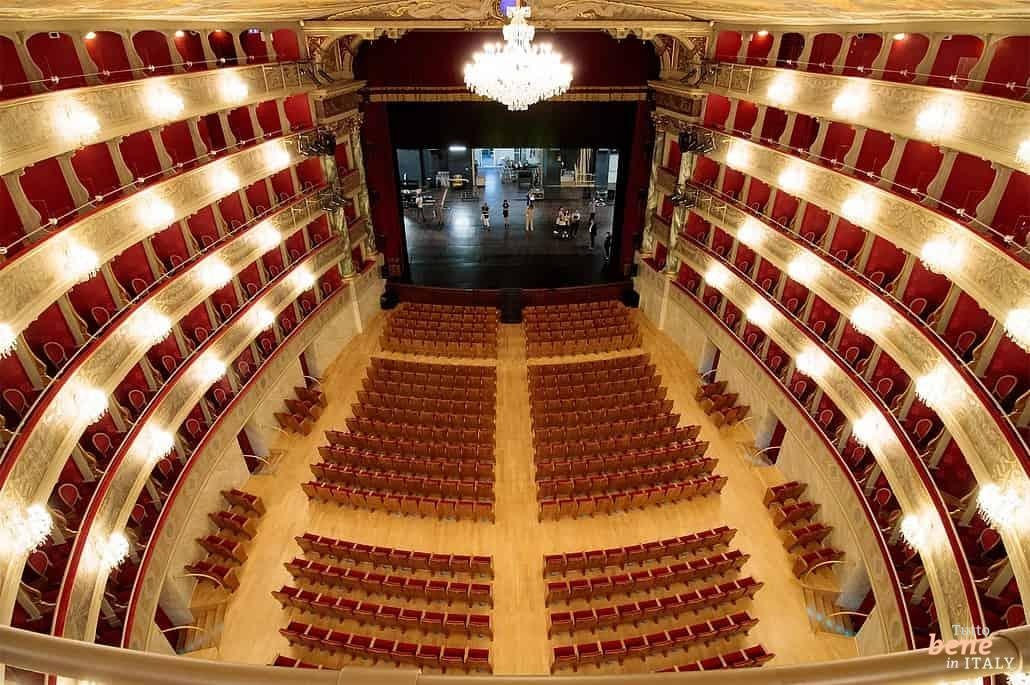
Teatro Donizetti, Bergamo, Italy. Photo supplied
Actively restoring neglected works to the stage, Donizetti Opera offers more than an opportunity for historical rediscovery. It is also an ambitious showcase for the richness and variety of the composer’s catalogue, demonstrating the capacity of these works for theatrical adaptation and reinterpretation. In doing so, the festival makes a compelling case to opera companies, large and small, to look beyond the familiar repertoire and consider how these works might be brought back to life.
The 2026 programme brings together three early works, composed between 1826 and 1828, each exploring a different dramatic world while revealing musical characteristics that would become familiar hallmarks of Donizetti’s operatic style. All three are almost certainly yet to receive an Australian performance.
★★★★ ½
Le convenienze ed inconvenienze teatrali (1827)
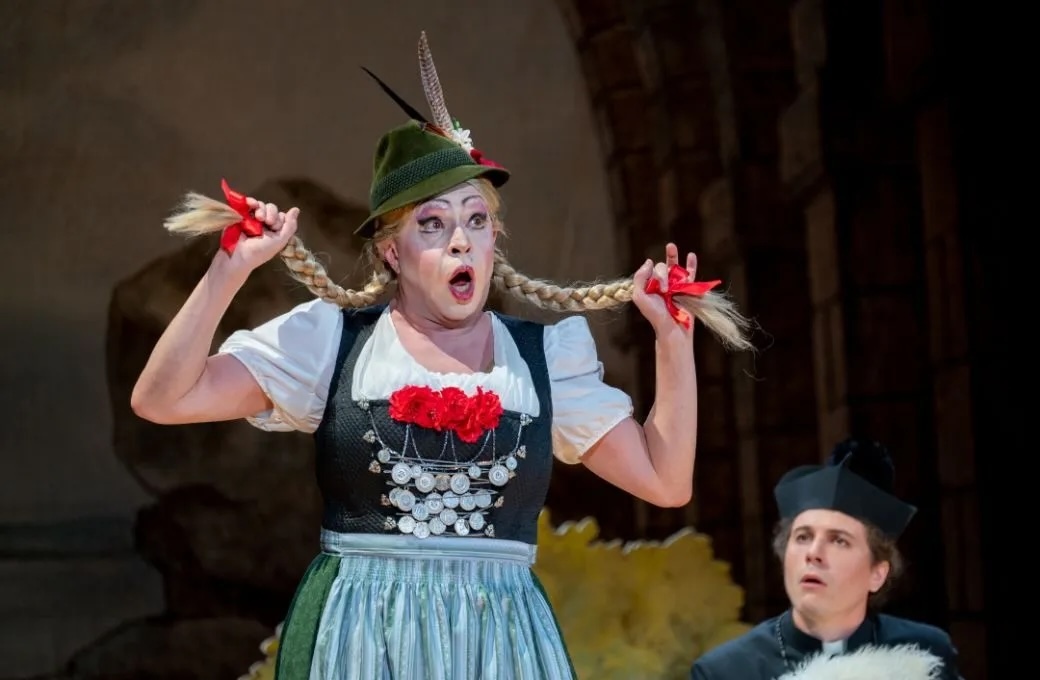
Paolo Bordogna in Le convenienze ed inconvenienze teatrali. © Photo Studio U.V. | Fondazione Teatro Donizetti
Mamma Agata, pleased to make your acquaintance! Bass-baritone Paolo Bordogna waltzes in to steal the moment – and ultimately the performance – in Donizetti’s infectious farce. An assertive outsider who barges into the operatic establishment, challenging its hierarchies and demanding recognition for her daughter Luigia, the seconda donna, Mamma Agata is an unforgettable creation. Bordogna makes the most of the en travesti role, giving her a wonderfully outsized presence.
The plot centres on a provincial opera company attempting to stage a new production, with rival performers, interfering relatives and inflated egos threatening to bring the enterprise undone. Director Silvia Paoli transplants the action to 1950s Italy, with Act I opening in a bar where the chorus plays bingo, much to the prima donna’s irritation.
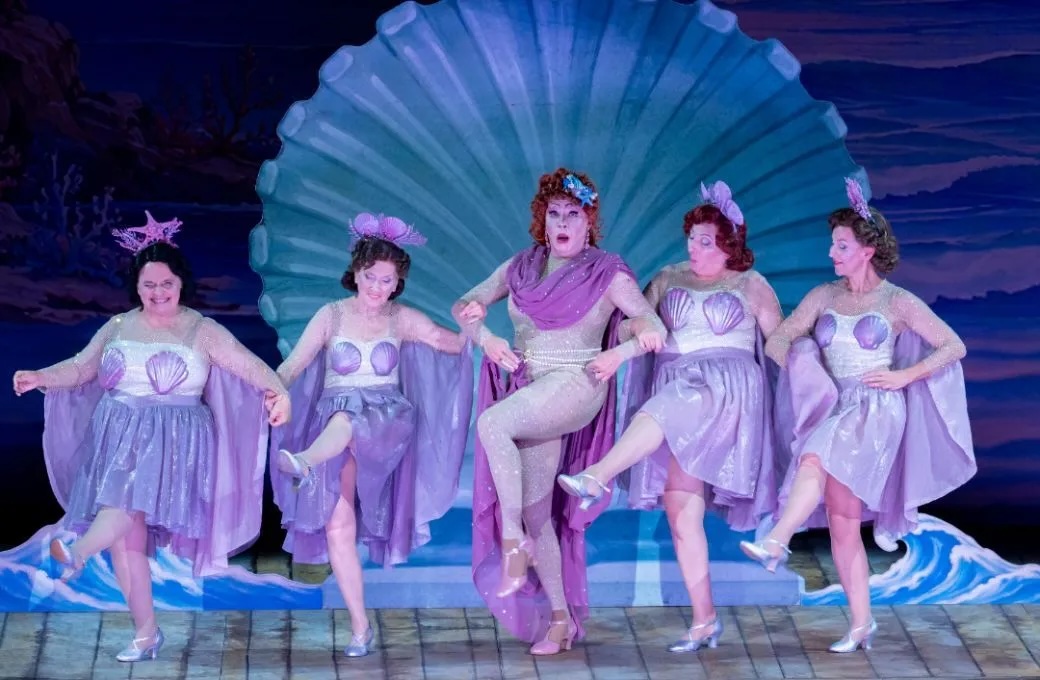
Paolo Bordogna (centre) in Le convenienze ed inconvenienze teatrali. © Photo Studio U.V. | Fondazione Teatro Donizetti
Act II moves to a community theatre, where the production descends into disaster. References to television presenter Mike Bongiorno and Maria Callas add cultural recognition to the adaptation. The juxtaposition is an interesting one: performers fighting for the spotlight while their company struggles to attract audiences increasingly drawn to television. It works rather nicely, and the concluding chaos leaves one wondering whether opera itself has a future!
Ilaria Ariemme’s costumes give the troupe an everyday ordinariness, with Mamma Agata making her entrance in a tweed twinset topped by an enormous moth-like hat – a suitably extraordinary statement of character. Her hilarious subsequent attempts to take a part in the opera-within-the-opera bring Swiss milkmaid and mermaid outfits, among other costume changes.
Eleonora De Leo’s wood-panelled and plastered interiors, with their distinctly utilitarian character, reinforce the contrast between the performers’ grand ambitions and the less glamorous reality of their daily lives. This is neatly exposed when the prima donna’s husband, Procolo, sings a brilliant aria extolling his wife’s credentials, only for Mamma Agata to dismiss her as little more than a chorus rat.
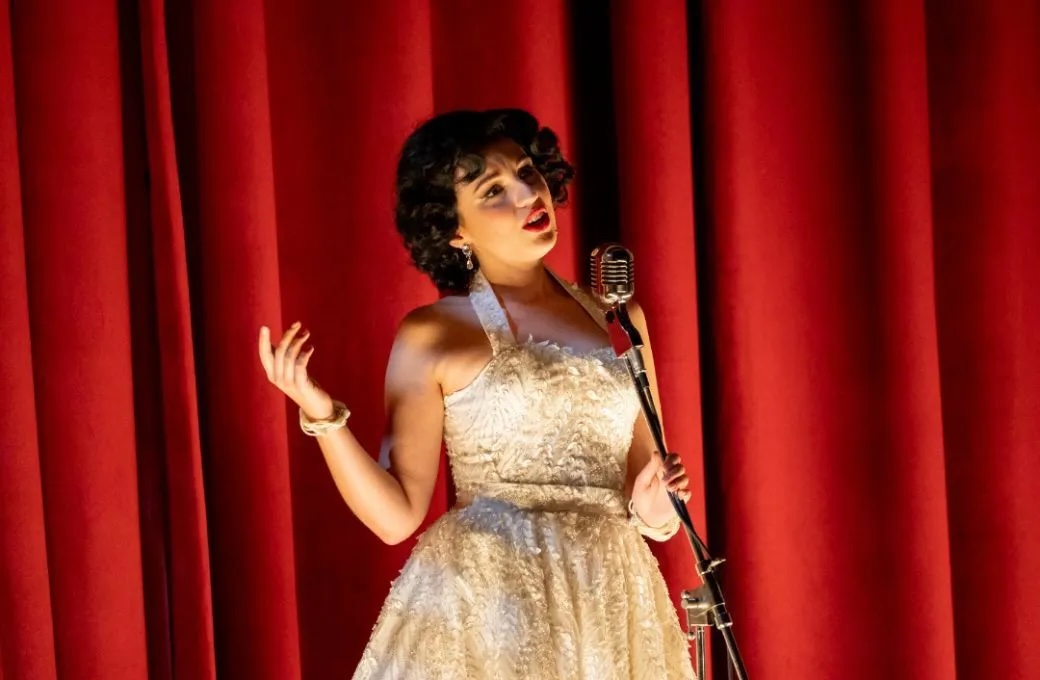
Elene Gvritishvili in Le convenienze ed inconvenienze teatrali. © Photo Studio U.V. | Fondazione Teatro Donizetti
Fine voices and sharp comic acting prevail throughout. Soprano Elene Gvritishvili is a fierce combatant as the prima donna in a tug of war with Mamma Agata, with a creamy, acrobatic soprano and a comically subversive stage presence, evident immediately in the impressive succession of register shifts in her extended opening cavatina, ‘E puoi goder, tiranno’. Young baritone Giacomo Nanni is particularly impressive as Procolo; his Act I aria, ‘Che credete che mia moglie’, has all the ingredients of a concert showpiece.
Croatian tenor Filip Filipović makes a powerful impression as Guglielmo, returning unexpectedly in Act II to perform ‘Come uno spirto angelico’ from Donizetti’s later Roberto Devereux.
Soprano Veronica Prando’s Luigia, a mollycoddled wallflower, comes into her own during the Act II rehearsal for her only featured musical moment, her glorious vocal lucidity ringing out – followed by a gobsmacking cartwheel! Giovanni Accardi, Giulio Iermini and Mattia Venni enliven the proceedings as the composer, librettist and impresario respectively, while conductor Alberto Zanardi maintains admirable clarity in the score’s shifting textures and ensemble interplay.
Everyone, from director and cast to Donizetti himself, seems to have relished the fun of making fun of opera itself. What emerges is a work whose manic energy, irreverent satire and percolating score make a persuasive case not only for its return to the stage, but for its potential to entertain audiences in Australia.
★★★
L’esule di Roma (1828)
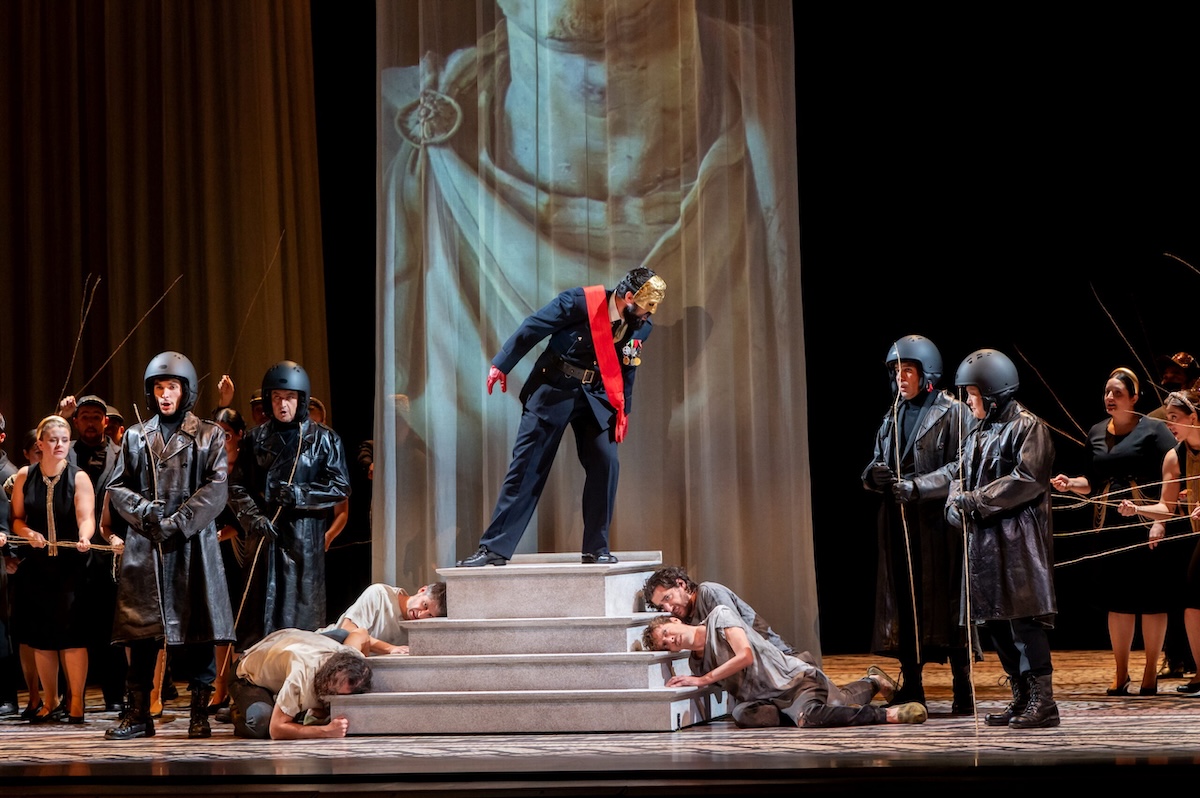
L’esule di Roma. © Photo Studio U.V. | Fondazione Teatro Donizetti
Donizetti’s politico-romantic opera L’esule di Roma, which premiered in Naples in 1828, remained in the repertory for much of the 19th century, enjoying performances across Italy and Europe.
Set in imperial Rome, the opera follows the exiled Settimio’s return and attempt to reunite with Argelia, while her father Murena is tormented by guilt over betraying the young tribune. A lion that recognises and spares Settimio in the finale is certainly an operatic rarity – although the encounter itself takes place offstage.
The score offers attractive individual moments, but short scenes and hurried action make for an uneven drama. Director Katharina Thoma’s attempts to give the work contemporary relevance are largely unconvincing, despite a modernised setting of abstract scenic elements. Performances are often static and audience-facing, with little human connection.
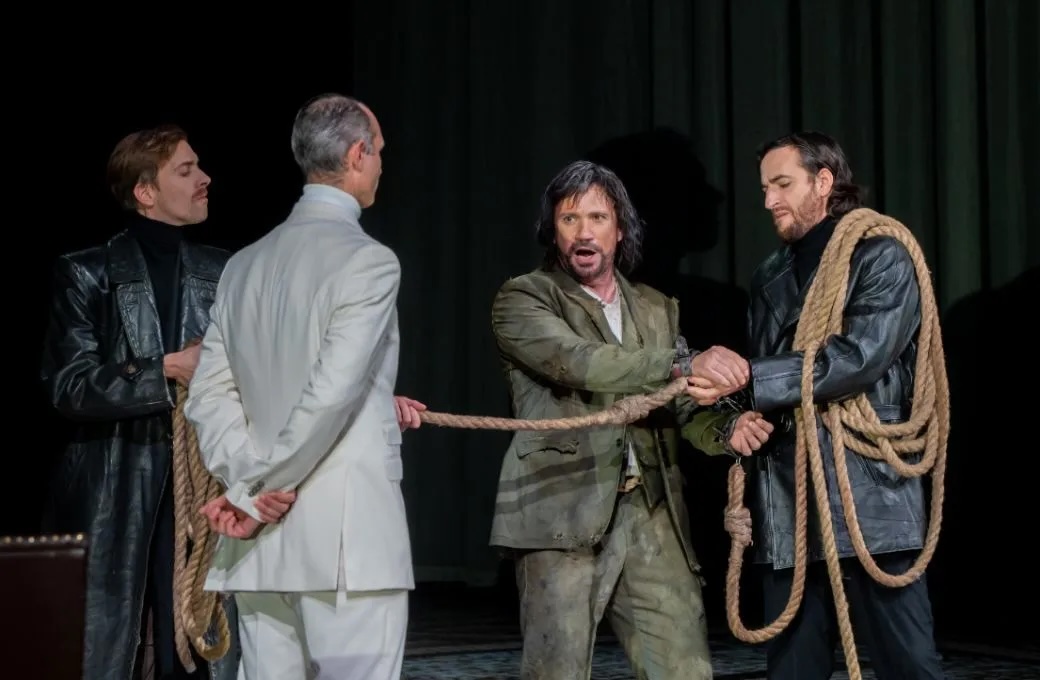
Sergey Romanovsky (Settimio) in L’esule di Roma. © Photo Studio U.V. | Fondazione Teatro Donizetti
Settimio and Argelia’s reunion, their first encounter since his exile, should offer compelling physical chemistry, yet is marked by a peculiar coldness that sits uneasily alongside the emotional strength of Donizetti’s music.
That emotional distance is reinforced by the production’s visual form. Devin McDonough’s formalised design features sheer curtained panels reaching proscenium height and columns that descend to frame more intimate stage pictures.
Fiammetta Baldiserri’s subtle lighting shifts do little to dispel the visual monotony, but Luca Scarzella’s occasional filmic projections are effective, adding context – as in the overture, when Murena signs the letter sealing Settimio’s betrayal – or attaining the poetic. During Settimio’s Act II prison aria, an inverted projection of Argelia reaching down to touch him does the work that the performances themselves often fail to achieve.
Not all of Thoma’s interventions are so dependent on visual suggestion. Her thoughtful conceit of bringing Sejanus, the powerful Praetorian Guard commander absent from the original opera, into the visible action is more successful. Dressed in white and caped, he is most compelling watching Settimio being tortured by helmeted soldiers.
The sombre tone continues in Irina Bartels’ costumes: the chorus largely in black suits, the principals stylishly delineated, and Settimio dishevelled and worn as befits a fugitive and prisoner.
The production’s most powerful moment, however, comes not through these broader directorial ideas but through Argelia’s extended final scene. Soprano Lidia Fridman is the knockout star of the night, conveying her psychological unravelling with technical nuance and expressivity. Her radiant, ecstatic vocal outpouring contrasts with the devastating revelation that both Murena and Settimio have died. Her erupting top notes on ‘Sangue’, as blood drips down the columned curtains, are gripping, leading into anguished introspection. Thoma departs from the expected happy ending, making clear that Argelia has lost her grip on reality. Her accumulated trauma finds expression in a profoundly affecting mad scene that eclipses the opera’s earlier focus on Murena’s psychological collapse.
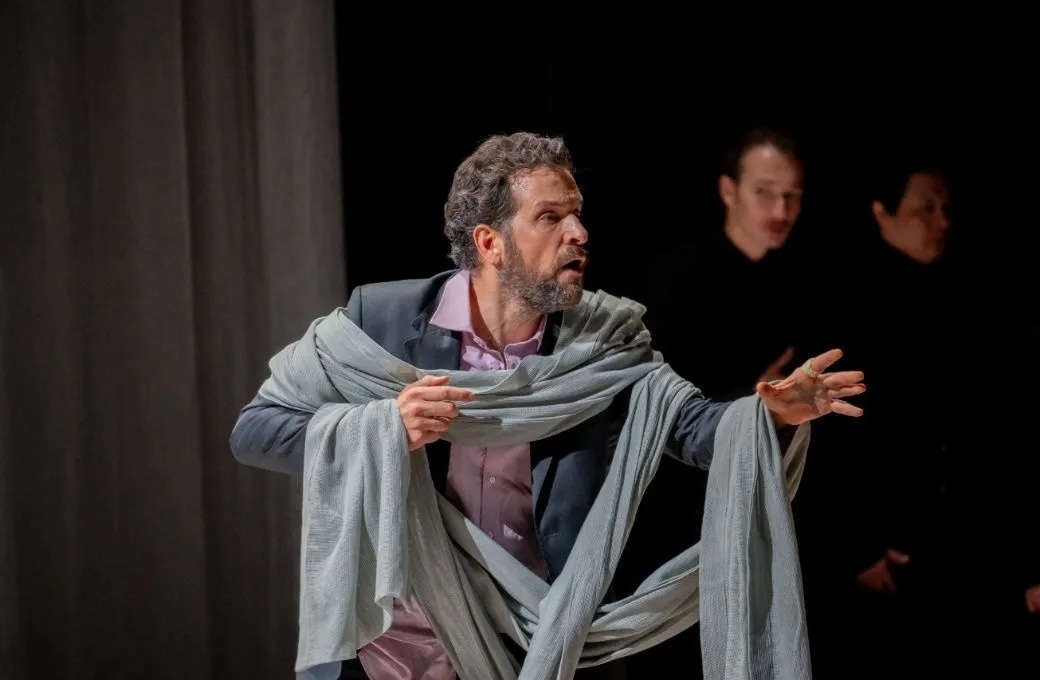
Luca Pisaroni (Murena) in L’esule di Roma. © Photo Studio U.V. | Fondazione Teatro Donizetti
That shift in emotional emphasis invites comparison with Murena himself. As father and statesman, betrayer and guilt-ridden sinner, he is a character of considerable complexity, which bass Luca Pisaroni navigates with mixed results. His Act II mad scene, in which remorse over his betrayal gives way to visions of Settimio’s death in the arena, feels forced. He finds particular poignancy, however, in the duet with Fridman, recalling the infancy of his younger daughter Emilia.
Sergey Romanovsky possesses a handsome, bronzed tenor voice and makes an appropriately ardent Settimio. His Act II prison aria is a highlight, although his upper register elsewhere tends towards volume rather than vocal shape, and his portrayal rarely establishes intimacy with Argelia.
As the Roman general Publio, expected to marry Argelia, Marcelo Solís is compassionate but somewhat underpowered. The chorus of the Accademia Teatro alla Scala – engaged across all three festival productions – provides melodic strength, although its interventions are largely presented in concert form rather than integrated into the stage action. In the pit, conductor Fabrizio Maria Carminati balances orchestral writing and vocal lines, allowing Donizetti’s melodic invention to emerge without overpowering the singers.
Ultimately, the contrasting psychological breakdowns of Murena and Argelia shift the opera’s emotional centre. While Murena’s remorse provides the original dramatic focus, it is Argelia’s final unravelling, powerfully conveyed by Fridman, that gives the production its most affecting trajectory. As a first encounter with the work, there are many vocal and musical moments to savour, but the production does not always make a convincing case for its dramatic life beyond the score.
★★★ ½
Alahor in Granata (1826)
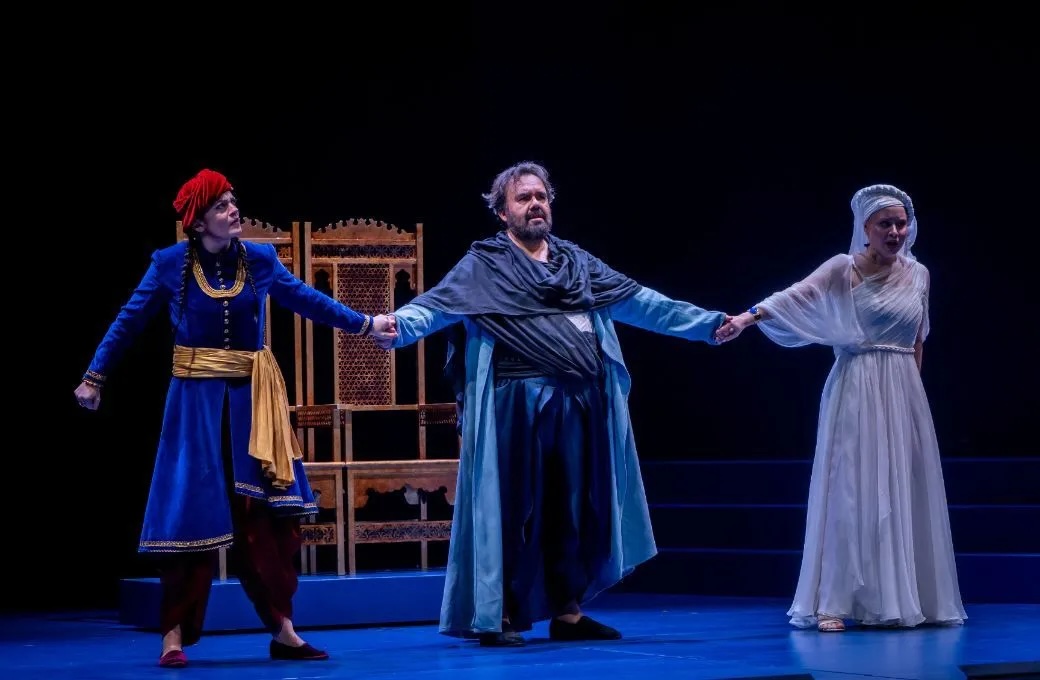
Laura Verrecchia, Roberto de Candia and Mira Alkhovik in Alahor in Granata. © Photo Studio U.V. | Fondazione Teatro Donizetti
Donizetti’s Alahor in Granata had a relatively short stage life, even in its own day. A tale of vengeance, political factionalism and the eventual triumph of forgiveness, it draws on the exoticised Moorish setting so popular in 19-century opera, while offering musical passages that Donizetti would later reuse in L’elisir d’amore.
Like L’esule di Roma, it is very much a political romance, with another jubilant ending that director Benedetto Sicca Papa preserves. Approaching the drama with appealing warmth, Sicca Papa combines emotional sensitivity with the fluid, choreographic physicality of Leonardo Castellani’s movement direction.
The backstory, involving the separation of two siblings (Alahor and Zobeida) after the slaughter of their family, is played out in the overture by two young actors, who reappear at pivotal moments to revive these memories. Their murdered father is similarly incorporated into the narrative – as an aerial artist, seemingly with a heaven-sent purpose. It’s a fine idea, although its purpose is not entirely clear.
A persistent darkness hangs over the storytelling (lighting by Marco Giusti), reflected in an austere, walled perspective setting, with steps to either side (sets by Luigi Ferrigno). Against this, billowing, brightly coloured costumes inspired by Moorish design (by Marco Piemontese) provide welcome visual contrast, while a mobile, twin-level centrepiece makes intermittent appearances to focus the action. Sicca Papa also finds opportunities to break beyond the confines of the set, bringing the action into the auditorium.
Particularly effective is the moment when Zobeida stands in the aisle, facing Hassem as he sings his Act I cavatina from the stage. Hassem is a challenging trouser role, powerfully sung by mezzo-soprano Laura Verrecchia. The physical separation between them reinforces the emotional conflict: she loves the King of Granada, yet he belongs to the dynasty responsible for her family’s murder.
Their affecting relationship develops further in Act II, where a field of giant poppy-like blooms provides the setting for a further encounter. The action then moves swiftly towards the finale, as Alahor’s eventual willingness to put vengeance aside becomes apparent, bringing the opera to its joyous conclusion.
Sicca Papa is also assisted by a libretto that unfolds legibly and naturally. While the score may not offer the breadth of show-stopping arias found in L’esule di Roma, its transitions between scenes are smoother. Much of the beauty of conductor Chiara Cattani’s reading lies in its emphasis on the music’s introspective qualities, keeping the explosive passages in check and allowing the fully committed voices to carry the drama.
Verrecchia leads a strong cast as Hassem, her voice darting through tricky ornamented passages with dazzling agility, while giving the character its own distinctive chiaroscuro.
Hassem’s beloved Zobeida is portrayed with vibrant conviction by Mira Alkhovik, whose warm, creamy soprano gives fluid shape to the vocal lines. In what becomes a notable highlight, Zobeida’s extended final rondò, ‘Confusa è l’alma mia’, is a joyous expression of seeing her brother and beloved reconciled, while providing Alkhovik with an impressive vehicle for her expressive coloratura – another passage that could adorn the concert stage beautifully.
An unrelenting thirst for vengeance drives Alahor, and Roberto De Candia makes the most of it with a suitably gruff baritone delivery, despite a lack of ornamental polish. He also opens the work with an extended aria that seems to dwell a little too long before the action gets underway.
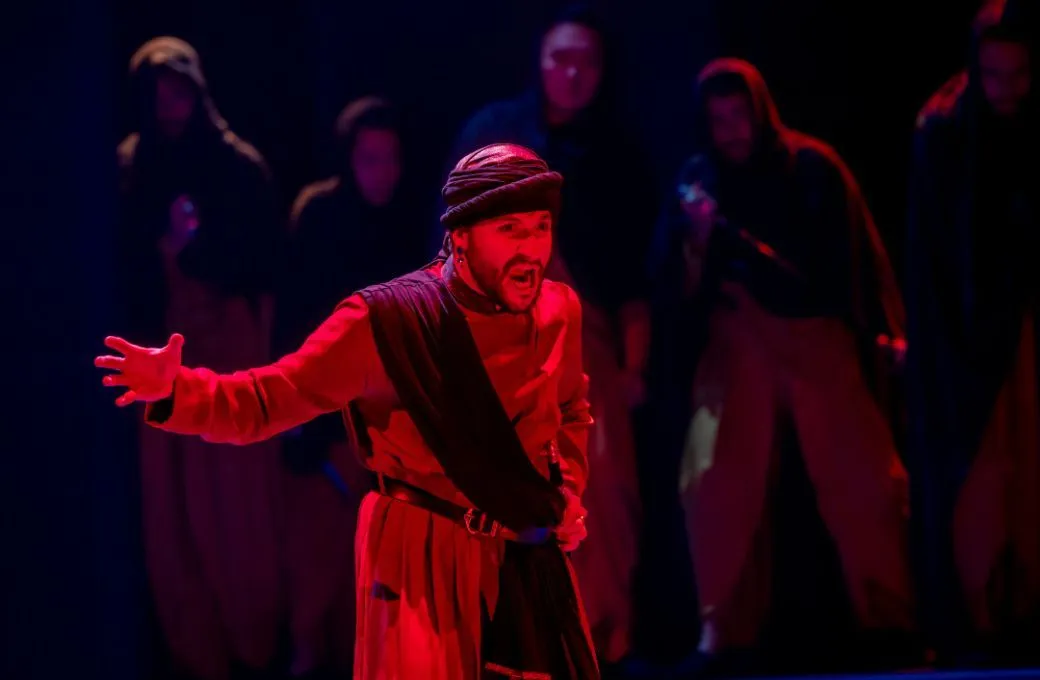
Dave Monaco (Alamar) in Alahor in Granata. © Photo Studio U.V. | Fondazione Teatro Donizetti
Alamar, the story’s political antagonist, is given a quirky, psychologically unsettling characterisation by young tenor Dave Monaco, whose richly centred, muscular voice, together with a secure and impressive top, points to a bright future.
The smaller roles are persuasively characterised, while the chorus brings considerable energy and dramatic weight to the proceedings – qualities the Coro dell’Accademia Teatro alla Scala has demonstrated across all three productions.
The merits of the work are clear, and Sicca Papa serves it kindly. Yet perhaps the more interesting takeaway, particularly for the seasoned opera lover, is the sense that Alahor in Granata could readily lend itself to inventive adaptation. There is more theatrical potential here than its relative obscurity might suggest.
For opera lovers, the Donizetti Festival offers a rewarding opportunity to explore the composer’s lesser-known works in the city where he was born. Bergamo is a spectacular setting in which to do so, with two historic opera theatres to discover – the Teatro Donizetti and Teatro Sociale – and the opportunity to pay respects to the composer himself, whose handsome tomb occupies a prominent position in the lavish Basilica di Santa Maria Maggiore.
And if there was one overriding reason to make the trip this year, it was unquestionably to make the acquaintance of Mamma Agata!
The 2026 Donizetti Opera Festival continues in Bergamo, Italy until 29 November.







Comments
Log in to start the conversation.