




A few months ago I listened to Vilda Frang’s magisterial account of the Elgar Violin Concerto, which lasted 55 minutes. When I saw that Christian Tetzlaff gets through the concerto in just 43 minutes, I must confess to a sinking feeling that I wasn’t going to enjoy it. One reviewer remarked that Tetzlaff would have left the building before Frang had left the stage.
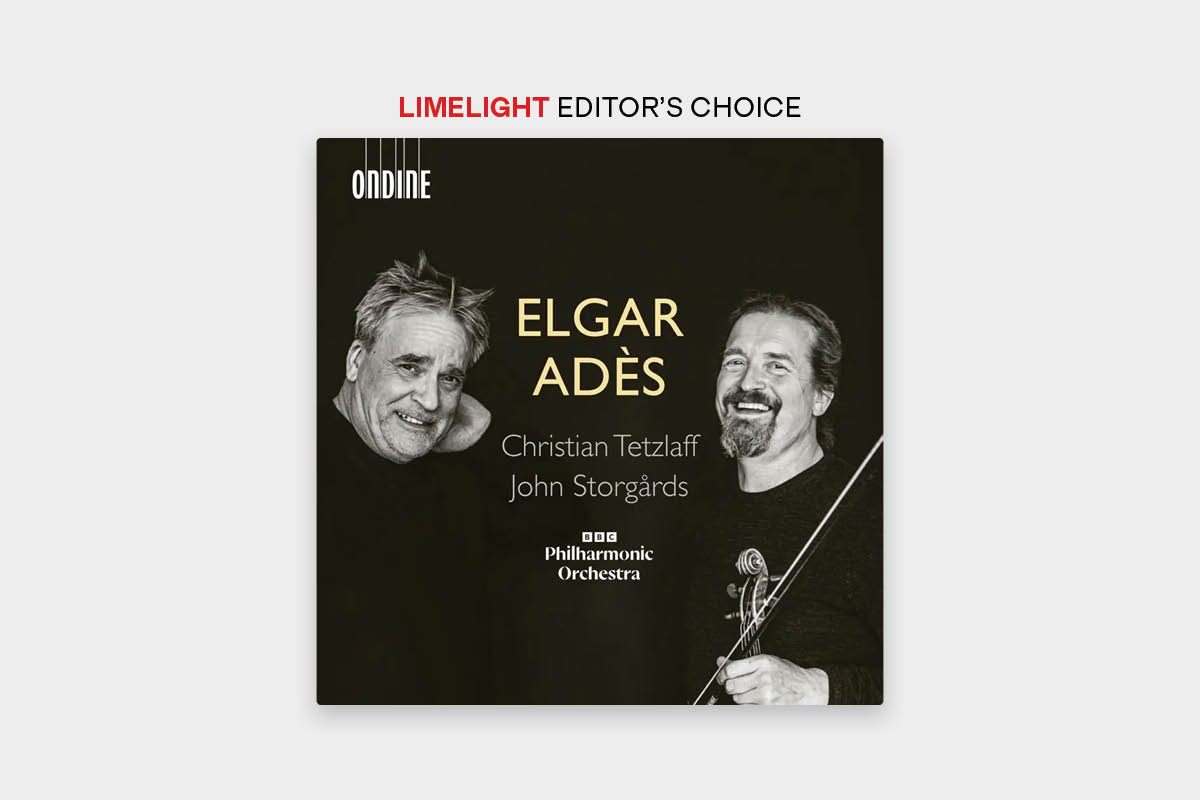
My favourite recording has long been the Ida Haendel with Sir Adrian Boult, with a duration identical to that of Frang. Well, I can assure you that despite the almost 25% duration deficit the reading is exhilarating, as is the other work on the disc, Thomas Adès’ Violin Concerto, which is much more than a fill-up.
The Elgar is awesome, both technically and interpretively, but the concentrated tension, always a hallmark of Tetzlaff’s playing, never faltered. Control of dynamics was particularly impressive, well matched by a responsive John Storgårds and the BBC Philharmonic, who are on fire throughout. Big moments were emphatically but never theatrically done. In the most intimate passages at the heart of Elgar’s concerto, above all in the cadenza near the end, Tetzlaff’s tone was a gossamer whisper. He avoids making it the musical equivalent of an Edwardian sunset while capturing the lofty spirituality, intrinsic nobility and emotional fervour.
To quote Elgar scholar Michael Kennedy: “The unique feel of the Violin Concerto is grand and opulent in scale but of a particularly expressive personal intimacy”. The second appearance of the second subject of the first movement is slightly altered giving it an even exquisite lyrical grace. In the second movement, which Tetzlaff takes as a true andante unlike many who settle into an adagio, the strings horns and woodwinds excel themselves. In the final movement the orchestra blossoms forth with a luscious melody, which only could have composed by Elgar.
The Adès concerto was composed in 2005 for the British violinist Andrew Marwood. I found it fascinating and wholly immersive, packing a great deal into 18 minutes. It is in effect a triptych with movement titles Rings, Paths and Rounds This is one the highest concept works I’ve ever encountered and too complex to describe in real detail here. Suffice it say, while much of the design depicts concentric circles i.e. ones which share a central point but maintain the same distance from each other, others intersect and overlap in a sort of musical Venn diagram.
The first movement radiates a laconic, brittle mood. Tetzlaff dances beautifully above the orchestra playing in an extremely high tessitura. The central movement, longer than the other two combined, unfolds, as the composer describes it, in “two large, and very many small, independent cycles, which overlap and clash, sometimes violently, in their motion towards resolution.” Further enhancing this cyclic sense are the chaconne-like repetitions of the movement’s opening sequence, as grave and gripping as a baroque lament.
Fiercely interruptive punctuations only heighten Tetzlaff’s expressive urgency and volatility, which attains a deeply moving eloquence in his successive overlaps with the ensemble. The vibe is dramatic, minatory and implicitly tragic and the orchestral interjections are deliberately confrontational and aggressive. Perhaps Adès is channelling the reference to the Bach choral in Berg’s Violin Concerto! The third movement is almost playful by comparison and Tetzlaff imbues it with a jeu d’esprit seemingly oblivious to what has just preceded it.
While the work would hardly qualify as contemporary music for people who normally care for contemporary music, I think it richly deserves a place in the mainstream concerto firmament. As I said, the BBC Philharmonic are alive to every twist and turn in this kaleidoscopic score and the sound is excellent. A testament to Tetzlaff’s impressive versatility.
Composers: Elgar, Adès
Works: Violin Concertos
Performers: Christian Tetzlaff v, BBC Philharmonic Orchestra/John Storgårds
Label: Ondine ODE1480-2





Comments
Log in to start the conversation.