


What does it mean to return home when the country you once knew has become unrecognisable? It is the central question animating Fatherland, Polish director Paweł Pawlikowski’s quietly arresting exploration of exile, memory and the uneasy business of reconciliation.
Set in 1949, the film reimagines a potent historical episode: the return of Nobel Prize-winning German novelist Thomas Mann (Hanns Zischler) to his homeland.
Having fled the Nazi regime in 1933, Mann has spent years in American exile. Now, accompanied by his daughter Erika (Sandra Hüller, The Zone of Interest, Anatomy of a Fall), he travels from the American-controlled West to Soviet-occupied East Germany to deliver speeches and accept awards marking the 200th anniversary of Goethe’s birth.
His reception is anything but straightforward. Some welcome him as a symbol of Germany’s cultural rehabilitation; others resent his decision to seek safety abroad. Former Nazis are eager to distance themselves from the past, while the competing political establishments of East and West vie to claim the celebrated writer as their own. Mann’s return becomes an uncomfortable exercise in national self-examination, exposing the expediency with which a country attempts to rewrite its history.
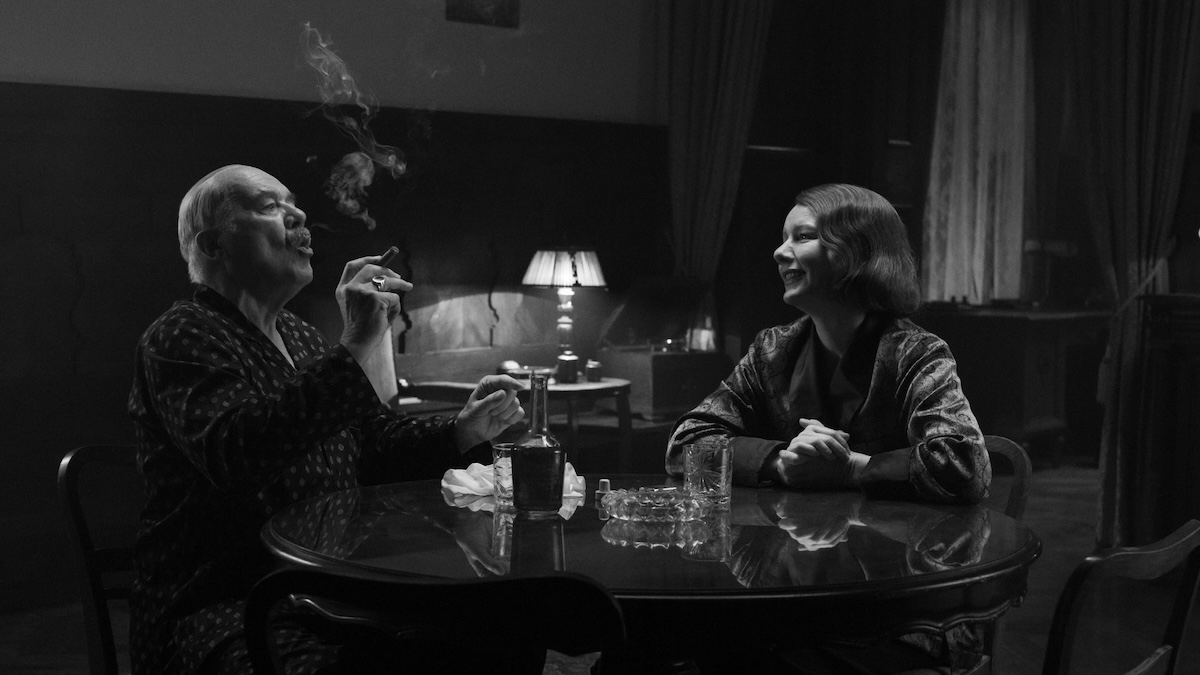
Hanns Zischler and Sandra Huller in Fatherland
There is a more intimate reckoning, too. Mann is struggling to come to terms with the death, probably by suicide, of his son Klaus, the novelist whose Mephisto offered a thinly veiled portrait of actor Gustaf Gründgens and his accommodation with the Nazi regime. It’s worth knowing (though not essential) that Gründgens was in a relationship with Klaus Mann when he married Erika – who was herself in a relationship with Klaus’s fiancée Pamela Wedekind. The historical background of this story is a knotty one indeed and Pawlikowski only allows us glimpses into it.
Zischler brings understated authority to Mann, conveying the fatigue and disillusionment of a man who finds himself both needed and resented. Hüller is equally compelling as Erika, whose intelligence, impatience and refusal to indulge former Nazis provide the film with much of its moral bite.
Shot in beautifully composed black and white and the Academy ratio, Fatherland transforms what might have been a conventional historical road movie into a meditation on the uses and abuses of memory. Its most affecting moment comes in a ruined church, where father and daughter encounter two men attempting to restore a neglected pipe organ. As they tentatively play Bach’s Jesu, Joy of Man’s Desiring, Mann finally breaks down, awash in contrdictory feelings.
Some will likely find Fatherland too restrained and elusive, but its questions about complicity, belonging and the selective memory of nations are live ones.
Fatherland opens in Australian cinemas, 12 November.
Rated PG
82 minutes






Comments
Log in to start the conversation.