Exposing oneself to new musical styles was one of the aims of the Grand Tour, a rite of passage for young, upper-crust English males from the mid 17th to mid-19th centuries. In the baroque era the places of pilgrimage centred around France and Italy, where the tussle between those two national styles was one of the dominant musical narratives of the times, exemplified in the early 1750s by the “Guerre des Bouffons”. 

While these bellicose buffoons were mainly concerned about opera, the development of instrumental music played out all over Europe along similar lines, but found its most satisfying synthesis in Germany, particularly in the works of JS Bach.

Tracing a more modest trajectory of some 800km from Freiburg in the southwest to Berlin in the northeast, the Freiburg Baroque Orchestra explores the variety of baroque styles that flourished in Germany through scores, both obscure and well-known. 

First stop on the tour is Rastatt where Johann Caspar Fischer (c.1670-1746) was employed as Kapellmeister to the Margrave of Baden-Baden. Fischer, who possibly studied with Lully, is credited with disseminating the Frenchman’s style through Germany. Fischer’s suite Journal du Printemps is certainly suffused with Gallic flair, from its imperious Overture to the final, swaying Passacaille which builds in impressive intensity.

By contrast, in Stuttgart, Johann Christop Pez (1664-1716) was a staunch proponent of the Italian style, having acquired through his study in Rome an intimate knowledge of the techniques of Corelli and Carissimi. Pez’s Concerto Pastorale lives up to its name, not only in mood, but by contrasting instruments in the concertato style.

Pez’s predecessor in Stuttgart was the widely travelled Johann Sigismund Kusser (1660-1727), whose 11-movement Overture in G minor, Apollon enjoué, reflects his six years in Paris with Lully. Radiating both elegance and ebullience, the Overture includes programmatic elements such as a wind machine in Les Vents

Johann Ludwig Bach (1677-1731) from Meiningen, a distant relative of Johann Sebastian, was primarily a composer of cantatas, yet his accomplished Overture in G major presages the stylistic transformations of his famous family member.

In Eisenach, the prolific Georg Philipp Telemann (1681-1767) was forging his own personal voice. His charming Concerto for Flute and Violin in E minor owes much to the Italian style, with its alternation of slow and fast movements, the motoric energy of the latter contrasting with the appealing lyricism of the former. The slow second movement with its pizzicato accompaniment and alternation of solo voices forms a captivating oasis at the heart of the work.

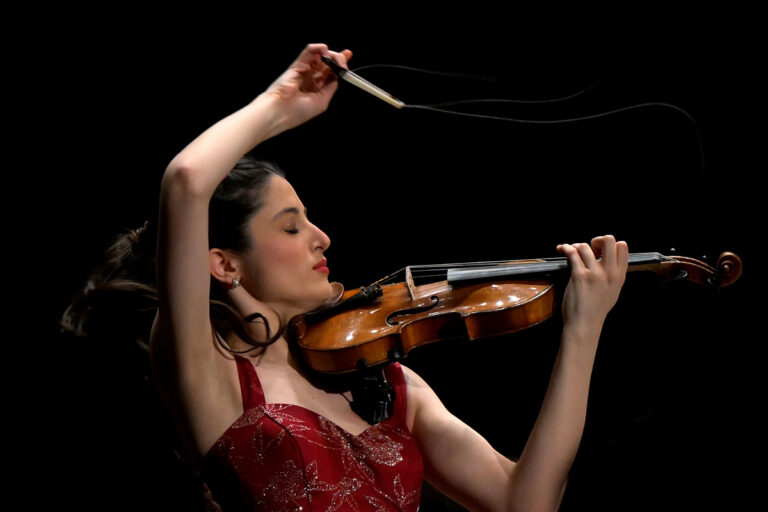
In 1718 JS Bach journeyed from Weimar to Berlin to acquire a new harpsichord. There he met Christian Ludwig, Margrave of Brandenburg-Schwedt to whom he would dedicate his most famous concerted works. Concluding their thoughtfully curated “grand tour”, the Freiburgers under concertmaster Gottfried von der Goltz offer a dazzling account of the Brandenburg Concerto No. 2 in F major, solo trumpeter Moritz Görg crowning a festive mood with dizzyingly accurate playing.

No stranger to Australian audiences, the FBO confirms its reputation as a leading ensemble in its field with polished, engaging playing and an innate sense of line and colour informing all that it does. So, when is the next Australian tour, Gottfried?

Listen on Apple Music

Composer: Grand Tour
Works: Music by Fischer, Pez, Kusser, JS Bach, Telemann, JL Bach
Performers: Freiburg Barockorchester/Gottfried von der Goltz
Label: Aparte

Contribute to Limelight and support independent arts journalism.