


Crossdressing has long been a part of opera, but a crossdressing saint? Consider Joan of Arc, the 15th-century girl from the French countryside, who dressed as a soldier, drove out English invaders thus helping to enthrone a French king, but was later burnt at the stake for her trouble. In a country where the relationship between Christianity and the state has been at best ambivalent, Joan became an important bridge between spirituality and patriotism, being officially proclaimed a saint in 1920.
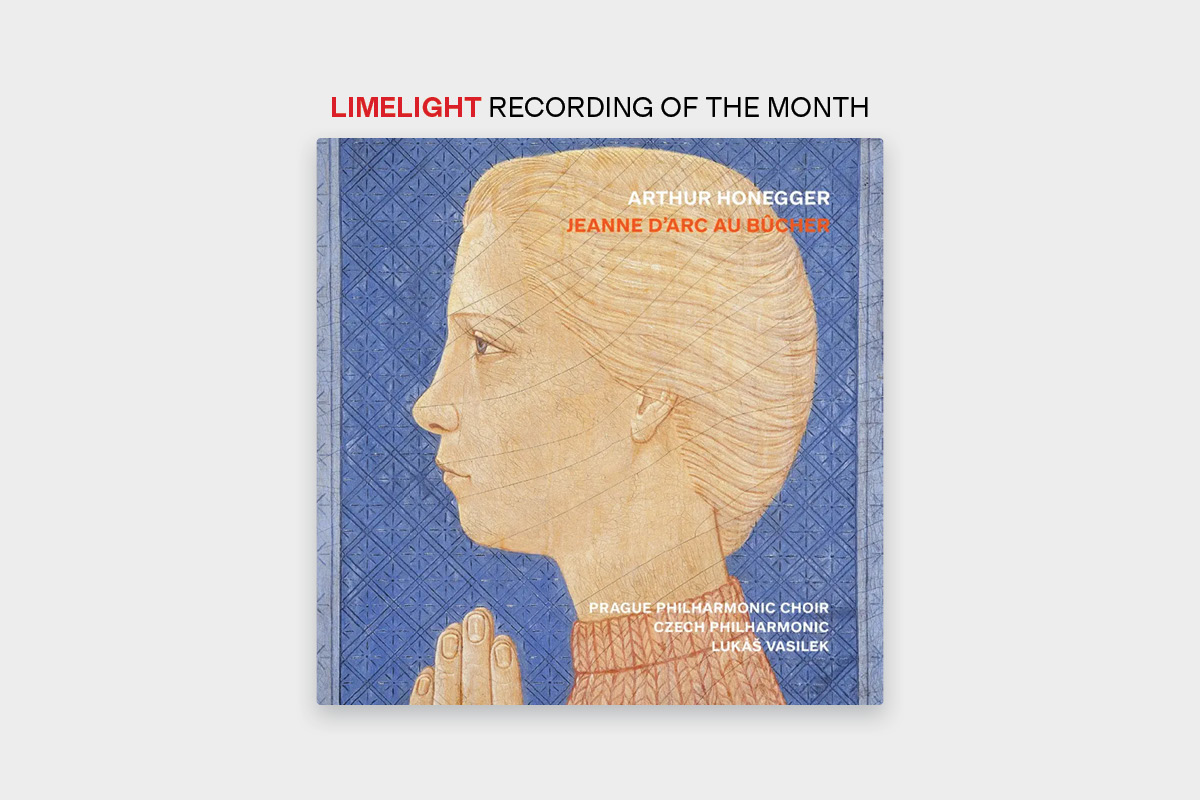
At the behest of celebrated dancer and philanthropist Ida Rubenstein, composer Arthur Honegger collaborated with Catholic poet Paul Claudel on a work that would celebrate Joan in a way recalling medieval mystery plays. Forged in the turbulent 1930s and 40s, Jeanne d’Arc au bûcher (Joan of Arc at the Stake) is a unique amalgam of spoken and sung drama, featuring a female actress in the title role supported by other actors, singers, adult and children’s choruses and a vast orchestra including a favourite instrument of the period, the ondes Martenot. Dubbed a “dramatic oratorio”, it is certainly dramatic; almost certainly melodramatic. It was designed to be staged, even if the composer preferred concert performances.
Prominent in the fascinating performance history of the work were leads taken by Felicia Montealegre (wife of Leonard Bernstein) and Vera Zorina, once married to the famous choreographer Georges Balanchine. Zorina starred in Eugene Ormandy’s groundbreaking 1952 recording with the Philadelphia Orchestra. In 1989, during the glory days of the Melbourne Festival, a memorable staged production in English directed by Jean-Pierre Mignon featured the Canadian actress Genevieve Bujold and French maestro Jean Fournet. Together with opera stalwarts Roxane Hislop and Noel Mangin in major vocal roles, a young Steve Davislim sang in the chorus.
Structured in 11 scenes with a prologue, Joan, chained to the stake, looks back on her remarkable journey, with St Dominic as a companion. Some surreal and scathingly satirical scenes unfold. In one, Joan is judged by a court of animals, headed by a pig; in another her fate is determined by card games played by kings, queens and knaves.
By contrast, other scenes depict Joan’s robust, rustic childhood; the pageantry of the approaching French king, her accompaniment by angelic voices and her final message of love as she is consumed by the flames.
Matching the grand scope of this outrageous and unapologetically Catholic melodrama comes this exciting new recording with the Czech Philharmonic under Lukaš Vasilek. French actress Audrey Bonnet shines with all Joan’s inner conviction and outspoken resilience, projecting her larger-than-life personality with penetrating effect. Sébastien Dutrieux, no stranger to this work, brings empathy and inquisitiveness to Frère Dominique.
There are no weak links in the vocal casting, either. Susanne Bernhard gives the Virgin Mary requisite maternal tenderness, while Veronika Rovná and Anna Goryachova radiate celestial brilliance as Marguerite and Catherine respectively. Tenor Kyle van Schoonhoven is hilarious yet sinister as the porcine judge.
Mastering French seems to have been no obstacle for the Prague Philharmonic Choir and its associated children’s chorus. Their characterful singing is matched by the consistently vivid and empathetic playing of the Czech Philharmonic, excellently paced by Vasilek.
Today, a religious melodrama may seem highly unfashionable, but this first-rate account makes a compelling case for this extraordinary piece of theatrical and hyper-religious imagination.
Composer: Honegger
Work: Jeanne d’Arc au bûcher
Performers: Audrey Bonney, Sébastien Dutrieux, speakers, Prague Philharmonic Choir, Czech Philharmonic/Lukaš Vasilek
Label: Animal Music ANI153-2DDB






Comments
Log in to start the conversation.