




The distinguished members of the Lonquich-Clerici-Mehner Trio separately pursue multi-faceted careers: for example, cellist Umberto Clerici is chief conductor of the QSO, psychoanalyst and clarinettist Tommaso Lonquich is a member of the Chamber Music Society of the Lincoln Centre in New York and pianist Claudio Martínez Mehner is a professor at the Hochschule für Musik in Basel.
But the three assemble as a trio periodically, having developed a close musical relationship over the last 15 years. This concert offers a precious opportunity to hear these globetrotting musicians together.
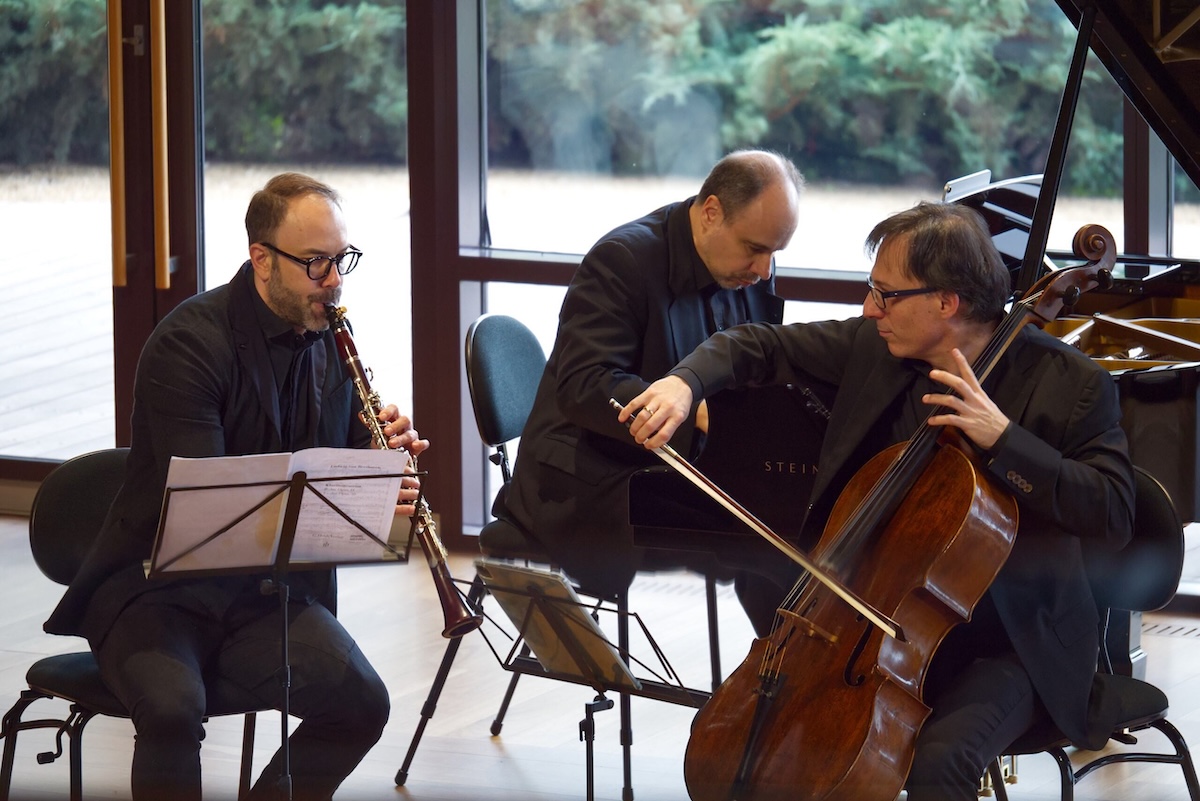
Tommaso Lonquich, Claudio Martínez Mehner and Umberto Clerici. Photo © Ben Nicholls
They open with Beethoven’s Piano Trio in B-flat, Op. 11, an early work of his, known as the Gassenhauer Trio. The effervescent Allegro con brio first movement recalls the joie de vivre characteristic of Mozart’s music, with Martínez Mehner’s sparkling piano leading the way.
The second Adagio movement opens with a gentle, dreamy melody in the cello, and this theme is answered by the clarinet. The wistful character of the music is briefly interrupted by a darker theme that hints at the mood of Beethoven’s later work, before the opening melody returns and the movement ends with a slow, quiet, descending passage in the piano.
The third movement, which is marked Tema con variazioni: Pria ch’io l’impegno. Allegretto, comprises nine contrasting variations on a theme from the Drama Giocoso, L’amor marinaro ossia Il Corsaro. The popular song Pria ch’io l’impegno(“Before I go to work, I need a snack”), became a gassenhauer, or street song, and its inclusion would have delighted Beethoven’s Viennese audience. The Gassenhauer Trio is pure entertainment.
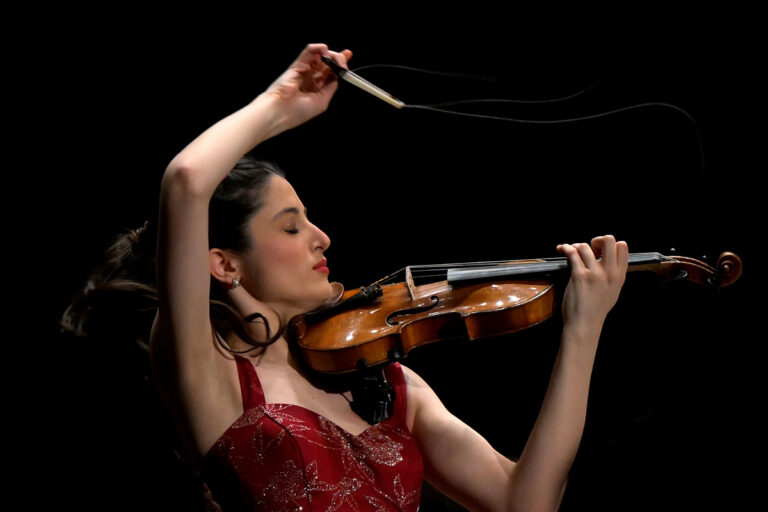
Celebrated Hungarian violinist Júlia Pusker then join Lonquich and Martínez Mehner for Stravinsky’s Suite from the Soldier’s Tale, which is taken from his theatre work of 1918 and comprises five short movements. The first, Marche du Soldat, briefly introduces us to the soldier who is walking home from war, his rhythmic left-right march rendered by the pianist’s steady lefthand.
The soldier makes a pact with the devil which he later regrets, and he aims to win back his freedom. In the fourth movement, Tango – Valse – Ragtime, the soldier plays his violin to revive a bedridden princess and win her hand, and she then performs these three dances. The soldier tries to defeat the devil by playing his violin in the brief, frenetic finale, Danse du Diable, but the moral of the tale is that one cannot have everything and must resist temptation.
Pusker and Lonquich combine wonderfully in Stravinsky’s extraordinary work, which is characterised by the complex interplay between the violin, representing the soldier’s soul, and the clarinet. There are abrupt changes of tempo with short, competing melodies in contrasting keys and idiosyncratic renderings of the tango, waltz and ragtime forms which seem to merge into a single, agitated dance.
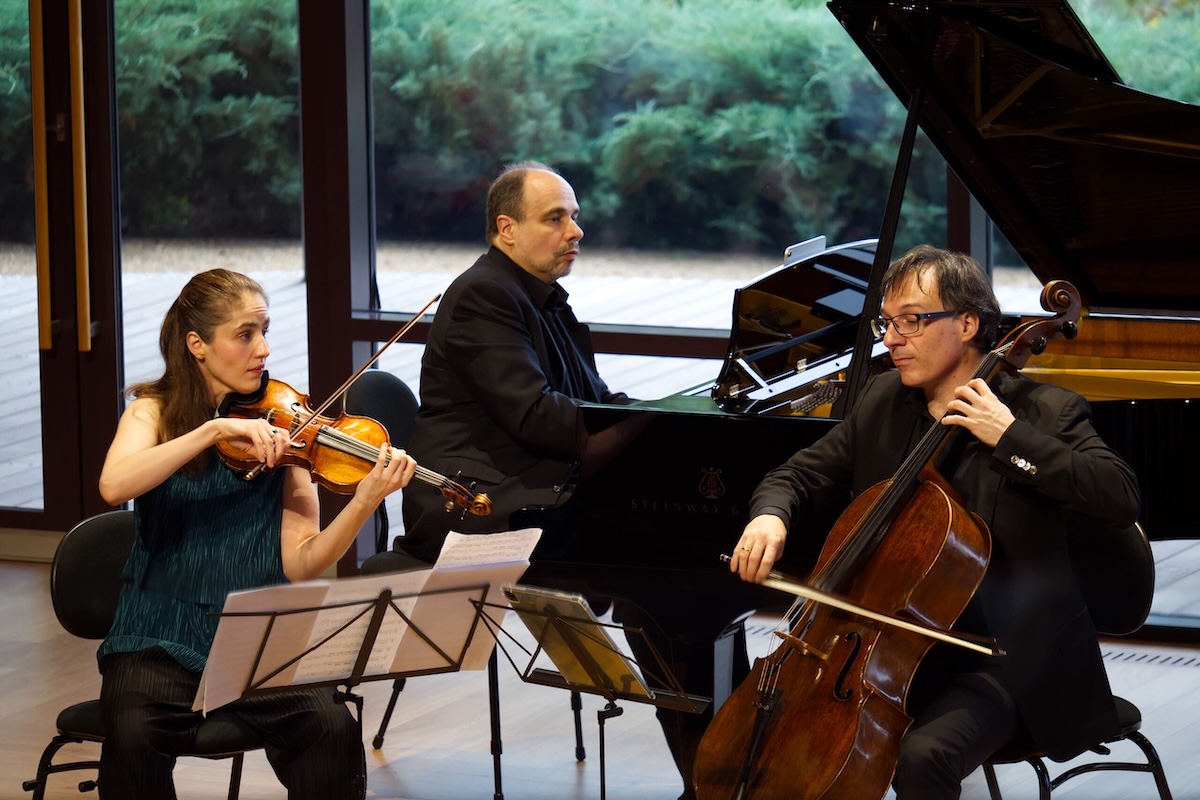
Júlia Pusker, Claudio Martínez Mehner and Umberto Clerici. Photo © Ben Nicholls
Pusker and Martínez Mehner then give a delightful performance of Bartok’s Rhapsody No. 2 for Violin and Piano, Sz. 89, which is based on the gypsy czardas sequence of slow and fast movements – lassú and friss – and employs folk tunes and dances the composer collected from eastern Europe.
The first movement, Lassú, is a lilting, romantic melody, with expressive vibrato, while the Friss second movement begins jauntily and features frequent, abrupt shifts in pace, with constant changes in rhythm and tempo through the successive tunes, as if the violinist is challenging the dancers to stay in time. Pusker’s sinuous, insightful performance highlights the musicality in this demanding violin showpiece.
Having traversed such diverse musical territory, Mehner, Pusker and Clerici nicely bookend Beethoven’s Gassenhauer with Mendelssohn’s glorious Piano Trio in C minor, Op. 66. The dramatic Allegro energico e con fuoco first movement is characterised by the restless rising and falling motives of the first theme in the piano, following which the strings introduce the second theme.
The music quietens for a moment with a delicate passage for the piano before resuming its tempestuous trajectory. The piano is the central voice, but alternating slow, sombre passages in the strings calm the mood, soothing the piano’s troubles. The movement returns to the energy and passion of its opening and ends with a declarative resolution.
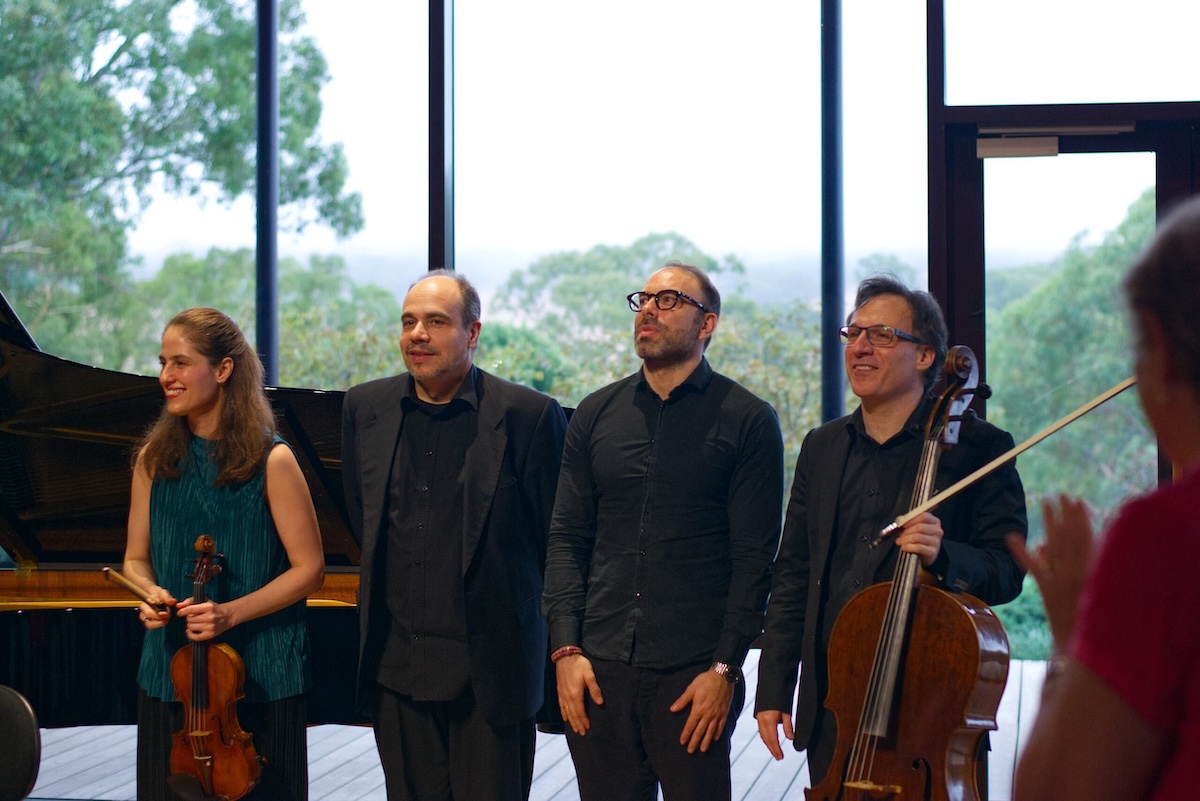
Júlia Pusker, Claudio Martínez Mehner, Tommaso Lonquich and Umberto Clerici. Photo © Ben Nicholls
The Andante espressivo second movement begins as a sweet but rather melancholic lullaby, and an involving conversation develops in the strings. The jaunty Scherzo: Molto allegro quasi presto is characterised by a relentless, motoric flurry of fast notes in the piano that propel the music forward.
The Finale: Allegro appassionato opens with a heartfelt cry from the cello that is then answered by the violin, and the passion builds through exchanges between all three instruments. The cello’s initial tune recurs periodically with variations, and the passion increases towards Mendelssohn’s triumphant conclusion that echoes the final bars of the first movement.
Lonquich, Clerici, Mehner and Pusker combine wonderfully to deliver an engaging sample of the best in chamber music.
Lonquich-Clerici-Mehner Trio and Júlia Pusker also perform in the Sanctum Series during the Perth Festival on 20 February







Comments
Log in to start the conversation.