




The curtain rises to a still Isabelle Huppert as Mary, Queen of Scots, in silhouette at the back of the stage – swan-like – a simultaneously elegant and jarring beginning to an exhilarating 90 minutes of theatre. I find myself reviewing a review, as Mary, in her final days of incarceration at Fotheringhay Castle in Scotland at the hands of her cousin Elizabeth I, looks back at her life from beginning to its pending end.

Isabelle Huppert in Mary Said What She Said. Photo © Lucie Jansch
The show is a three-part monologue in French, which appears strange at first glance. However, when Mary reveals a nostalgic longing for her fleetingly happy childhood in France, coupled with her contempt for Scotland and England despite being in line to rule both, Darryl Pinckney’s French text becomes the seam for Mary’s tempestuous, complex reflection on her tragic fate.
In her rage at the “painted virgin” who lets men into her bedroom through the back door at night, and the men who have shaped her unfortunate destiny, Mary assumes the roles into which she was cast by her enemies at different times. With brilliant use of staging, dim lighting and frenetic choreography contrasted with moments of intense stillness, Huppert’s Mary is at times rag doll, witch, madwoman and plotter. The one role that she embraces is that of queen.
Mary lashes out constantly, chanting repetitious text to the point of babble. It’s challenging theatre. Are we watching a dream? Sometimes the French text is out of sync. Death is everywhere as Mary oscillates between hell and purgatory.
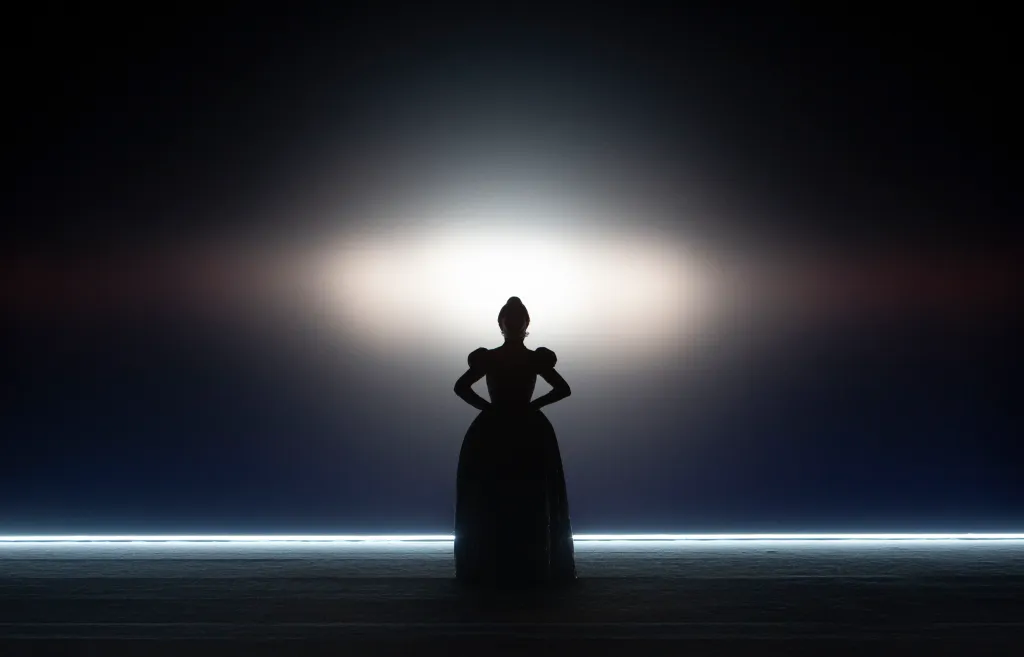
Isabelle Huppert in Mary Said What She Said. Photo © Lucie Jansch
In this production created by the late Robert Wilson, Huppert has an aura of majesty. Her forays into Hollywood (Heaven’s Gate, The Bedroom Window, I Heart Huckabees, among others) were excellent but largely unnoticed. However, she is justifiably revered around the world, and in her native France in particular. I don’t think that I have seen such a powerful one-person stage show since I had the privilege of seeing John Astin performing Edgar Allan Poe in the Nineties – another show where death featured prominently.
In this production, Huppert is a force of nature. Her speech is clear and forceful – regal, you could say. The production is a physical marathon, with Mary raging through mesmerising, dance-like movement. All of this occurs to the background of Ludovico Einaudi’s courtly score – Bach and Handel mixed with minimalism – an insistent counterpoint to Huppert’s unhinged treble.
The tragedy hits home in the final sequence of the production, where Mary writes a letter to her brother, resigned to her fate. She implores him to reward her loyal servants; she laments the relationship with her son of which she was robbed by her captors. Her final moments are a sad triumph as she glides swan-like once again, as she began, towards her unjust fate.
The stunned audience members take their time to rise to their feet as Huppert takes her bow, but they are united in their adulation for what they have just experienced.
Mary Said What She Said was performed at the Adelaide Festival, 6-8 March.





Comments
Log in to start the conversation.