Picture this: The stage is set for an orchestra but lined up along the front of the stage is a vast assortment of non-musical (?) stuff: tinsel, boots and balloons, various cloths and blankets, fluids, a helmet, a whip and a wind machine, an umbrella, a sandpit and a half-filled sack, a celery stalk … and much more.
They were assembled for the world premiere of Hollywood Parsifals – a concerto for orchestra and Foley (sound effect) artists by Australian composer Thomas Meadowcroft.
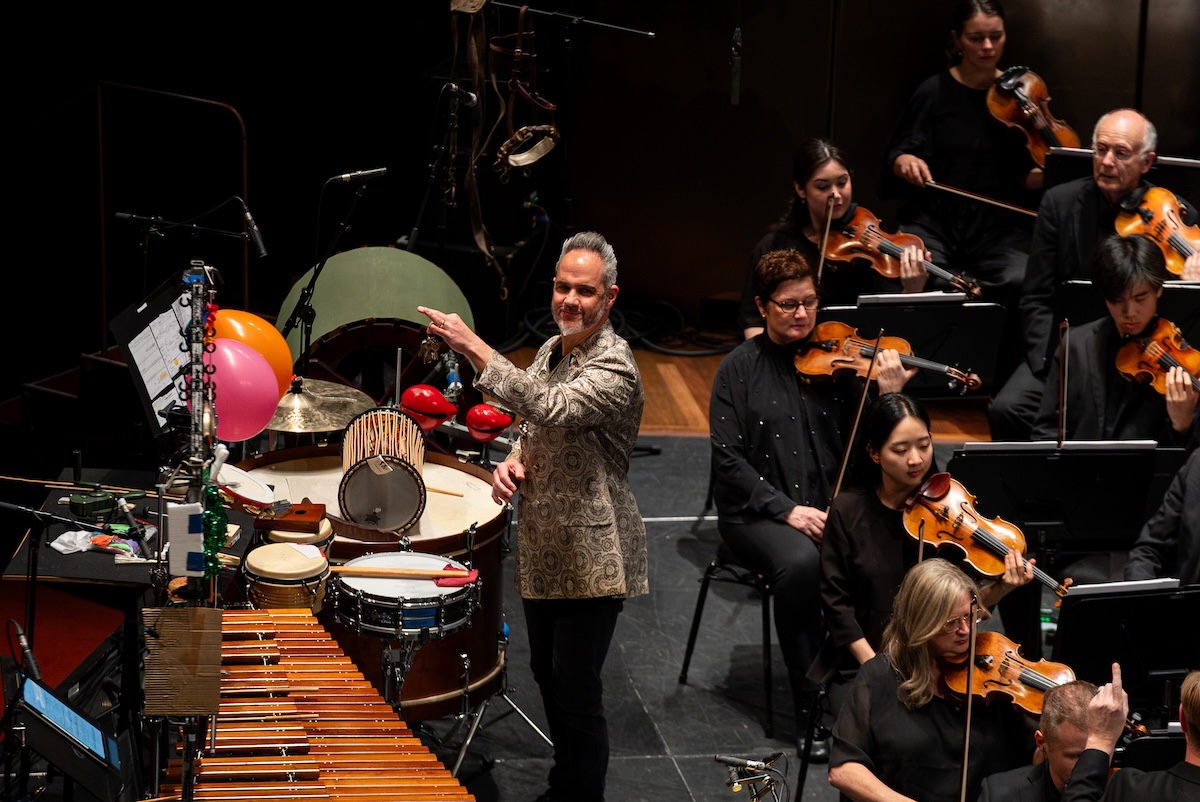
Eugene Ughetti and musicians of the Melbourne Symphony Orchestra. Photo © Samantha Meuleman
Meadowcroft’s concerto turns the soundtrack inside out: he has made a musical feature of the sound effects and placed the Foley artists in the limelight. And in so doing, the composer has flipped the way the soundtrack is scored and heard.
Thankfully, he was there in person to explain his complicated compositional journey. Instead of adding sound effects to amplify the action, Meadowcroft – aided and abetted by the Foley artists – developed the score around six popular film genres: War, Western, Thriller/Horror, Rom-Com, Crime and Science Fiction.
He used instantly recognisable musical tropes, such as swooning strings and hollow ‘space odyssey’ harmonies, to set the scene for the six vignettes. And, as in a film script, the score for each vignette contained sonic cues – such as ‘Horse and Cart’ in the Western – for the Foley artists.
The cues were not shared with the audience. Meadowcroft said he was curious to see whether the music would still make sense once its visual anchor has been removed. He invited the audience to imagine stories that matched the evolving soundtrack, hinting that we could find five deaths, a chase and a smooch in the score.

Foley artists John Simpson and Tracy Parton. Photo © Samantha Meuleman
If you had shut your eyes, you might have been able to construct your own version of events; but with the soloists dashing from one ‘station’ to another, breaking celery stalks, squishing balloons, stomping in a pit and flapping their arms/wings, you couldn’t take your eyes off the stage for a minute.
Australian Foley artists John Simpson and Tracy Parton, dressed inconspicuously in black, calmly delivered their complex parts with split-second precision. Percussionist Eugene Ughetti performed some brilliant solos on ‘conventional’ percussion instruments and supplemented the Foley effects, adding to the theatre with his glitzy costume and dramatic stage presence. The MSO, directed by Benjamin Northey, produced an authentic Hollywood sound that highlighted Meadowcroft’s colourful score.
All traces of the Foley effects were removed during the interval, with the second half devoted to conventional film scores.

Leonard Grigoryan, Slava Grigoryan, conductor Benjamin Northey and the Melbourne Symphony Orchestra. Photo © Samantha Meuleman
The 2007 thriller Noise was Bryony Marks’ first film score. The film revolves around a police caravan where Constable McGahan, who suffers from tinnitus, encounters the perpetrator of two horrific crimes and the terrified, sole-surviving eye-witness. In Their World. Marks depicted the noise (McGahan’s deafening tinnitus) using a prepared piano evoked pervading sense of fear with sharp, punctuating rhythms and colourful orchestration, undertaken by Jared Haschek.
The final items in this substantial program were three soundtracks, introduced on stage by the composer, David Hirschfelder. For The Dressmaker Suite Hirschfelder selected several contrasting episodes from the soundtrack, including his adaptation of the Flower Duet to accompany Sgt Farrant’s coming out.
The Legend of the Guardians was an animated adventure concerning a brave owlet kidnapped by a gang. Hirschfelder said he wanted the orchestra’ to ‘flap its wings’ in his score, and The Guardian Suite evoked an unsettling, ominous mood with dark harmonies and an insistent rhythmic pulse.
Baz Luhrmann’s Strictly Ballroom celebrated a collision of styles, which Hirschfelder’s mirrored in his score. For this event, Hirschfelder transcribed and transformed the original electro-acoustic recordings into a concerto for two guitars, piano and orchestra and in this remarkable performance, the Grigoryan brothers brilliantly performed the blazing guitar solos.
Hearing the soundtracks in isolation highlighted the colour and sophistication in both the score and the MSO’s performance. Fingers crossed this ‘one night only’ performance can be repeated.

Comments
Log in to start the conversation.