




Swara Synthesis is a music ensemble based in Perth, made up of artists with experience and training in India, Bangladesh, Australia and beyond. On September 11 and 12, they offered two programs, the first ostensibly more focused on Indian classical forms, while the second was more of an improvised “World Music” fusion. I attended the first.
The group is led by Avra Banerjee on sarod, an instrument similar to the larger sitar, but whose fretless design means Banerjee often employs string bending to glide through sections rather than the slightly more staccato attack characteristic of the sitar.
In addition to Banerjee, the musicians include Carnatic violin virtuoso Krishna Prasad, together with Sudarshan Subramanian on the long, double-headed mridangam drum. Subir Guha on tabla is also often featured in the numerous solos and combinations, though slightly less often than Prasad and Subramanian.
Shwet Jeshrani, on electric keyboard, also adds non-rhythmic highlights to those pieces featuring the group’s two vocalists, Amitav Islam and Riddhi Mitra.
To my mind, this slightly noodling, less rhythmically sharp musical framing of the vocal contributions was less successful – though this is a question of musical preference more than skill of execution.
Also included in the ensemble was Tao Issaro, a frequent composer-collaborator in fusion percussion for Perth theatre productions, whose contribution on cajon (percussion box) and chimes added a slightly Caribbean flavour.
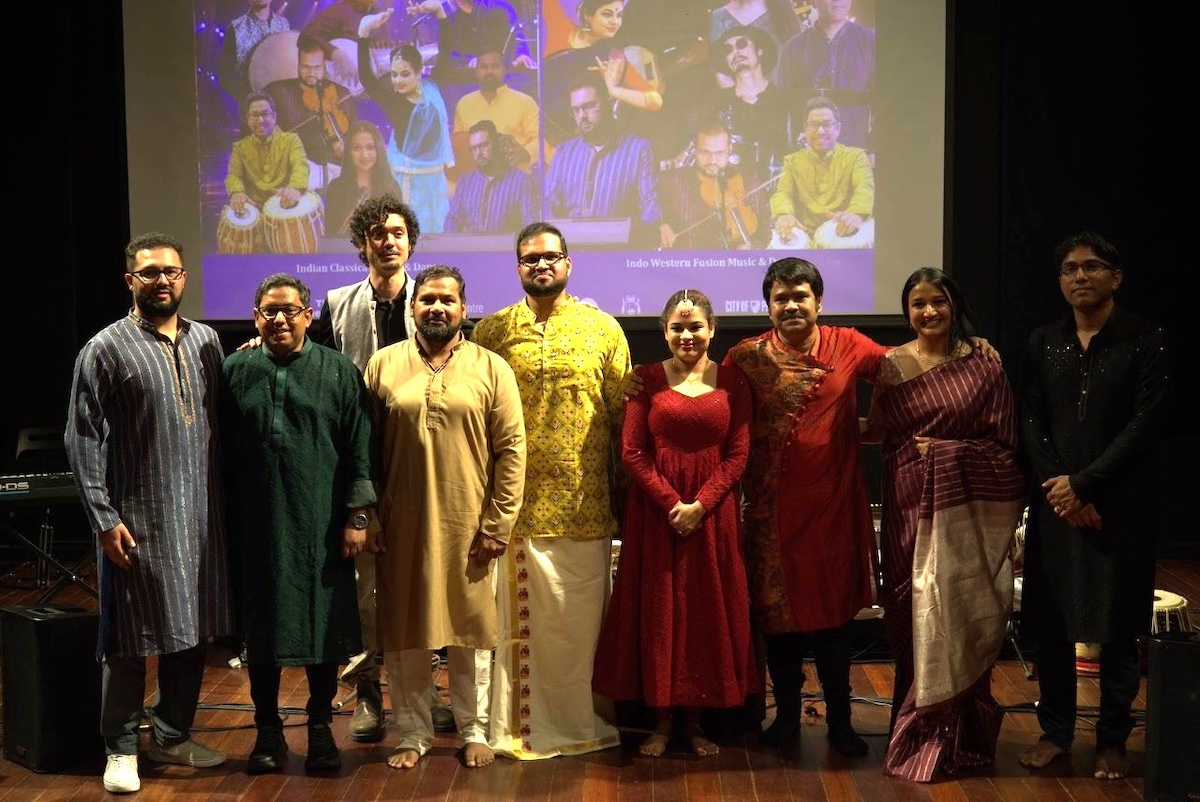
Swara Synthesis at Midland Junction Arts Centre. Photo supplied
As is conventional for South-East Asian classical musics, the pieces were based on established ragas, or predetermined melodic structures and fragments, and talas, or predetermined rhythmic structures. These serve as a framework for a performance that evolves into distinct sections of structured improvisation, with most of the compositions having three main developments.
Initial slow builds and scattered leading notes from the sarod evolve into rapid-fire virtuosic displays, often leading to a more sparse set of call-and-response solos between the violin and mridangam, or the sarod and violin, and so on. The featuring of solo, paired or tripartite exchanges then typically was followed by a dense collective climax, in which the full ensemble came thrillingly into play.
In this sense, contemporary Indian classicism, at least as realised by Swara Synthesis, is close to the structure of jazz improvisation and the performance of jazz standards – though most Indian classical artists would argue that the attention to microtonal subtleties and uneven beats is much more complex than most jazz.
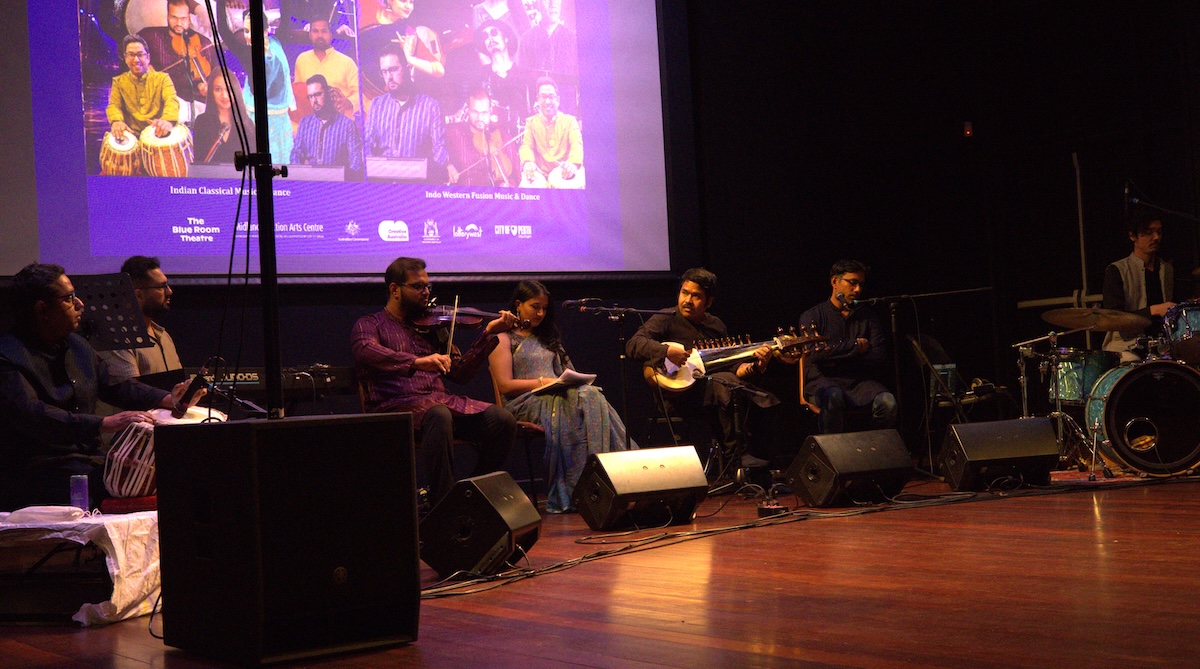
Swara Synthesis at Midland Junction Arts Centre. Photo supplied
The point, then, is that although Swara Synthesis’ promotion and concert descriptions make a clear distinction between their Indian classical performances and their fusion collaborations (where the ensemble also includes a Western drum kit and/or amplified bass guitar), Banerjee and his associates are already performing a distinctive modern fusion, particularly in their combination of tunings and musical principles from the two major schools of South Asian music, namely Carnatic music and Hindustani forms.
My ear is not well trained enough to positively identify these nuances in Banerjee’s framing, but the scintillatingly rich density of the musical material is immediately apparent. While I myself would have preferred a warmer and more percussive approach to the keyboard element, to help it better integrate into the rest of the sonic textures, as a supplementary if not necessarily required element of musical ornamentation, Jeshrani’s contribution is also effective.
Banerjee and his associates are a welcome addition to Perth’s musical culture.







Comments
Log in to start the conversation.