




Returning last year to the Hampstead house where, through the 1990s, he had played so often for Alfred Brendel, Paul Lewis sat down at his late teacher’s old Bösendorfer and felt, as he tells Matthew Westwood in the program, Brendel’s presence everywhere in the room, only to learn weeks later that the ashes had been placed beneath the instrument.
It’s a story about inheritance, which is also the subject of Mozart+. This is the first of four programs in which Lewis sets Mozart’s piano sonatas among composers who owe him more than they might seem to, and in Perth’s Winthrop Hall what those composers turned out to share was a sense of play, a delight in invention and the appearance, at least, of improvisation.
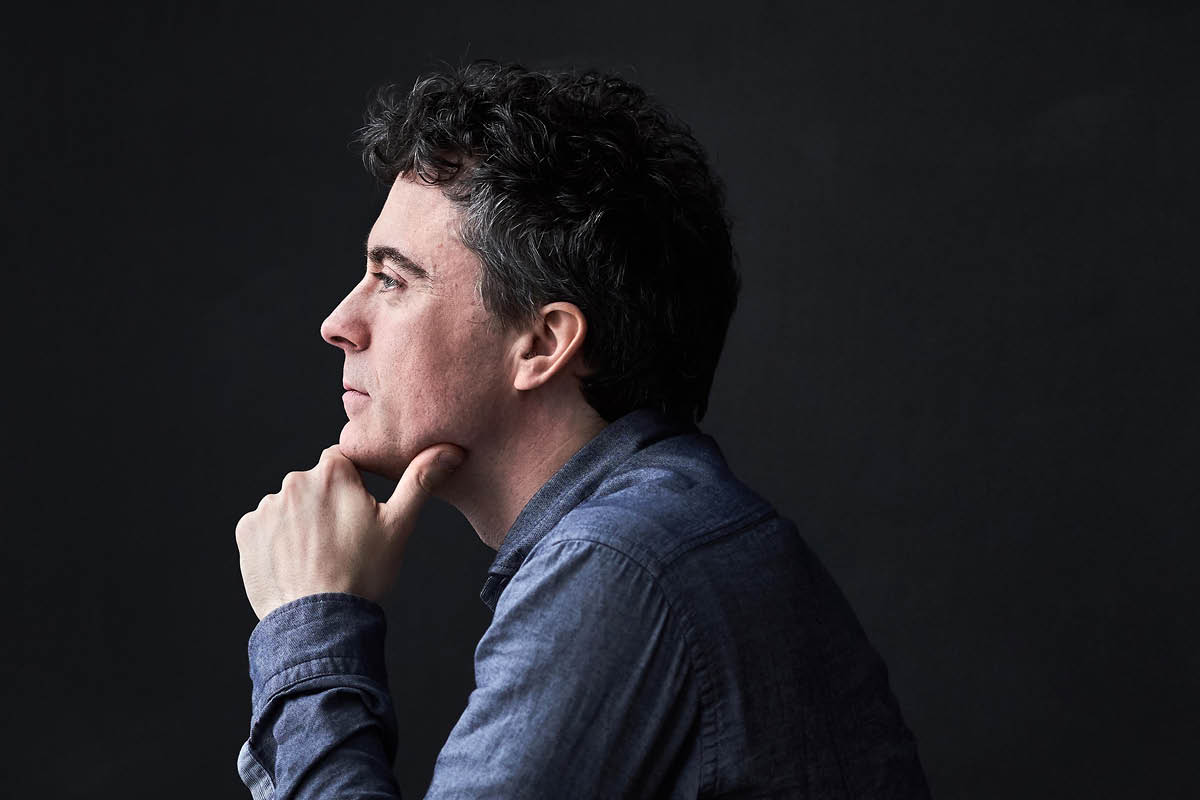
Paul Lewis. Photo © Kaupo Kikkas
The sunny C major Sonata K. 330 established the terms. Mozart, as Paula Kennedy’s note observes, opens both outer-movement developments with entirely new material. For Lewis, Mozart’s textures are so transparent that “every note has its colour, its place, its character”, and he let these fresh ideas arrive as though they had just occurred to him, while the minor-key episode at the heart of the Andante cantabile clouded the music without breaking its singing line.
Poulenc’s Improvisations Nos. 7 to 12 followed. They resemble Fred Williams’s You Yangs Landscape on the program’s cover, whose scattered marks look spontaneous until you notice that each one is exactly where it must be. Lewis played them dry and ironic where Poulenc asks for it, as in No. 8, and gave the Hommage à Schubert a Viennese lilt. Debussy’s L’isle joyeuse then carried the first half out on a tide of glittering, precisely weighted figuration; this was music by the composer Poulenc called “my oxygen”.
After the interval the remaining Improvisations, from the driving B minor No. 1 to the Hommage à Edith Piaf – so suffused with une douce mélancolie – led the ear back towards Mozart, and towards a paradox. Lewis played Poulenc’s Improvisations with the freedom of a pianist thinking aloud, yet Poulenc composed them at leisure, desultorily, across nearly three decades.
The evening’s closest thing to improvisation set down on paper came from Mozart, who was by all accounts a genius extemporiser. In the major-key Adagio of the otherwise stormy proto-Beethovian C minor Sonata K. 457, the rondo theme returns each time more lavishly ornamented, Mozart notating the kind of embellishment a player of his day would have invented at the keyboard.
Spontaneity in music is nearly always a written effect, and the art lies in concealing the ink. Lewis concealed it entirely, shaping each decoration as a thought arrived at in the moment, so that the movement seemed to unfold in real time between the turbulence of the outer movements. Lewis has said he likes “the idea of Mozart having been affected by the journey”, and here the sonata did sound changed by the company it had kept.
Throughout, the playing was technically flawless, stylish and never less than tasteful, its wit unforced and its virtuosity always in the music’s service. The encore, Chopin’s Nocturne in B major Op. 32 No. 1, recalled that improvisatory spirit once more, its tranquil song broken off by a recitative that turns, without warning, to B minor.
A perfect end to a near-perfect recital.
Paul Lewis performs Mozart+ at the Concert Hall, QPAC on 6 October; Newcastle City Hall (7 October); Llewellyn Hall, Canberra (9 October); City Recital Hall, Sydney (12 October); Melbourne Recital Centre (13 October) and Adelaide Town Hall on 15 October.








Comments
Log in to start the conversation.