Oh no, yet another Jane Austen adaptation – and it’s the big one, Pride and Prejudice. Good news: this play is neither redundantly slavish to nor jarringly at odds with the novel. It cleverly reinterprets the Regency tale of love and class with modern sensibilities, humour and karaoke.

Yes, hold onto your bonnets, Pride and Prejudice* (*sort of) has karaoke, and it works – brilliantly.
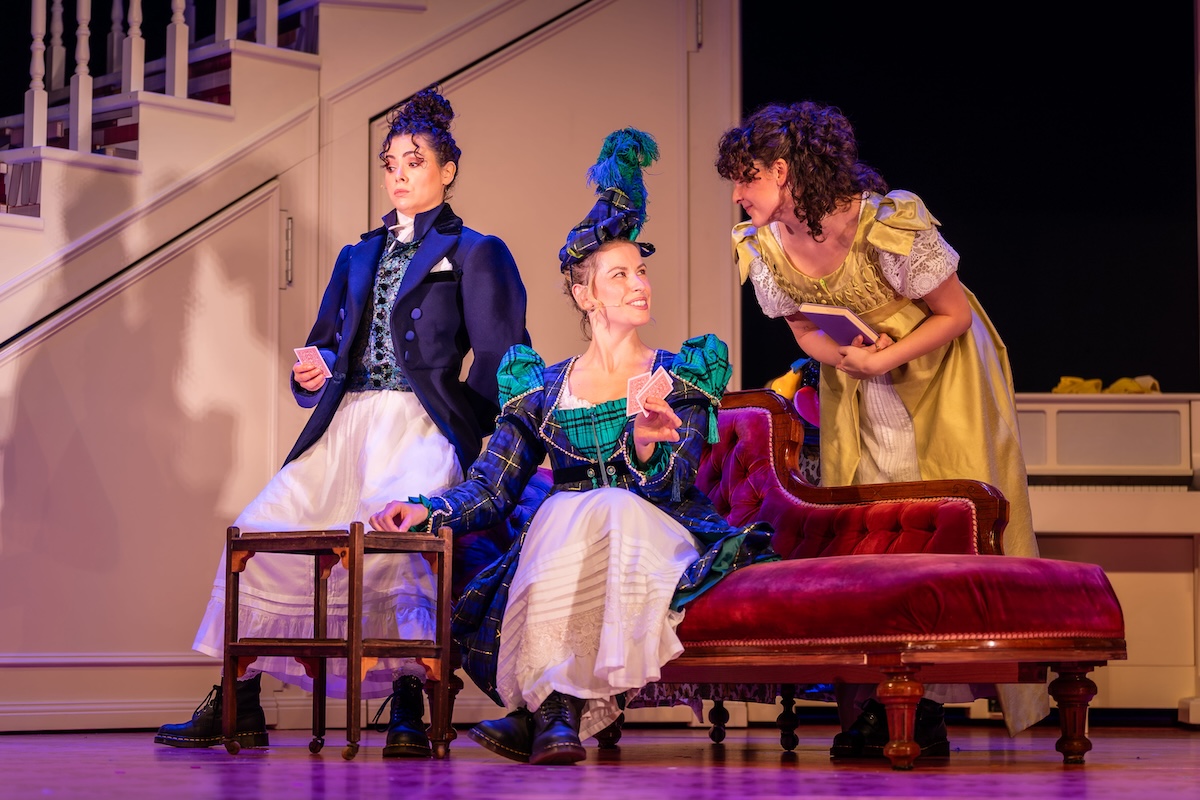
Zoe Ioannou, Amy Lehpamer and Teo Vergara in Pride and Prejudice* (*sort of). Photo © Matthew Chen

Making its debut in Glasgow in 2018, this adaptation was written by Isobel McArthur, who also directed and performed. What was intended to be a two-week season evolved into a UK tour, then an Olivier Award-winning West End season co-directed by Simon Harvey. He directs this Australian premiere production.

Pride and Prejudice* (*sort of) is told by five female servants, who provide some earthy insights in between playing more than a dozen key characters. No surprise there’s ice then fire between Elizabeth Bennet and Mr Darcy, Jane Bennet and Mr Bingley’s romance is temporarily torpedoed, Mr Wickham charms and deceives before eloping with Lydia Bennet, and wife-hunter Mr Collins is odious.

Some characters are understandably eliminated for efficiency – though the ineffectual Mr Bennet is amusingly represented by a wingback chair facing upstage. McArthur also trims the plot and makes minor changes for clarity and to maintain a cracking pace, condensing the tale to just over two hours (plus interval).

Pride and Prejudice* (*sort of). Photo © Matthew Chen

While Austen’s novel is renowned for its well-mannered satire, Pride and Prejudice* (*sort of)’s comedy is more overt and modern. That includes treats for fans, such as servants strongly hinting to Mr Darcy he ought to jump in the lake (non-fans, see the 1995 BBC TV adaptation).

The language is almost entirely contemporary, including a smattering of colourful words, and the cast regularly pick up microphones to sing bits of popular songs from the mid-late 20thcentury.

None are more perfectly chosen than You’re So Vain, which Elizabeth directs at Darcy when he makes his first priggish impression. Other highlights include Jane’s Will You Love Me Tomorrow (we know what’s coming), Smooth Operator (that’s Mr Wickham), Holding Out for a Hero and Young Hearts Run Free.

This injection of song is funny, sometimes silly – like when Lady Catherine de Bourgh demands Elizabeth sing her “nephew” Chris de Burgh’s Lady in Red. This song feels shoe-horned in, until it turns into one of Pride and Prejudice* (*sort of)’s many moments of sincere emotion.

Kaori Maeda-Judge in Pride and Prejudice* (*sort of). Photo © Matthew Chen

While the characters are usually broadly interpreted, there’s ample balancing depth. A notable example is McArthur’s twist of Charlotte Lucas’s unrequited love for bestie Elizabeth, which is initially written for laughs before becoming a sad inevitability of the era.

Despite countless rapid costume changes, the cast’s energy never flags. They have a flair for comedy, sing well and occasionally show their accomplishment with live instruments, from upright piano to kazoo.

Often reminding me of glamazon actor-singer Hannah Waddingham (TV’s Ted Lasso), Amy Lehpamer is the lead servant, bumblingly adorable Mr Bingley and his nasty, scheming sister, Caroline – a role she devours with scene-stealing physicality.

Zoe Ioannou could hardly be more different as crass, couch-loving Mrs Bennett and haughty, physically stiff Darcy, whom she gradually softens. That Ioannou sometimes plays them seconds apart makes her performance all the more wonderful.

Apart from a servant, Teo Vergara only tackles the prominent role of Elizabeth. They flesh out this character, who is by turns feisty, stubborn, candid, shocked, remorseful and loving.

Kaori Maeda-Judge carries quite a load as a Scots-accented servant, sweetie Jane, rakish Wickham and pompously proper Lady Catherine. She emphatically ticks every box.

Ruby Shannon makes her professional stage debut with assured interpretations of contrasting sisters Mary and Lydia, Mr Collins and kind aunt Mrs Gardiner.

Ana Inés Jabares-Pita’s costumes sees the cast wearing simple white shift-style petticoats and heavy boots as servants, over which they throw colourful Regency dresses, smart frockcoats and the occasional hat for Austen’s characters.

Zoe Ioannou, Amy Lehpamer and Teo Vergara in Pride and Prejudice* (*sort of). Photo © Matthew Chen

It’s effective, and sometimes amusing: the initial surprise of seeing gentlemen in petticoats below the waist; minor differences between Mr and Miss Bingley’s ensembles; Lady Catherine’s sartorial excess; and occasional gags born out of speedy costume and character switches.

The book-themed set designed by Jabares-Pita is also adaptable and evocative of the story’s time and places. A sweeping staircase with cupboards and open space below meets a towering bookshelf, allowing the action to flow while also creating focal points with the addition of the odd prop, from chaise lounge to life-size horse.

It’s nicely lit by Jason Bovaird, who has fun with romantic stars, flashes of lightning and Lady Catherine’s horror movie-inspired entrance and exit.

Pride and Prejudice* (*sort of) is a remarkable balancing act of irreverence and respect for Austen’s classic. While the humour sometimes has fringe theatre’s heavy-handedness (the skip stamped “Jane Aust-bin”, for example), it’s otherwise a thoroughly enjoyable romp. Probably including for those who aren’t, like me, part of the Pride and Prejudice repeat business community.


Pride and Prejudice* (*sort of) plays at the Athenaeum Theatre, Melbourne, until 12 July; Sydney Opera House 16 July–30 August; Wollongong’s IPAC 2–13 September; Canberra Theatre Centre 16–27 September, and QPAC, Brisbane, 30 September–18 October.

Contribute to Limelight and support independent arts journalism.