Jazz musicians have been known to accuse classical performers of not being creative, of merely reproducing existing notes in over-played works. That’s a harsh judgement because classical ensembles have to be creative in order to deliver fresh interpretation of works which have been heard in concerts thousands of times. Audiences soon disengage unless tried and tested pieces are given new ideas.
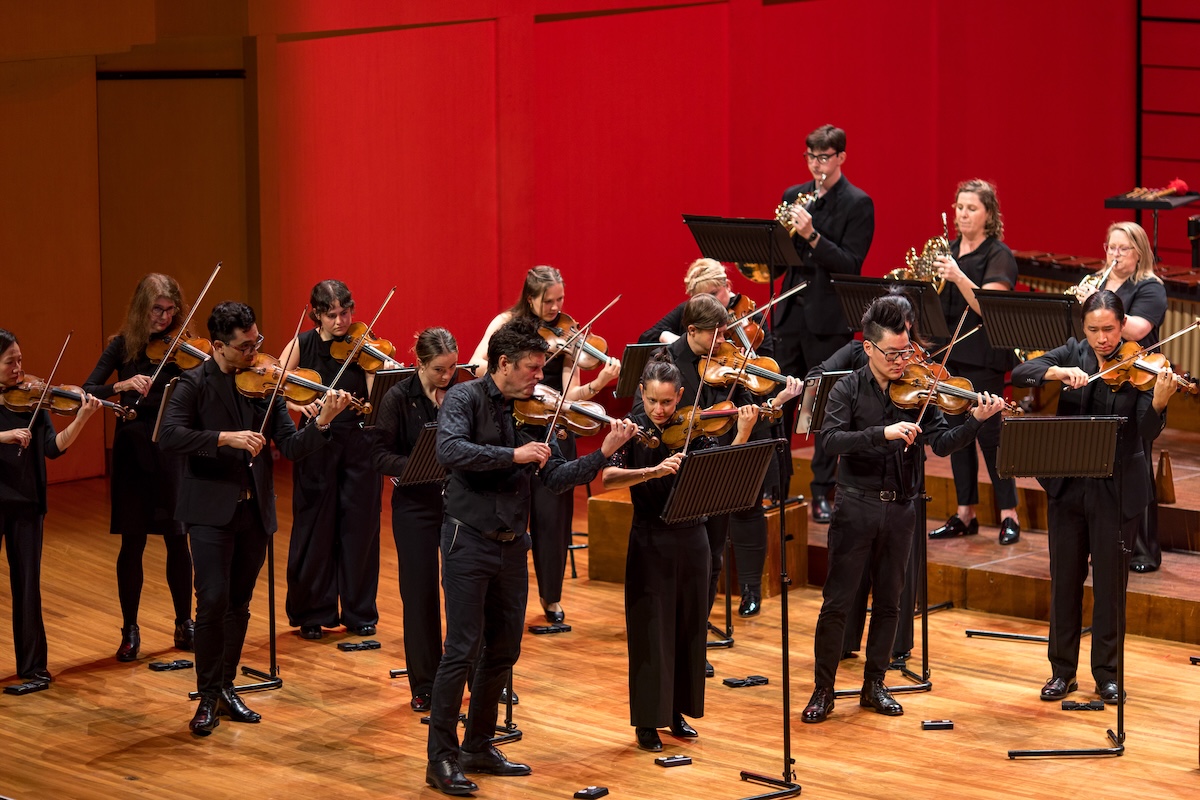
Revolution Remixed.

Revolution Remixed, Camerata – Queensland’s Chamber Orchestra. Photo supplied

This performance of Beethoven’s Third Symphony, Eroica, proved that Camerata is more than capable of arresting the ear with a generously imagined interpretation. The rendition had a force field of energy, colour and an unusually heightened fervour and formidable attack.

The Eroica revolutionised symphonic form with its daring emotional intensity, ambitious structural gestures and its maelstrom of sharp tonal contrasts, sudden pauses and fevered intensity. There’s nothing worse than a mannered and polite performance.

“I believe that heaven and earth will tremble when it is performed for the first time,” said Beethoven’s student Ferdinand Ries about this monumental work.

Camerata played to the hilt and did its best to achieve Ries’ vision. The initial accented chords were a call to arms, the pacing fast and furious, the outline of the tune by the cellos had a smooth and buttery legato, and the ensemble was on fire – a rush of bristling energy.

Scarcely through the first movement, several hairs on the bow of Orchestra Leader Brendan Joyce had loosened and danced in the lights. All the players were emotionally invested, lovingly exploring full ensemble segments, expertly matching phrases shared between instruments and supportively underpinning solos. This was particularly so in the second movement’s heavy, funereal mindset where Eve Newsome’s cresting oboe phrases had crystal clarity. The proud emphasis of the lower strings and bass lines deepened the movement’s gloomy nature.

Revolution Remixed

Revolution Remixed, Camerata – Queensland’s Chamber Orchestra. Photo supplied

Julian Yu’s reimagination of Mussorgsky’s Pictures at an Exhibition was premiered by the Tasmanian Symphony Orchestra in 2021. The score treads a razor’s edge between recalling Mussorgsky’s original and then shattering this familiarity with surprising twists of colour, edgy harmony, extended instrumental techniques and an Asian flavour. Ornamental embellishment is extended in exhilarating ways.

Yu abandons Mussorgsky’s pomp and majesty in presenting the connecting, overarching melody in favour of a detailed celebration of musical contrasts. There’s a frequent use of hocket where the melody is shared between two or more players or different instrumental sections. Camerata scaled the challenging score impressively, vividly revealing Yu’s unusual orchestration, spliced with flashes of wild timbre and shimmering echoes.

Solo instruments represent characters. There’s a newly cast viola cadenza in the last statement of the Promenade and this proved to be a useful vehicle for Thomas Chawner’s ravishing tone. The solo double bass portrays Samuel Goldenberg, while the clarinet communicates an impoverished character. Children having fun in the Tuileries Garden is conjured by scampering xylophone. There are wonderful effects, for instance where several players each sustain a note of the melody and achieve cathedral like resonance.

Camerata delivered a wonderful menu in two courses – a thrilling account of Beethoven’s Eroica and a stunning performance of Yu’s Pictures at an Exhibition.

Contribute to Limelight and support independent arts journalism.