Two interruptions – one avoidable, the other not – broke the rhythm but failed to mar the performance of two late Franz Schubert works in the latest tour featuring Artistic Director Richard Tognetti and the Australian Chamber Orchestra.

Tognetti has won many admirers for his arrangements of chamber works for small orchestra, but you would think he must have had a head-scratching moment or two when it came to setting Franz Schubert’s formidable Fantasy in C major for violin and piano as an octet for strings and winds.
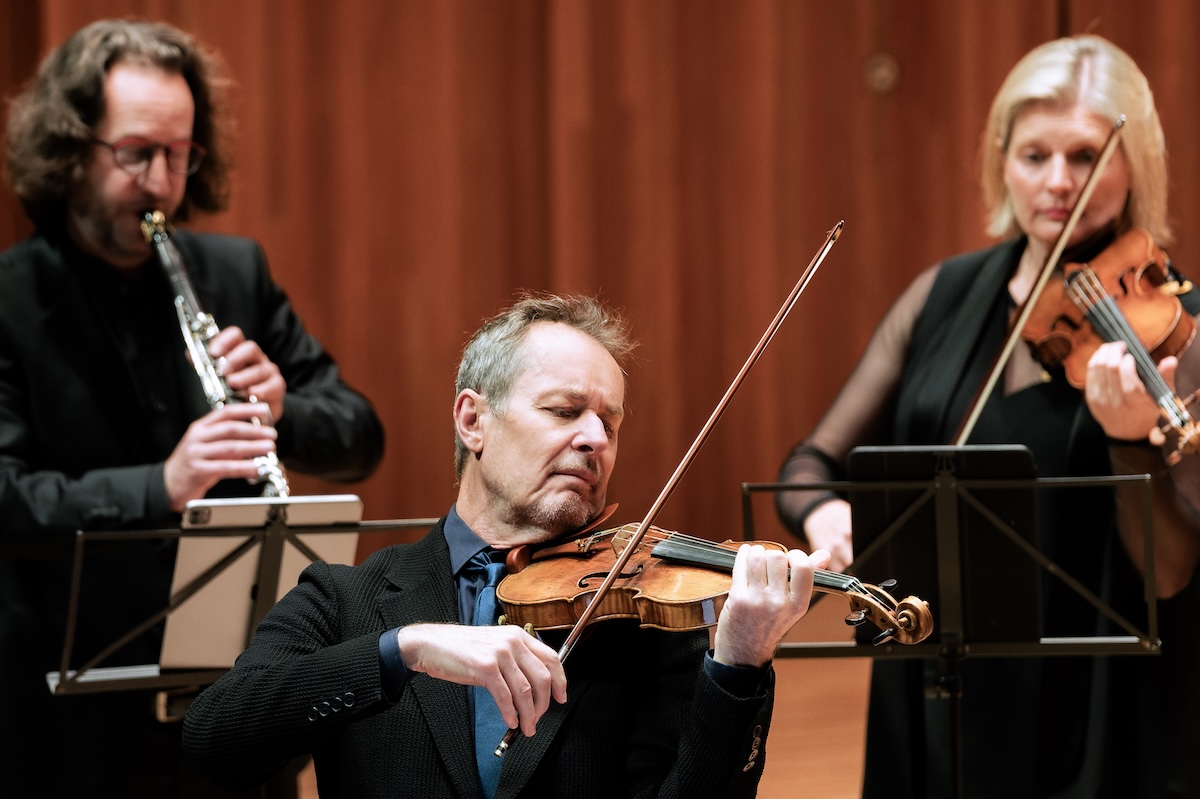
David Griffiths, Richard Tognetti and Helena Rathbone. Photo © Nic Walker

Both instrumentalists are evenly matched for virtuosity, with Russian pianist Nikolai Lugansky describing it as “the most difficult piece ever written for piano – more difficult than all of Rachmaninov’s concertos put together”.

But Tognetti’s reasons were compelling. He wanted a companion for Schubert’s Octet with the same configuration of instruments – two violins, viola, cello, double bass, clarinet, bassoon and horn – for the Australian Chamber Orchestra’s latest tour. And besides, this homage can be seen as a complement to those other late masterpieces the String Quintet, Death and the Maiden Quartet and the E-flat major Piano Trio.

As Tognetti says the Fantasy is like a “marvellous poem, unfolding … through chains of sound like radiant images”.

Much of the piano’s bravura passages were taken on by clarinetist David Griffiths, with additional orchestral colours provided by Todd Gibson-Cornish’s bassoon, Carla Blackwood’s horn and core string players Helena Rathbone, second violin, violist Stefanie Farrands and Finnish guest cellist Johannes Rostamo. Maxime Bibeau’s double bass, as always, provided a grounding presence.  

The chamber setting highlighted some of the piano part’s sunny melodies and a lovely moment was hornist Blackwood’s noble solo in the Andantino section before Tognetti and Griffiths contended with each other in the set of variations on Schubert’s song “Sie mir gegrüßt! (Be greeted by me!)” which forms the fulcrum of the work. 

The Octet unfolded unhurriedly with clarinet and horn sharing solo duties before the Allegro unleashed the whole ensemble in some joyful and seamless to and fro.

Griffith’s languid clarinet solo was a high moment in the gorgeous Adagio, a 14- minute gem which is up there with Mozart’s Clarinet Quintet in terms of serene beauty.

Richard Tognetti. Photo © Nic Walker

The third movement is perhaps the most familiar of six sections with its scherzo-like symphonic sweep, and Tognetti and his band brought out the exquisite yearning final Andante before the jovial and good-natured finale.

This concert was twice interrupted, once by a broken string near the end of the Octet. That could not be helped and Tognetti had to leave the stage to replace it.

But 20 minutes into the Fantasy Tognetti called a halt to proceedings because of a crying baby.

While I’m all for opening up concerts to as wide an audience as possible, this is a case where I think the parents should consider a) the baby and b) the audience.

There are family concerts available where outside contributions are welcomed.


Australian Chamber Orchestra presents Schubert’s Fantasy & Octet at Wollongong Town Hall, 21 May; Melbourne recital Centre (23, 25 May), Hamer Hall, Melbourne (24 May) and City Recital Hall, Sydney (26–30 May).

Contribute to Limelight and support independent arts journalism.