It felt like the Last Night of the Proms.

The program opened with an exquisite interpretation of Debussy’s Prelude to the Afternoon of a Faun, with a notable solo by principal flautist Prudence Davis.

The MSO was one of four orchestras that co-commissioned English composer Edmund Finnis to write a cello concerto. Finnis composed it with Sheku Kanneh-Mason in mind and was in the audience for this Australian premiere performance.
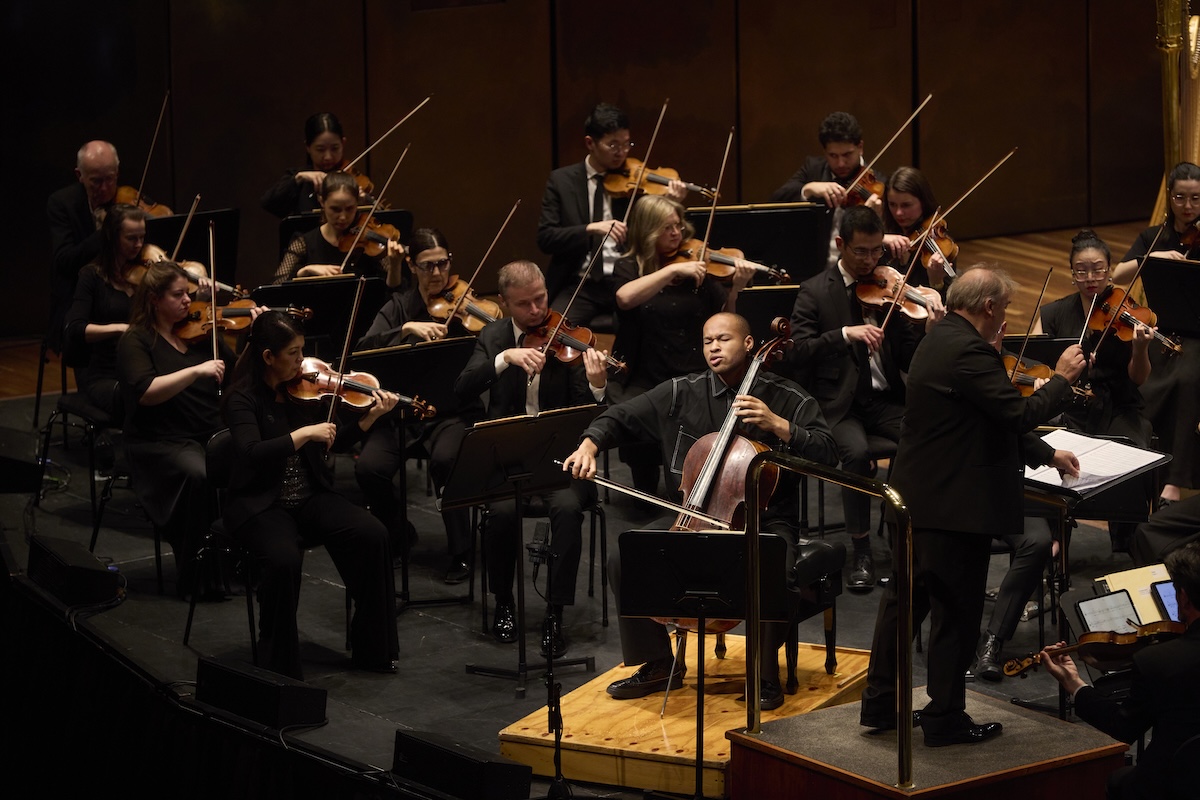
Sheku Kanneh-Mason and the Melbourne Symphony Orchestra. Photo © Laura Manariti

Finnis’ concerto broke the traditional mould. There were no virtuosic high-wire acts, though the solo part must have been challenging in many ways. Nor did the soloist and orchestra take turns as they would in a traditionally structured work. Instead, the soloist and small orchestra jointly created a single sonic image or sensation.

Each of the three movements had a distinctive ambience. In The Shimmering Space, the lower strings and brass provided a vibrating, textured soundscape that was constantly in flux. Around this, Finnis exploited the cello’s wide register and Kanneh-Mason’s extensive palette of sounds, so that the high, evocative solo cello melodies cut through the ambient orchestral part.

Nocturnal Lament evoked a solitary scene. Kanneh-Mason brought out the emotion latent in the melody, which soared over a slow, growling orchestral accompaniment.

Radiant Ecstasy evoked the primal, unstoppable energy of the dance, interrupted occasionally by sudden explosions of sound. The cello and orchestral parts were intertwined, suggesting that neither could break free until the music dissipated. Finnis joined the performers for warm and sustained applause.

Conductor Jaime Martín and the Melbourne Symphony Orchestra. Photo © Laura Manariti

As an encore, Kanneh-Mason played Finnis’ short unaccompanied Prelude lll. It began with a transparent, open-string sequence that held many musical possibilities. Without being able to identify the music, listening without preconceptions allowed the audience to feel curious about the melody’s direction. The composer seemed to have set the cello free, giving it a free-flowing melody that spanned the instrument’s full range. It was later identified as Prelude No. 18 by Mieczysław Weinberg.

The full orchestra returned after the interval and gave a thrilling performance of Tchaikovsky’s Fifth Symphony, with compelling solos by Philip Arkinstall (clarinet) and Lucie Krysatis (horn). From the sombre opening to the exhilarating finale, Maestro Jaime Martín and the MSO brought out not only the shape of this monumental work, but also the myriad nuances in Tchaikovsky’s score.

You could hear the happiness in the hall.


Sheku Kanneh-Mason plays Finnis with Melbourne Symphony Orchestra at 2pm, 8 August, Hamer Hall.

Contribute to Limelight and support independent arts journalism.