There was no escaping the spectre of death in this Melbourne Symphony Orchestra program. It opened with Ravel’s Pavane pour infante défunte, a tribute to untimely corporeal death.

Then came the world premiere of Joe Chindamo’s Are There Any Questions? (subtitled A Requiem for the Vanishing Self).

The finale of this emotionally charged program was Stravinsky’s groundbreaking depiction of human sacrifice, Le Sacre du Printemps (The Rite of Spring).

The MSO, under the sensitive direction of Principal Conductor Benjamin Northey, gave an atmospheric performance of the Pavane and an electrifying Rite of Spring. But it was Chindamo’s Requiem, the first work completed during his tenure as MSO 2026 Composer in Residence, that was the highlight.
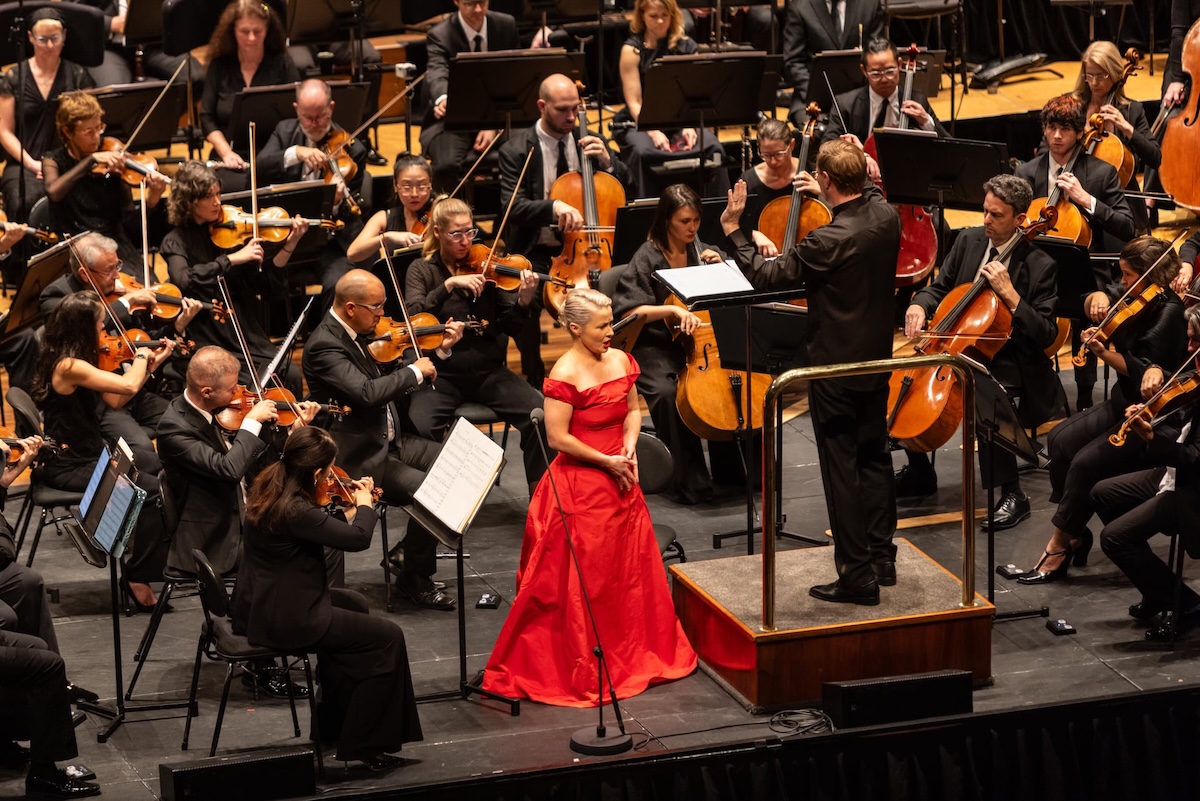
Jessica Aszodi and the Melbourne Symphony Orchestra: Stravinsky & Chindamo. Photo © Mark Gambino

The idea was seeded during the pandemic, when Chindamo dived into dystopian literature. The title quotes the last sentence in Margaret Atwood’s novel The Handmaid’s Tale.

Chindamo describes his work as a “meta-requiem”, because the self has not yet passed away. He focuses on the individual’s sense of self – what is left of it – in a world where this is under threat.

I wonder if the Requiem is a musical response to cognitive dissonance; i.e. the mental anguish a person feels when – unwittingly, subconsciously – they hold two contradictory, incompatible notions, and find themselves in a situation where they are forced to confront and resolve this dilemma.

The work opens with two choruses sung in Latin, which build to a climactic third movement. O Gentle Eye is a solo aria sung in English by mezzo-soprano Jessica Aszodi, who sings an enigmatic but searingly beautiful supplication to the all-seeing Eye. An orchestral interlude, Canticle of the Bound, leads into the last two choruses, again sung in Latin.

The meta-requiem is full of contradictions that cause us to question whether we can put any faith in either the literal meaning of the lyrics or the emotions engendered by the musical setting. Aszodi, for example, sings “I kneel, I smile, I bow, I stay. You show the light. I lose the way”, before declaring “I serve you well until my death”; but we sense that the Eye is despotic, and we are unsure whether this individual is in fact willingly, genuinely and knowingly surrendering to it.

Melbourne Symphony Orchestra: Stravinsky & Chindamo. Photo © Mark Gambino

The choir sings threatening and contradictory slogans, such as “Nolite dubitare” (Doubt is treason) and “veritas est falsum” (Truth is falsehood), in a liturgical style ordinarily reserved for hymns of praise to a benevolent god, and the requiem ends explosively with a series of warlike grunts.

Chindamo has fused elements of his Catholic upbringing, Italian heritage and Western classical music into an accessible style that reflects his personal identity and resonates with the wider community. It is a remarkable work, and the musicians ensured this premiere was memorable.

Contribute to Limelight and support independent arts journalism.