




Ensemble Lumen, which comprises lecturers of Adelaide University’s Elder Conservatorium of Music, is establishing itself as a significant institution in Adelaide’s musical scene, and this concert added to its reputation with some thoughtful programming and fine performances.
Prodigious young Sydney composer Holly Harrrison is known for her energetic compositions that draw from popular culture to create highly original and engaging works. Her Swivel and Swerve was written in 2024 for soprano saxophone and piano, and for this concert she adapts it specially for Ensemble Lumen founder and clarinettist Lloyd Van’t Hoff, who is partnered in this performance by the Dean of the Conservatorium, acclaimed pianist Anna Goldsworthy.

Ensemble Lumen: Swivel and Swerve. Photo © Chris Reid
Swivel and Swerve is drawn from Harrison’s concerto for saxophone, Superhighway, and it’s a bouncy, joyous, six-minute burst of musical energy, bearing influences of several popular musical genres.
Van’t Hoff is in his element in this demanding work, with its frequent shifts of tempi, swirling melodies, angular syncopation and offbeat rhythms as it swivels and swerves through its various musical references.
In one passage, the pianist must mute the strings with the lefthand to create a percussive effect. Swivel and Swerve might conjure images of a fast car swerving through traffic, but its musicality is charming.
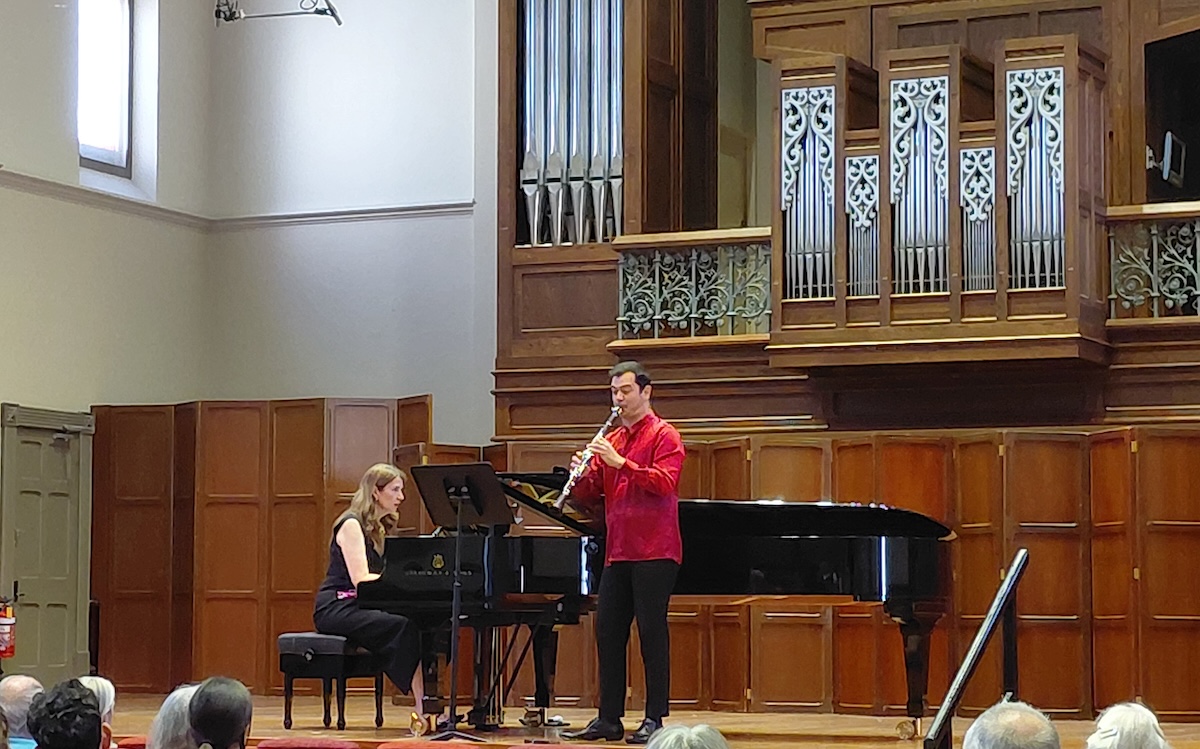
Anna Goldsworthy and Lloyd Van’t Hoff. Photo © Chris Reid
Following on is Wynton Marsalis’s strangely titled Meeelaan. Written for bassoonist Milan Turković, the spelling of the title plays on the pronunciation of his given name. It is written for the unusual combination of bassoon and string quartet and is in three movements – Blues, Tango and Bebop – another blend of musical genres.
Marsalis has transformed these three musical styles so that, at times, they are barely recognisable. In Blues, the mellifluous bassoon and the strings weave competing, blues-inflected melodic lines, and in the Tango movement, the tango rhythm only appears following a slow, wistfully romantic opening passage. The movement concludes with a fragment of Dukas’s The Sorcerer’s Apprentice.
The combination of bassoon and string quartet creates some delightful textures, as the growling bassoon voice contrasts with the ethereal, dancing violins and the occasionally grumbling cello. There are some sublime moments of string quartet playing, but then there are abrupt shifts in rhythm and style. A lovely walking bass line in the cello emerges in Bebop before the music accelerates and a discordant final bassoon note acts as a full stop to end this enchanting work.
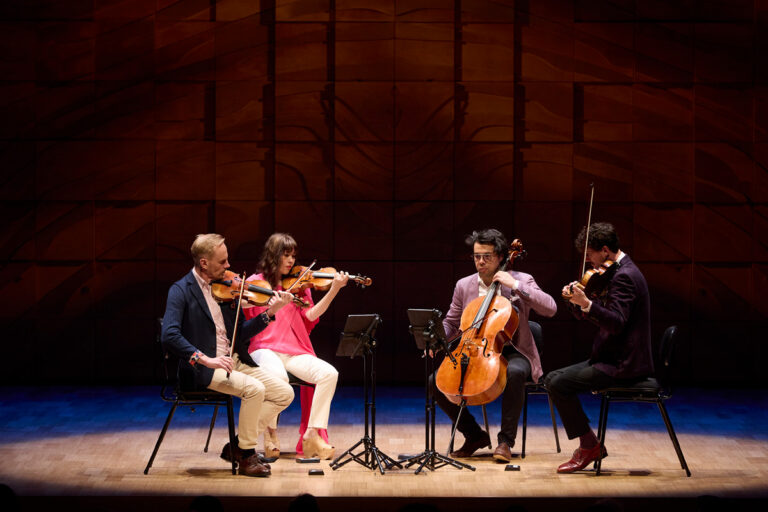
Accompanied by Elizabeth Layton and Alison Heike (violins), Martin Alexander (viola) and Edith Salzmann (cello), Adelaide Symphony Orchestra principal bassoonist Mark Gaydon create magic in this fascinating work that, like the Harrison piece, foregrounds a virtuoso wind player.
Pairing the Harrison and the Marsalis works is an adroit piece of programming, as the latter seems to flow from the former. Both works spring from vivid musical imaginations.
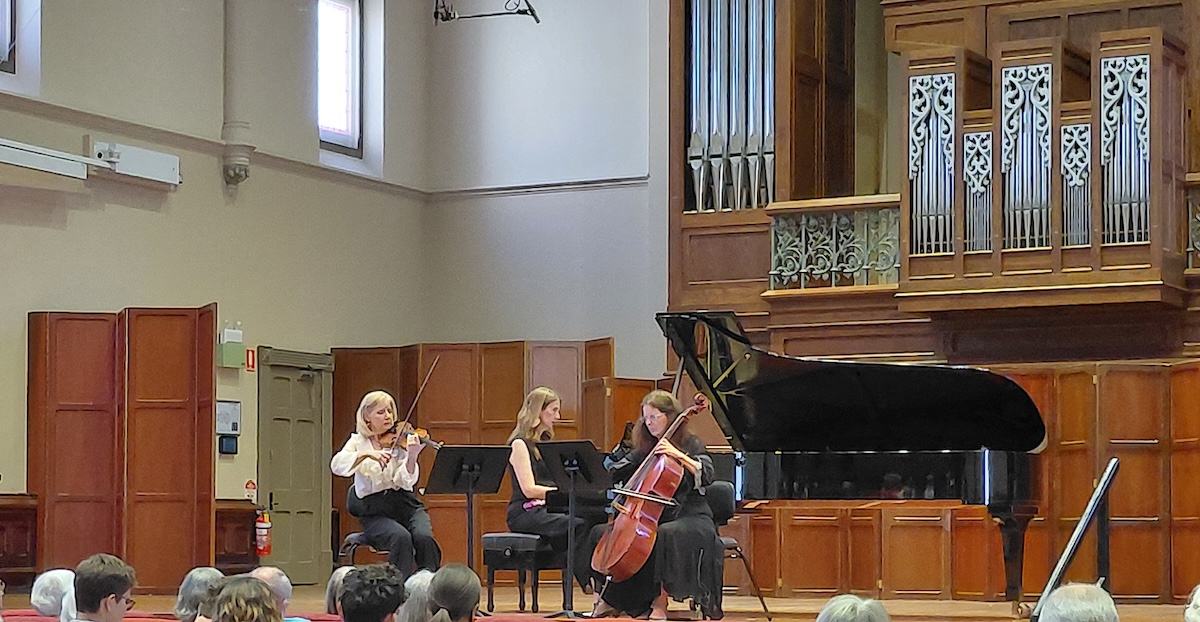
Alison Heike, Anna Goldsworthy and Elizabeth Layton. Photo © Chris Reid
The centrepiece of the concert is Maurice Ravel’s Piano Trio in A minor, one of the great works in the piano trio repertoire, performed here by Layton, Salzmann and Goldsworthy. A long and complex composition exhibiting Ravel’s characteristic musicality and ethereality, it was completed as World War I was beginning.
The first movement, marked Modéré, draws on a traditional Basque dance, the zortziko, and it opens with a gentle, dreamy piano passage. The violin and cello repeat the theme, and the lightness of the opening then gives way to more excited passages, and Layton and Salzmann perform with the utmost delicacy and nuance. Quiet bass notes in the piano punctuate the ending of the first movement.
The short, jaunty scherzo second movement, Pantoum (Assez vif), is based on a Malaysian poetic form, the pantum, in which the second and fourth lines of each stanza are repeated as the first and third lines of the next stanza, and it recalls the character of the Harrison and Marsalis pieces.
The piano establishes the slow, funereal theme of the Passacaille (Très large) which is then heard in the cello and then the violin as if three voices are in close, mournful conversation. The music gradually builds to a crescendo and a desolate passage for the strings is succeeded by sombre bass notes in the piano to conclude the movement.
The exuberant Final (Animé), features irregular time signatures and extended, agitated trills in the strings accompany the piano to the work’s glorious ending.
The Lumen Ensemble’s performance throughout is excellent. All three works in this concert combine diverse musical genres in beguiling and highly original ways. The Harrison and Marsalis works extend and enliven the field of chamber music and broaden its appeal to a wider and younger audience, bridging musical cultures and generations.





Comments
Log in to start the conversation.