Two years after staging Tennessee Williams’s A Streetcar Named Desire, MTC tackles his breakthrough work, The Glass Menagerie, which the company previously presented in 2004.
Directed by Mark Wilson, and starring the ever-remarkable Alison Whyte, this new production is engaging but overemphasises the comedy to the detriment of the play’s tragedy.
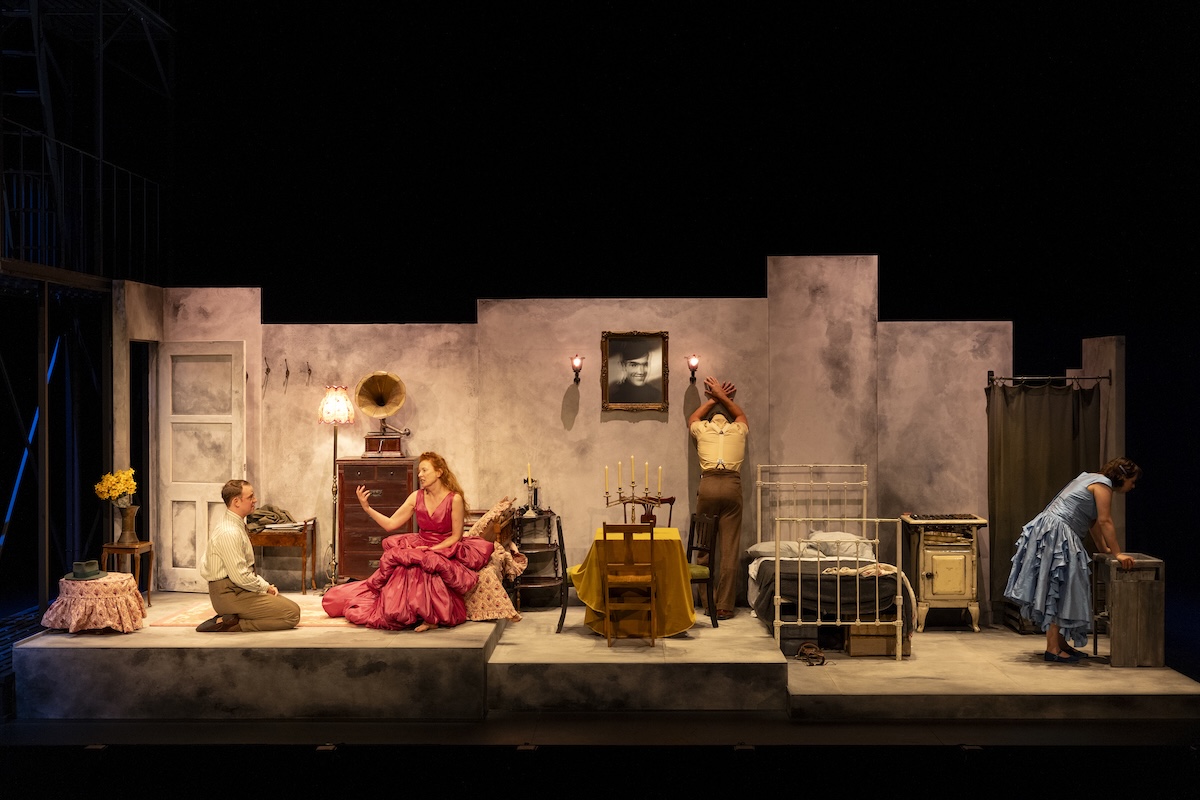
The Glass Menagerie: Harry McGee, Alison Whyte, Tim Draxl and Millie Donaldson. Photo © Pia Johnson
Premiering in Chicago in 1944, The Glass Menagerie looks back on a pivotal period for the Wingfield family, struggling financially and emotionally in 1930s St Louis. Bookending this memory play with present-day monologues, Tom recalls being a frustrated poet working in a warehouse to support his mother Amanda and sister Laura.
The former is a faded Southern belle whose husband departed long ago. Desperate for her children to prosper, Amanda fusses over Tom, who is always out late, ostensibly watching movies, and withdrawn, physically disabled Laura. She has little interest beyond old records and her glass-animal collection.
Believing marriage is her daughter’s only hope, Amanda persuades Tom to invite his colleague Jim home for dinner. This visit by a “gentlemen caller” will make or break the family.
Something hinted at in the text is made more overt by Wilson: Tom’s queerness. He’s played by Tim Draxl, who first appears with muscles bulging out of a tiny singlet – a look inspired by artist Tom of Finland’s erotic gay drawings, as the director notes in the program.

The Glass Menagerie: Millie Donaldson and Tim Draxl. Photo © Pia Johnson
The character’s interactions with Jim (Harry McGee) occasionally suggest frustrated desire, while Whyte’s Amanda flirts with and snuggles up to the visitor as if recalling the many gentlemen callers of her youth. These and many other moments are played for laughs, even veering into sitcom territory. The audience was so primed for comedy on opening night that they sometimes laughed when the text’s tragedy was being embraced.
Even though the tone is sometimes off, the cast persuasively inhabit their characters, including through assured accents (thanks to voice and dialect coach Geraldine Cook-Dafner).

The Glass Menagerie: Millie Donaldson and Alison Whyte. Photo © Pia Johnson
Whyte is like a hopeful, nervous bird, constantly chirping and flitting about, then reveals her dramatic depth in Amanda’s flashes of despairing anger. Draxl is also at his best when venting Tom’s intense frustration, while McGee nails Jim’s earnest positivity.
Millie Donaldson impresses in her professional theatre debut as Laura. Often quiet and physically removed, sometimes taught with anxiety, she’s mostly unencumbered by the comic excess.
The late scene in which Laura and Jim sit on the floor for an increasingly warm candlelit conversation is the production’s best. Unlike much of what’s come before, it’s still, focused and sincere, allowing drama to bubble up.
Kat Chan’s cramped, drab domestic set demonstrates the Wingfields’ poverty while also emphasising their psychological confinement. Requiring the cast to comically squeeze behind the little dining table’s chairs perhaps goes too far though.
Like the set, Matilda Woodroofe’s costumes take us back to Depression-era America. They suggest a dreary making-do, until the dinner delivers two flashy dresses that make it obvious Amanda is trying way too hard.

The Glass Menagerie: Tim Draxl and Millie Donaldson. Photo © Pia Johnson
While Paul Lim’s lighting is naturalistically appealing, Marco Cher’s soundscape intrudes from time to time usually for no good reason. One audio moment related to the absent father’s photo is cheap sitcom humour.
The Glass Menagerie has a great cast, but they are kept too busy with the work’s comic potential to fully convey its inherent melancholy and heartbreak. Those unfamiliar with Williams’s play will be entertained, while others will likely walk away with a lingering feeling this production is a missed opportunity.
The Glass Menagerie is at The Sumner, Melbourne, until 5 June.

Comments
Log in to start the conversation.