




Israeli choreographer Hofesh Shechter knows how to choose a dancer. His company, 10-strong for Theatre of Dreams, is astonishing.
Every fragment of energy each dancer possesses is extracted for Shechter’s extraordinarily muscular work. Bodies whip like a length of wire that’s been put under pressure and released. They often stand up tall and strut forward, shoulders back, elbows bent, arms following jauntily
As always in Shechter’s work there is the ancestral memory of folk dance, seen in lines, circles and shapes. That is the most moving part of his work – his insistence on and persistence with community celebration.

Hofesh Shechter: Theatre of Dreams. Photo © Andrew Beveridge
Otherwise the dancers look ultra confident and cocky, dressed apparently in whatever they thought they’d look good in under Tom Visser’s hazy lighting (there is a costume designer of course, Osnat Keiner). There is not one jot of vulnerability, not even when one dancer strips off completely. He looks fantastic, obviously.
That dancer is a sort of stand-in for the audience I think. He’s the one who enters the auditorium from a side door (fully clothed at this point one must confirm), goes to the stage and slips through a hitherto unseen hole in the curtain.
After that there is an inordinate amount of curtain work. There are multiple sets that open and close, move side to side and reveal one or several dancers doing stuff. Repeat.

Hofesh Shechter: Theatre of Dreams. Photo © Andrew Beveridge
For a short amount of time it’s interesting, although as the repeats pile up the interest in what one is seeing fades. The mind wanders to thoughts of how chaotic it must be behind the curtains and also asks, why are they doing this?
The most pertinent question is this: what are these dreams of which Shechter speaks, and whose dreams are they?
The work has no answer to this, at least not for this viewer. So for 90 minutes, it is all about the spectacular quality of the dancers and their unwavering commitment to Shechter’s aesthetic. The dance is fast, furious and complex, often in unison and then asking for short periods of individuality that burst through like short, sharp rain showers.
At about the centre point the house lights go up and the cast invites audience members to dance, which many do at the performance I attend. I find the atmosphere is rather broken when a voice informs patrons they can now return to their seats as if announcing the end of interval. It sounds naff.
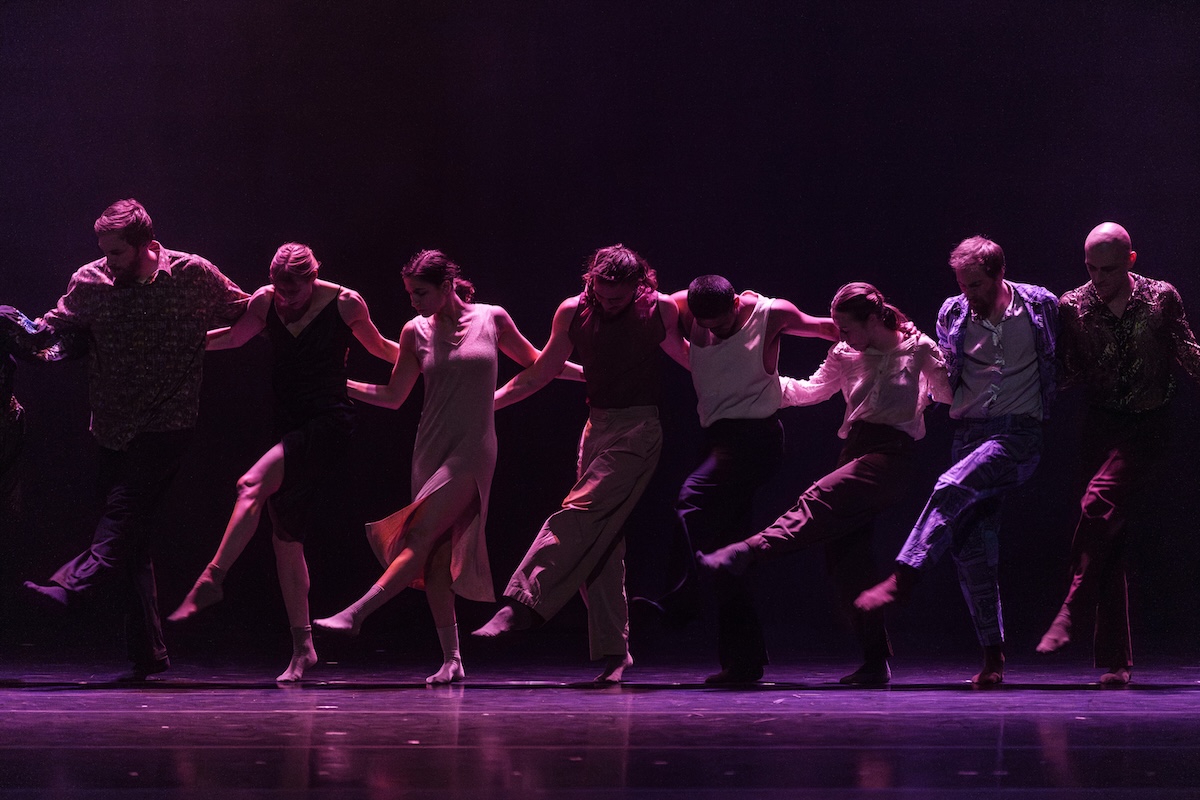
Hofesh Shechter: Theatre of Dreams. Photo © Andrew Beveridge
On the plus side there is a live three-piece band of brilliant versatility that’s worth the price of admission.
Shechter is a festival favourite whose work has come to Australia a handful of times. Political Mother, which Shechter made in 2009 and has revised since, has remained the benchmark for his work. It’s certainly the most often cited, as I have just done.
That sometimes happens with an artist. They have a huge early hit and disappointment is likely to follow. I was disappointed with Sun, which made its world premiere in Melbourne in 2013. Grand Finale, seen in Sydney in 2020, was more engrossing.
Theatre of Dreams, however, I find a bit of a snore.





Comments
Log in to start the conversation.