




Next year, Peter Sellars brings Perle Noire: Meditations for Joséphine, an in-depth portrait of Joséphine Baker, to the Adelaide Festival. It stars Grammy Award-winning soprano Julia Bullock, who in turn reworks John Adams’ oratorio El Niño which Sellars staged at the 2002 Festival. Jansson J. Antmann talks to Bullock and Sellars about their 15-year association and the art of activism.

It is early autumn in Europe when I meet director Peter Sellars over Zoom. He is in the thick of rehearsals for the Italian premiere of Kaija Saariaho’s Adriana Mater with Teatro dell’Opera di Roma, and his mood is as effervescent as ever, fuelled by a tireless appetite for discovery.
A few days later, my screen flickers again, this time to reveal a sunless London, where Grammy Award-winning soprano Julia Bullock is rehearsing The Magic Flute at the Royal Ballet & Opera, Covent Garden (she later withdraws from the production due to ill health).
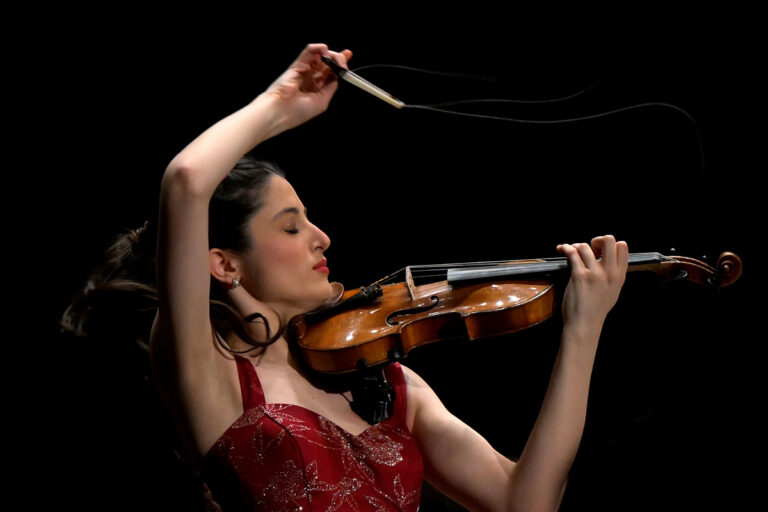
Her voice is resonant and deliberate, hinting at the same mixture of resolve and freshness that has made her one of the most arresting sopranos of her generation.
The topic of our conversations? The 2026 Adelaide Festival – Matthew Lutton’s first as Artistic Director – at which they will replace the usual large-scale operatic centrepiece with two intimate works that hold special significance for them both.
The first is Perle Noire: Meditations for Joséphine, in which Bullock “reincarnates” the singer, dancer, activist and spy for the French Resistance, Joséphine Baker. Directed by Sellars with spoken interludes written by the poet Claudia Rankine, it has already been performed to great acclaim at the Ojai Music Festival in California, New York’s Metropolitan Museum of Art, Oberon American Repertory Theater at Harvard, Dacamera in Houston and the Dutch National Opera. Blending opera, jazz, spirituals and early 20th-century French music hall, the score is written and arranged by Pulitzer Prize-winning composer Tyshawn Sorey, who performs it with the International Contemporary Ensemble.
The second production is El Niño: Nativity Reconsidered, Bullock’s own chamber reworking of John Adams and Sellars’ oratorio El Niño, which brings the voices of women and Latin American poets to the fore. For this one-off performance at Adelaide Town Hall, Bullock will be joined by the Adelaide Chamber Singers and players from the Adelaide Symphony Orchestra.
As Bullock and Sellars explain, these works are very much about legacy, activism and confronting history through the voice and body.
First Encounters
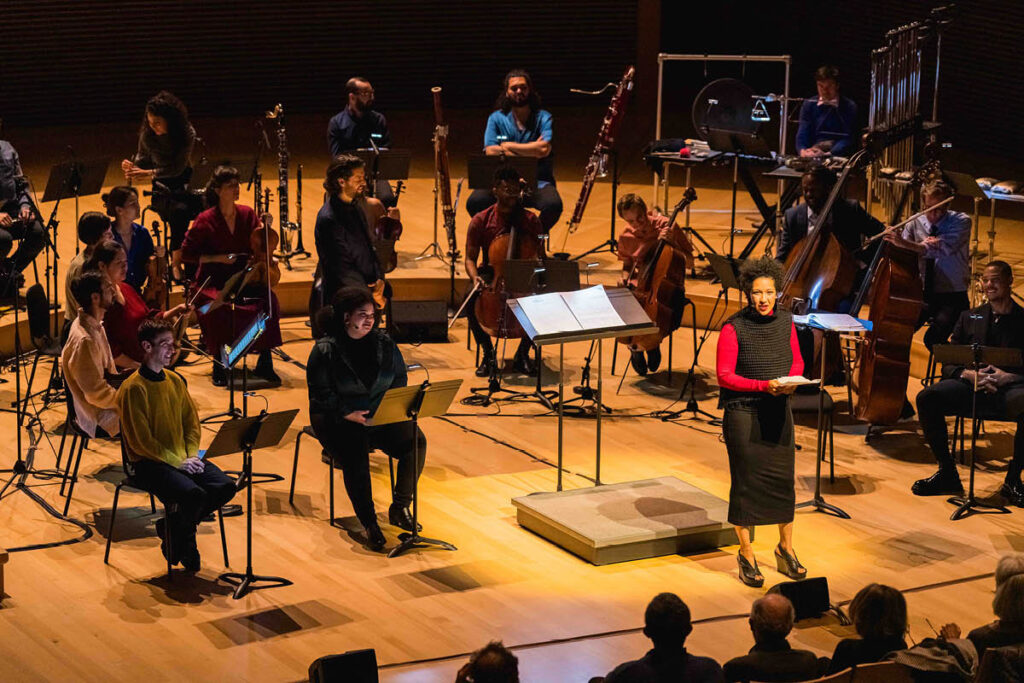
Bullock’s artistry is steeped in an inherited tradition of activism and cultural consciousness. Raised in St Louis, she recalls her father had a beautiful voice. He was head of housing and urban development in Eastern Missouri and took part in the civil rights movement, even sharing a jail cell with Martin Luther King Jr. Her mother was also engaged in city planning and liked to dance, encouraging her daughter to take tap classes.
After her father passed away when she was nine, Bullock grew up in a city often fraught with racial tension. From early on, she blended her acute awareness of social justice with an unshakable drive toward performance, recognising the power of music as a vehicle for connection and reflection.
In her formative years, she drew deeply upon trailblazers in opera and song such as American mezzo-soprano Lorraine Hunt Lieberson, whom she first saw in a video recording of Handel’s Theodora directed by Sellars, and soprano Dawn Upshaw, who mentored Bullock at Bard College where holistic artistic inquiry was encouraged.
When Upshaw was the Music Director of the 2011 Ojai Festival, Bullock’s talents quickly drew notice and she crossed paths with Sellars, developing a creative rapport that would define their future collaborations, all of which have been rooted in a shared belief in art as activism.
“Julia is one of the performers of a generation,” Sellars says. “She is unique and overwhelming; I mean, talk about star power! But at the same time, she has this determination to engage the world. Every one of her recitals is an event. And the way she programs them is breathtaking.”
It was Diane Malecki, Sellars’ longtime producer, who first insisted that he call Bullock after hearing her leap from Spanish medieval songs to Messiaen, Billy Strayhorn and finally Joséphine Baker during her first New York recital as a young student.
He recalls, “I was on the phone with Julia the next morning and said, ‘You’ve got to make something from this. I mean, this is clearly important to you, so go deeper into it.’”
First, however, Bullock needed to get her head around how she wanted to embrace Baker’s legacy.
Race, she says, “put me through a kind of identity crisis or at least identity questioning. My whole life, I have been dealing with being compared to other notable Black people who are occupying predominantly white spaces.”
Being compared to Baker by her singing teacher was a good case in point.
“I think the association for her was: ‘Baker has a light voice and so do you. She could do coloratura and so can you. Baker was a wonderful dancer and so are you.’”
And while Bullock says her teacher didn’t say, “She was a light-skinned, Black-presenting woman and so are you,” the inference was certainly there.
“When she made the comparison, I had not fully clocked that Joséphine Baker was even from St Louis, which, of course, I am too,” Bullock continues. “Instead of shoving the comparison away, as a student, I was really curious and wanted to listen to her sing.”
However, she says, it wasn’t until she started reading more about Baker and listened to her lyrics and recorded history that she recognised “something really interesting” beneath the stereotype.
Improvising
In those early stages, Bullock was performing Baker’s songs in their original arrangements, and as Sellars recalls, it was after the Ojai Festival that the International Contemporary Ensemble became involved.
“Claire Chase, who was their Artistic Director at the time, said, ‘Well, Tyshawn Sorey is the person you people should be talking to.’ And so, Julia and Tyshawn had long sessions in New York going through the body of Joséphine Baker’s material.”
Soon, the project expanded beyond a traditional songbook, as Sellars explains.
“Julia and Tyshawn really opened it up and, as it turned out, Tyshawn was getting his doctorate in music composition from Columbia University and made this his dissertation. So, the research was really intense, and he was deeply invested in what this meant for the history of Black music and Black performance.”
Bullock describes the evolving process with Sorey as dynamic. Their dialogue was candid, especially around movement and what Bullock calls “the silent dance”.
“I initially conceived it as a deconstructed Charleston – something to do in silence,” she explains. “Even though I had discussed it with Tyshawn, he would start to play, and it turned into this amazing but accompanied Drum Dance. But then my movement started to be dictated by what he was playing. Finally, I [had to explain that it’s meant to be] a kind of tease to satisfy the [audience’s] expectation of what Baker’s movements were and that energy, but ultimately, I need to be able to carry that within myself and break in and out of it as I feel called to do. Once we had that conversation, the physical gestures I was willing to take on and throw in the audience’s faces became more and more extreme.”
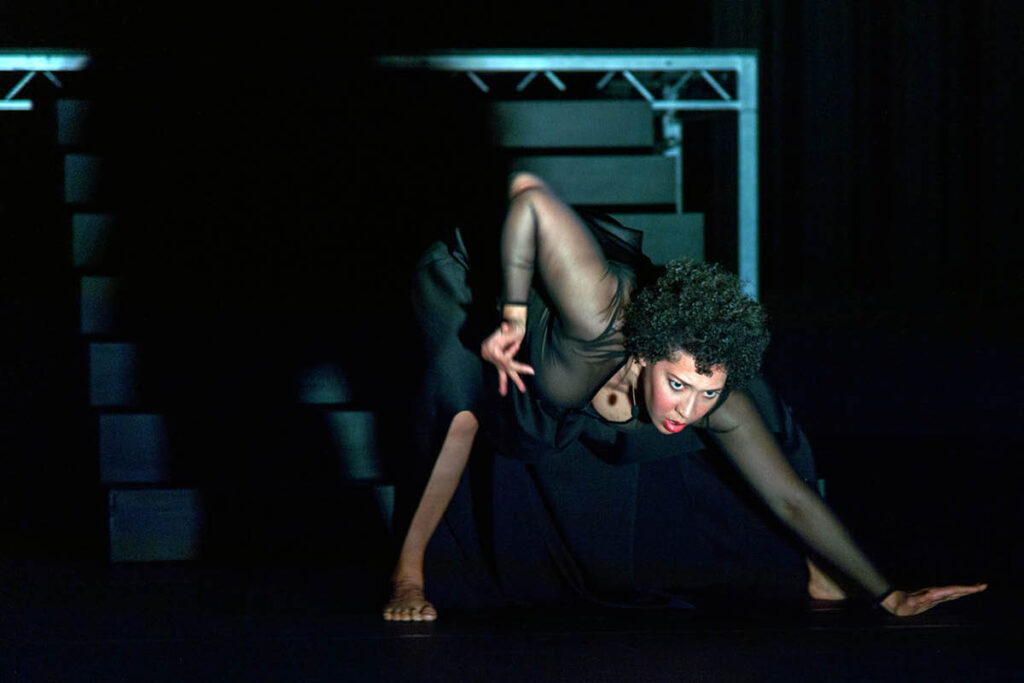
Musically, too, there is a great deal of improvisation in the work, which has evolved accordingly with each iteration.
“The way that the music is written, a lot is transcribed, but then there are these open sections of improvisation,” Bullock explains. “Early on, Tyshawn just had me singing the original melody, even though all of the rest of the instrumentation had been totally broken apart and fractured. Before we did it at the Metropolitan Museum, I said, ‘I think I want to be more incorporated into the texture, and if you don’t want to do it, do you mind if I start experimenting?’ He replied, ‘Experiment as you want, but I hear you and please let me do it. And he did.’”
This improvisational approach, which Sellars considers foundational, means that Perle Noire: Meditations for Joséphine is constantly evolving.
He recalls that the version at the Ojai festival was much longer than anybody could have guessed. “We then started to work on it in performance,” he says, with Bullock and Sorey touring it in cabaret across America. “They performed it quite a lot as a concert, and then Julia did it on the grand marble staircase of the Metropolitan Museum of Art in New York City, with Zach Winokur putting the production together. That was quite an experience.”
Since then, Sellars says the piece has continued to evolve, from the Dutch National Opera and the version that will be presented at the Adelaide Festival, to a planned production at the Paris Opera.
Asked if they’re taking a leaf out of the Metropolitan Museum’s performance and mounting it on the grand staircase of the Palais Garnier, Sellars laughs, “No, Julia has done her stair work.”
He says the ever-changing, improvisational nature of Perle Noire, including the music and choreography, is a hallmark of Black culture. “That’s the difference between the commercialisation and music-hall stuff, which is quite formulaic, and what it is to actually go off formula and say, ‘This is an incantation, and we’re releasing something that is going to have a much bigger and more powerful life than just a moment’s entertainment.’”
“Julia is one of the performers of a generation . . . she is unique and overwhelming; I mean, talk about star power!”
According to Sellars, much of the work’s success is thanks to his long-time collaborator, choreographer Michael Schumacher.
“Michael is one of the great, great improvisatory dancers of his generation and has taught improvisation all over the world,” he says. “Michael and Julia have had a long history, and they trust each other. He has a great way of seeing what Julia is doing in her body and then taking that to the next level, and giving Julia a way to live in it that’s utterly convincing but also truly upping the level of danger and the way content suddenly looms.”
In this way, both Sellars and Bullock hope to interrogate and debunk the stereotypes associated with Baker.
“We all know the history of those racist gestures . . . the jungle stuff that was the backbone of Joséphine Baker’s early Paris performances,” Sellars says. “But what is that about, and what does that mean? Who’s saying what to whom, and who’s seeing what? When somebody does something, what is at stake, who’s entertained and who’s entertaining?”
Bullock admits that, on stage, risk is always present, and with each performance her gestures grow more “exciting and confrontational”.
Sellars believes this is why Perle Noire: Meditations for Joséphine is the antithesis of entertainment.
“In America, we have this incredible thing of inventing ‘entertainment’, which is how to make three hours go away, versus my thing, which is focus and how to give three hours meaning. ‘Entertainment’ is about being zoned out, and that’s your pleasure, but of course, this is the opposite. It’s focusing on what this means, what it’s about and what you’re actually feeling, as well as why you are feeling it and where those feelings are coming from. It’s super intense, and at the same time, it’s done with a kind of virtuosity that takes you into the danger zone with brilliance and aplomb.”
“That’s what opera is about,” Sellars adds. “If you’re going to go into a dangerous place, you have to show people you’ve got the chops, and it has to be stunningly realised. That’s Julia’s specialty, and Tyshawn just takes your breath away with his stunning improvisations.”
The Reluctant Poet
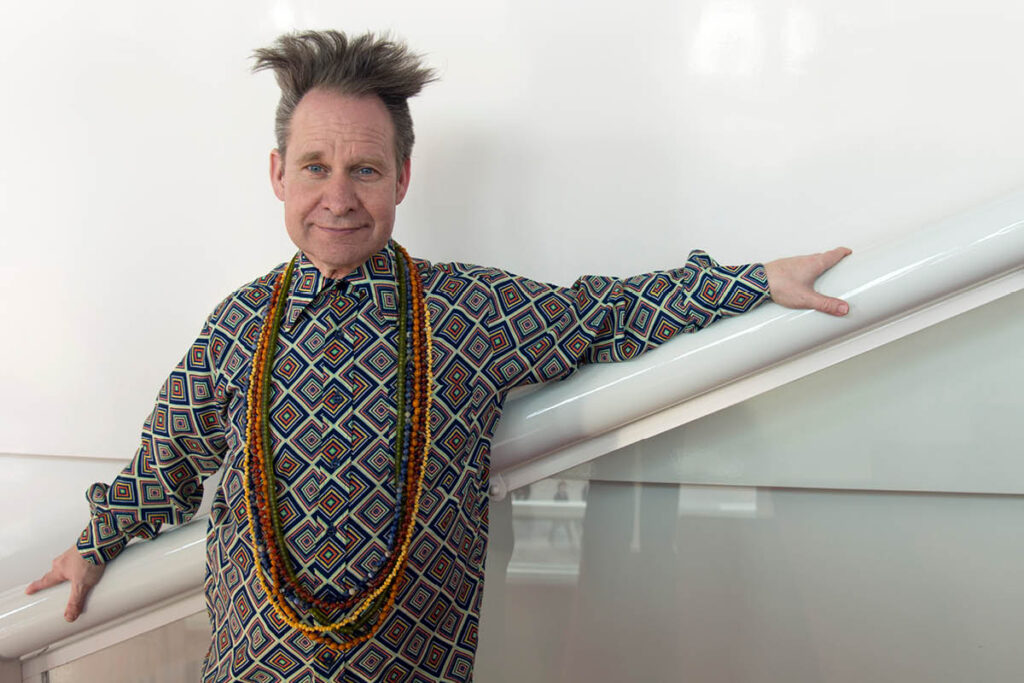
During the development of Perle Noire: Meditations for Joséphine, Sellars says, “It became clear that we didn’t want it to be a variety show. The songs needed to be linked in some way, and that’s when I invited Claudia [Rankine] to step in.”
Some accounts suggest the decorated Jamaican-American poet, essayist and playwright was initially reluctant to come on board. Asked if this is true, Sellars replies, “Oh, not merely reluctant; she was appalled.”
“It was not Claudia’s idea of Black activism,” he explains. “Even though Joséphine was the only woman to stand and speak at the March on Washington next to Martin Luther King, nonetheless she was a strange icon of the civil rights movement, and that was not Claudia’s idea of the way forward. So, Claudia really dug into the research, and just as a Black woman who says what’s on her mind, she gave Joséphine that chance to say things she never said in public at least. Joséphine can finally get them off her chest without having to charm and endlessly sing for her supper.”
He continues, “Claudia wrote eloquently, sharply, with a kind of wide, open-eyed intensity, and when Julia speaks these poems, it is a direct challenge to the audience and lets this woman challenge the hand that fed her, so to speak.”
These works are very much about legacy, activism and confronting history through the voice and body.
Observing that in today’s world, celebrity grants Black performers presence, fame and money but not necessarily their souls, Sellars says, “Claudia has gone there; Joséphine’s soul is present,” and as he sees it, that’s another level of power.
For Bullock, one of the most profound contributions Rankine made was to acknowledge Baker’s desire to raise a family. (Baker was unable to have children of her own and famously adopted 12 children she referred to as her “Rainbow Tribe”.)
“Claudia wrote some text [a lullaby] about Joséphine Baker’s children, which was very moving, but at the time, we didn’t have a piece of music to punctuate it. Tyshawn has since had two children and I’ve had a baby, so when we got together for [the season at] Dutch National Opera, we were really adamant about wanting to represent this very important aspect of her life, and what I think was her life’s work and mission.”
At the same time, Bullock was reading about women who had been lynched in the US. “In one case, a woman who was seven months pregnant spoke out the day after her husband was lynched. This mob tracked her down, strung her up from a tree and sliced her belly open. The reason we even know the details of this is because the mob reported it to the newspaper the next day. It’s really graphic. They burned her alive and stomped on the baby after it cried out.”
Bullock remembers recounting this horrific piece of history at rehearsal the following day. “Tyshawn’s face turned to stone, and he just said, ‘You know, I don’t think I can play any music right now, but this is the lullaby to do.’”
El Niño: Nativity Reconsidered
Themes of motherhood also lie at the heart of Bullock’s other performance at next year’s Adelaide Festival, El Niño: Nativity Reconsidered – her chamber reworking of John Adams and Peter Sellars’ oratorio, which had its Australian premiere at the 2002 Adelaide Festival for which Sellars was the Artistic Director.
El Niño was originally composed in 2000 by Adams, who wanted to create his own Messiah and meditate not only on the Nativity of Christ but also on the miracle of birth in general. Following the Biblical narrative with alternating narration, arias and choruses, Adams incorporated non-Biblical texts, especially women’s voices and Latin American poets including Sor Juana Inés de la Cruz, Rosario Castellanos and Gabriela Mistral, alongside texts from the Apocrypha, a sermon by Martin Luther and a hymn by Hildegard von Bingen.
“El Niño is how I first got introduced to John’s work,” Bullock says. “It was because he and Peter were looking for a soprano to sing it in a performance with the New York Phil, which ended up not materialising because they couldn’t secure the funds to do it. I spent time sitting alone and listening to it, and I was in tears in a library cubicle at Juilliard.”
“I had worked with Peter on The Indian Queen by Purcell at that point,” she continues. “I’m not sure if he mentioned me to John, but we had a wonderful 30-minute meeting, and I think I might have even sung one of the Joséphine Baker tunes for him. From that moment forward, he invited me to participate in a lot of things.”
Hailed by The New York Times as “intimate, affecting and quietly rich with activism”, this new reduced version, arranged by Bullock’s husband Christian Reif, premiered as part of Bullock’s 2018 Artist Residency at the Metropolitan Museum of Art.
“I believe in giving more options so more people can share this music, from churches or sacred spaces to museums to concert halls,” she says, explaining the reason for creating a cut-down version. “I was just annoyed that this work, which had activated my system so intensely, and that I really wanted to share with more people, was either rescheduled or cancelled because of the lack of resources within these larger institutions. So, when I got the invitation to be the Artist in Residence at the Met Museum in New York, I asked, ‘Could we do El Niño?’ to which they replied, ‘If the New York Phil can’t afford this, neither can we.’ But then they said, ‘We have an opening in the Cloisters around the holidays. Could you put a program together?’”
Bullock continues, “I spent a day going through the score, trying to tell the Nativity story straight through without any sidebars. I was told I had to keep it to within an hour and there could only be so many performers on stage [the orchestration is for 12 musicians]. I selected the musical numbers and wrote to Peter and John, who gave me their blessing.”
Describing the revised version in a program note, Bullock wrote: “Traditions develop out of passionate reactions to events. The Nativity story and themes that surround it have preoccupied us for centuries – there are miraculous aspects we celebrate like the unique relationship between birthing parent and child, and acts of generosity through gift giving; held alongside the challenging realities of genocide, forced displacement and how the promise of new, or liberated, life is often accompanied by a threat and enactment of violence. That’s part of why, at the end of each calendar year, we seek out opportunities to consider the past cycles we find inescapable.”
For Sellars, the staging of El Niño: Nativity Reconsidered and Perle Noire: Meditations for Joséphine at next year’s Adelaide Festival is something of a full-circle moment and a vindication, after his 2002 program for the Festival came under fire for its focus on multiculturalism and Indigenous cultures, resulting in his resignation as Artistic Director.
“I spent three years meeting astonishing Australian artists, and I met a new generation of Australians,” he recalls. “What was in that program was what they wanted to see, what they wanted to present, what they wanted to say. It wasn’t anything I’d cooked up.”
“That generation has moved forward, and what’s thrilling is they’re now in places where they are in charge, and what we’re now seeing every day, everywhere, was their vision, and I’m very thrilled to have been a part of that.”
He adds, “I have to say there’s something karmic about a weird American with funny hair having to leave so that Australians could step up to the microphone and say, ‘This is what we’re doing.’ And I think that’s what happened. Suddenly, the people who needed to claim it stepped forward and it was theirs. Of course, as with every historical moment, there had to be some blood on the altar, and Perle Noire is generated from the same thing. It isn’t just me; it’s the combined voices of Julia, Claudia and Tyshawn, and I’m very much a minority stakeholder. The power lies in these artists gathering and collectively raising their voices.”
The irony of being included in next year’s Adelaide Festival isn’t lost on Sellars either. “In 2002, I talked about the problem of white supremacy and got pushback. Now, 23 years later, one of the centrepieces of the Festival is the direct opposite.”
The Adelaide Festival presents Perle Noire: Meditations for Joséphine at Her Majesty’s Theatre, 1–4 March, 2026; Tyshawn Sorey in concert at Her Majesty’s Theatre, 2 March; and El Niño: Nativity Reconsidered at Adelaide Town Hall, 12 March.






Comments
Log in to start the conversation.