From Ancient Rome to a 1980s nightclub frequented by the mafioso – it’s not that great a leap, says Sam Strong, who is directing a new production of Monteverdi’s opera The Coronation of Poppea for Victorian Opera.
Both worlds simmer with violence, burning lust, treachery and “a flagrant amorality”, as Strong puts it. Passions erupt and blood is quickly spilled.
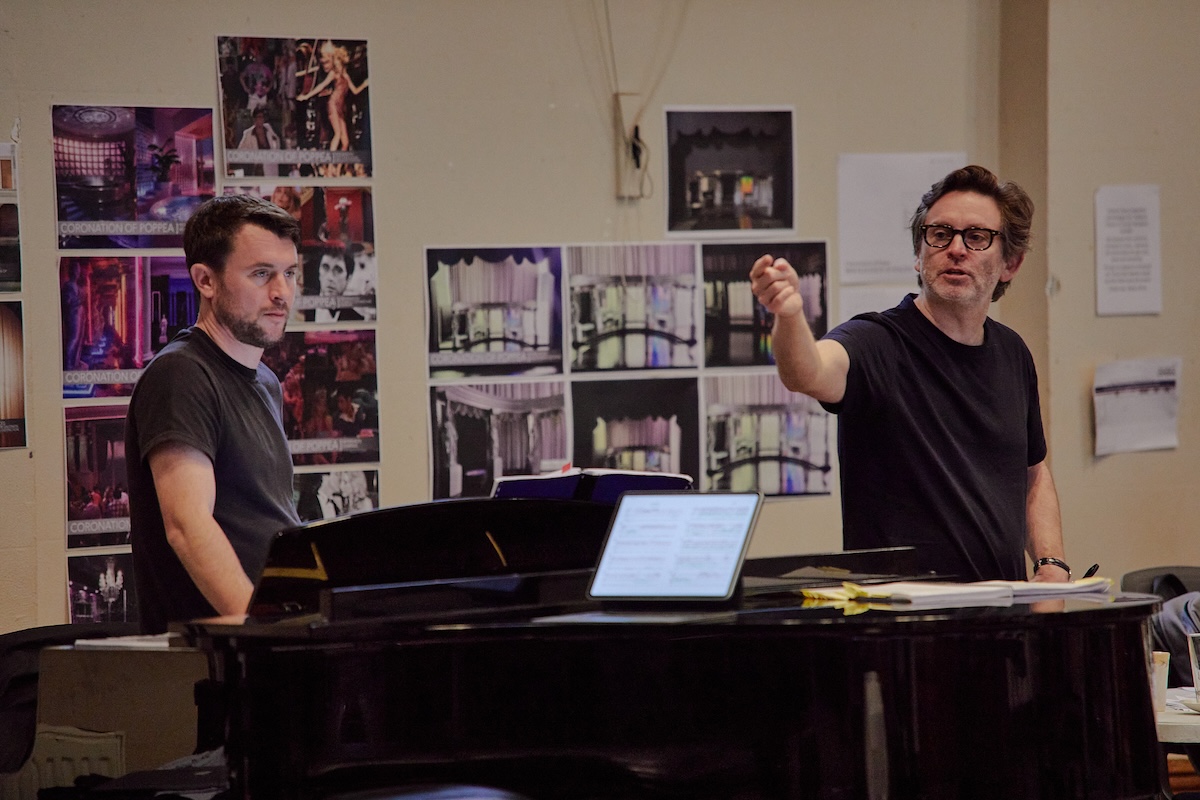
Chad Kelly and Sam Strong at rehearsals for Victorian Opera’s new production of The Coronation of Poppea. Photo © Casey Horsfield
The contemporary spirit of the production will be further enhanced by the use of Elena Kats-Chernin’s jazz-influenced orchestral rearrangement, conducted by Chad Kelly.
L’incoronazione de Poppea (The Coronation of Poppea) was Monteverdi’s last opera, with a libretto by Giovanni Francesco Busenello. One of the masterpieces of the early Baroque, it was first performed in Venice in 1643. Set in Nero’s Rome, it follows the ruthless ascent of the ambitious, power-hungry Poppea (Nero’s lover) to the Imperial throne.
The original manuscript no longer exists and the two surviving copies from the 1650s have significant differences. Essentially, there is a singing line and a bass line.
Kats-Chernin’s reorchestration was instigated by Barrie Kosky. In his first season as Intendant at the Komische Oper in Berlin in 2012, he staged a Monteverdi trilogy featuring three new orchestrations, for which he commissioned Kats-Chernin. In 2017, the Komische Oper staged a revised version of her Poppea.
Speaking to Limelight in 2023, Kats-Chernin said that when working on her orchestration, she “interpreted loosely” but stayed “within the frame. I never changed the bass line. I was now allowed to. That was a given. That’s Monteverdi.”
“We took it into the modern world. It has a jazzy favour, which Barrie wanted. It’s a sexy opera, all about lust and love and hate and jealousy. And a lot of deceit and lies. It’s very juicy.”

Elena Kats-Chernin. Photo © Jacintha Nolte
Chatting to Limelight, Kelly says that Victorian Opera is using a newly revised version. “Elena’s updated things, so it’s actually a bespoke orchestration for this VO [season]. We’re not recreating what they did at the Komische Oper. It’s a living organism. It’s great to have that artistic licence, specifically with Monteverdi, where the musical decisions and orchestration can be informed by the production we’re doing.”
Strong says he is thrilled to be working with Kats-Chernin’s score. “When I first encountered [Monteverdi’s opera], I was struck by how contemporary it felt in terms of the intensity and variety of its appetites and its flagrant amorality. Elena’s taken that contemporary spirit and amplified it through her wonderful orchestration and astute set of story edits.”
That streamlining helps focus the story and the central relationships. As Strong explains, “In [the Baroque] era, they tended to include subplots that are thematically linked but don’t necessarily add an enormous amount. So, in removing some of the [secondary] characters, we are able to focus on the relationships that are the most dynamic and mean the most.”
“Through that process, we’ve been able to fashion an opera that speaks more to a contemporary attention span and the way we take in information. For example, in the original version, the Seneca character finds out he is going to die on three or four separate occasions from different people, two of whom are gods. It’s more dramatically effective, if he finds out once from a person with whom he has a relationship, so it’s just bringing a more contemporary sensibility to the storytelling.”
In deciding when and where to set the production, Strong and his designer Anna Cordingley set out to find the most potent contemporary equivalent of Ancient Rome and decided that a sense of real danger was a requisite.
“[The opera] is set in a world where you can be killed randomly at any moment,” says Strong. “It is full of sex and desire; a universe where the characters are driven, and driven mad by lust. So, we tried to find a world that captured that intensity and landed on Brian De Palma’s [1983] film Scarface with its Babylon Club,” says Strong.

“One of the great things about Scarface is that it is so coherent and visually strong, so that was a fantastic leaping off point.”
As Kelly points out, “the danger, death and violence, and the innuendo, scheming and manipulation happening in Ancient Rome – at least our perception of it – was happening in the mid-17th century in Italy as well, so it’s not just that it’s contemporary; it’s kind of universal.”
Musically, the production won’t sound anything like John Eliot Gardiner’s renowned 1996 recording with The English Baroque Soloists or René Jacobs’ equally famous 2010 recording with Concerto Vocale.
“But you will hear the spirit and essence of Monteverdi’s music through the lens of a slightly different sound world, with a different colour palette,” says Kelly.
As he explains, in Monteverdi’s day, you would have heard “a continuo group that essentially improvised as it reacted to the action on stage. You would have had a number of plucked instruments – triple harps, theorbos, chitarrones and at least one harpsichord, maybe two, and probably a chamber organ as well. And you would probably have had a wind and brass band, which would have been sackbuts and cornets.”
“In Elena’s updating with its leaning towards tango-y, Latin-y rhythms and flavours, a traditional continuo group would have been at odds. It would have been like two separate worlds colliding rather than speaking to each other. So, instead of playing a harpsichord, I’m playing a modern piano and we have a modern harp. We do have a theorbo, but we have an electric guitar – which was Elena’s idea – and instead of a chamber organ, we’ve got a synthesiser.”
“When you combine that with lots of pizzicato bass, it sounds a bit like a five-piece jazz band, or a Latin funk band, which feels completely fitting.”
Monteverdi wrote Nero for a castrato. In the VO version, he is played by Australian baritone Samuel Dundas, who stars opposite Puerto Rican soprano Meechot Marrero as the scheming Poppea. The strong supporting cast includes Jeremy Kleeman as the lovelorn Otto, Margaret Trubiano as Ottavia and David Greco as Seneca.
Asked about casting a baritone in the role of Nero, rather than assigning it to a countertenor or soprano, Strong says, “I think it makes it feel like a more dangerous world when you have that kind of masculine energy.”
Kelly agrees. “I think that to have the three main male roles – Nero, Ottone and Seneca – sung by baritones and basses, as opposed to countertenors, adds to the realism.”
The Victorian Opera production of The Coronation of Poppea plays at the Palais Theatre, Melbourne, 30 June – 4 July. More information here.

Comments
Log in to start the conversation.