


Look closely at Charles Brooks’ photographs and you might find yourself somewhere unexpected.
A vast timber chamber, its walls bearing the marks of centuries of craftsmanship, might suggest the interior of a sailing ship.
A gleaming metallic passageway could be a tunnel beneath some sci-fi metropolis.
An otherworldly chamber, bathed in slanted shafts of light, feels like the foyer of an improbably ambitious opera house.
But these are not ships, landscapes or conceptual sketches for new architectural spaces. They are the insides of musical instruments. The wooden chamber is an 18th-century cello. The metallic tunnel is that of a concert flute. The otherworldly chamber? Part of a grand piano.
The extraordinary architectural vistas in Brooks’ Architecture In Music series are created from spaces that, in reality, are only centimetres – and often less – wide.
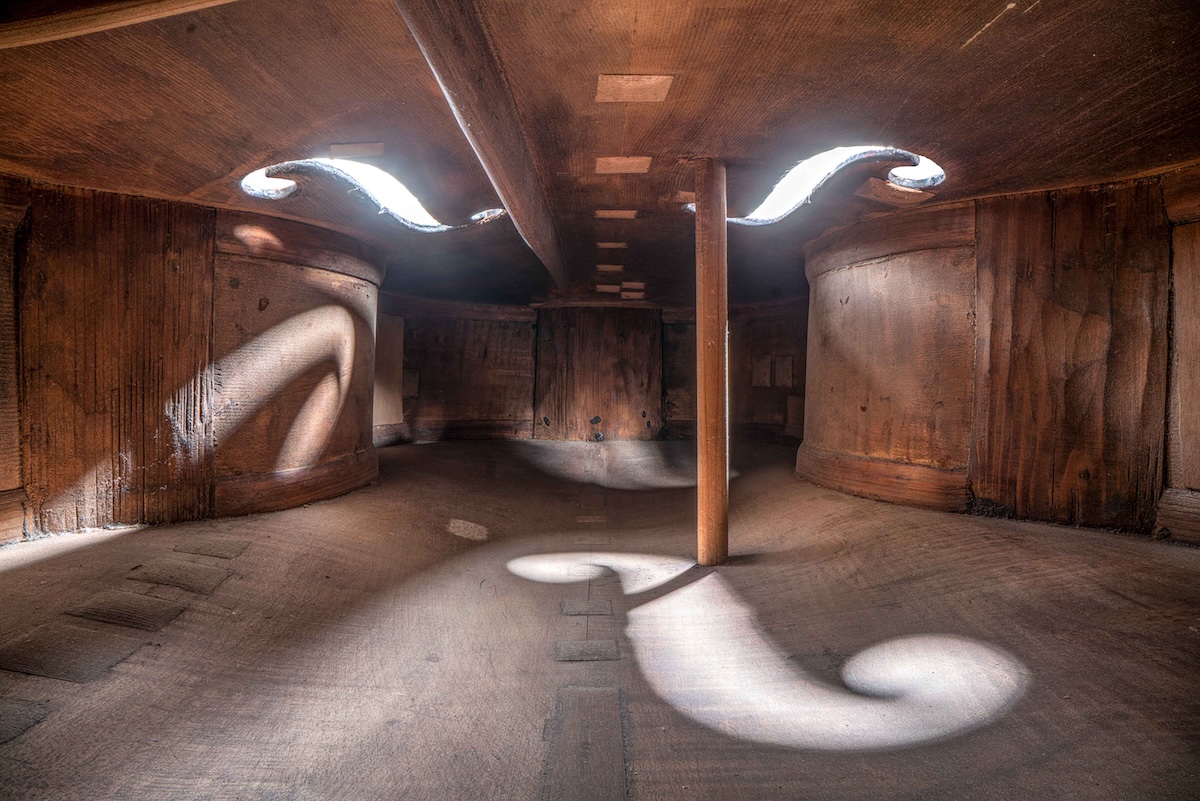
Interior of a Lockey Hill cello, circa 1780. Photo © Charles Brooks
Since beginning the project in 2021, the Australian-based photographer and former professional cellist has turned his attention to an ever-expanding collection of instruments, from antique stringed instruments to modern grand pianos, brass, woodwind and percussion. His images have been reproduced millions of times around the world, exhibited internationally and attracted an audience well beyond the musical community.
Now, five years after the project began, Architecture In Music is making its Australian exhibition debut in Adelaide’s Immersive Light and Art (ILA), opening on 13 November.
Significantly, the exhibition introduces a new immersive experience, taking Brooks’ photographs beyond their traditional frames. Here they will be viewed on 110 square metres of LED screens.
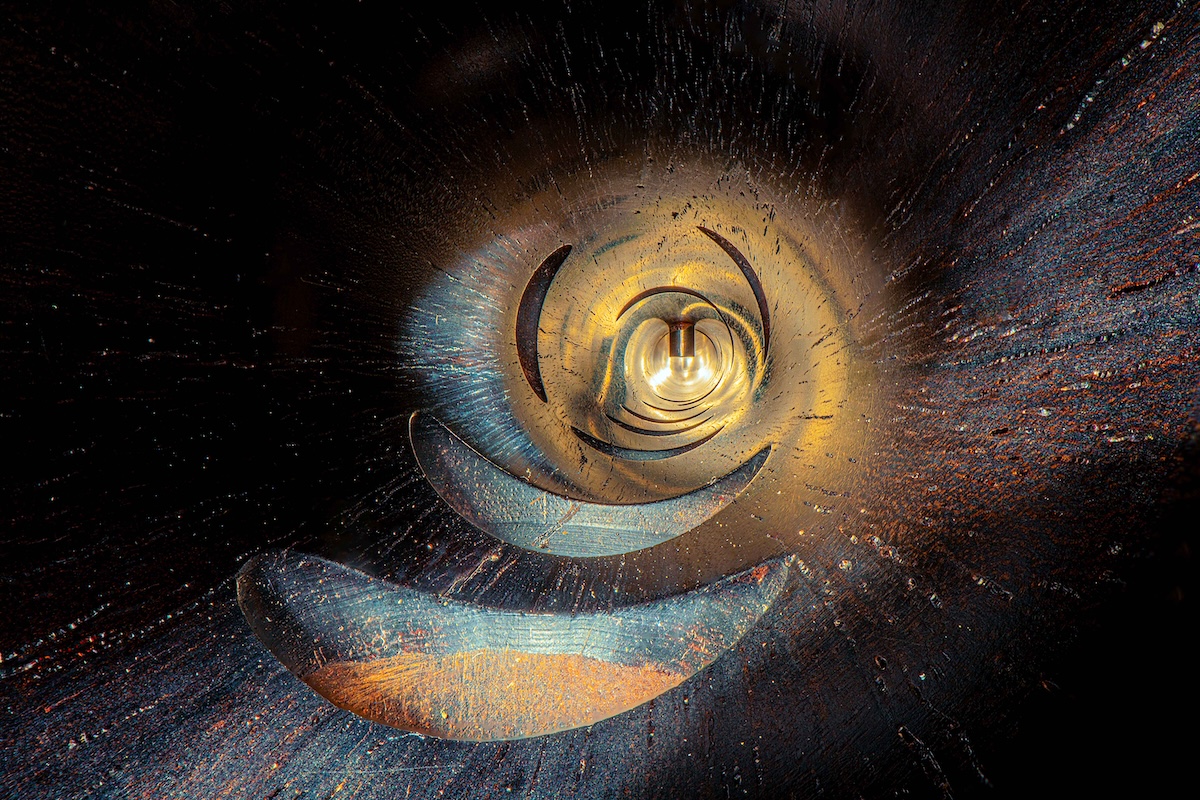
Interior of a bass clarinet. Photo © Charles Brooks
For an artist whose work has always invited viewers to imagine themselves entering these miniature worlds, the opportunity to make that experience physical is an intriguing development.
“It really does look like architecture when you experience these images at this scale,” Brooks tells Limelight. “This is as close as we can get right now to making you feel like you are stepping into the picture, into an instrument.”
Even Brooks has been surprised by the difference between seeing one of his images in print and experiencing it on a massive, high-definition screen.
“Printing is wonderful, but it’s not the same as having that kind of light actually coming at you.”
Music from the inside
Before turning his attention to the interiors of instruments, Brooks spent 20 years working as a concert cellist. Photography was already part of his professional life, although he mostly photographed musicians. When COVID brought performances and photographic commissions to a halt, he began looking for other ways to work with the musical community.
“With my background as a cellist, I thought I could maybe start doing some product photography for some of the local luthiers I knew,” he recalls.
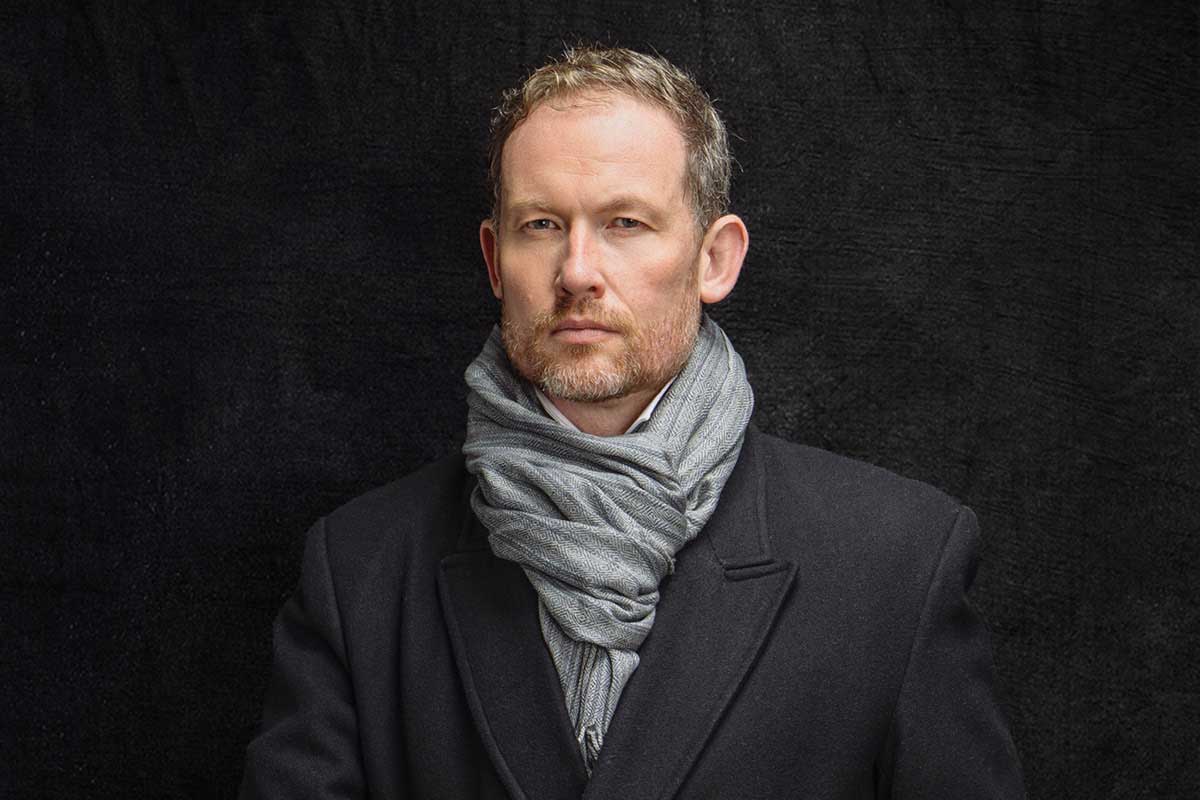
Charles Brooks. Photo supplied
Around the same time, he became aware of specialised camera lenses mounted on narrow, probe-like instruments, capable of capturing extremely high-resolution images in confined spaces. He acquired one and began experimenting with saxophones and flutes.
The response was encouraging enough to prompt him to approach an Auckland instrument maker about photographing an exceptional cello then undergoing restoration. Made by London luthier Lockey Hill in 1780, it offered Brooks an opportunity to explore a much older and more complex interior.
The resulting photograph changed the direction of his practice.
“You are able to see the hand of the maker in there, the chisel marks,” he says. “You can picture his hand shaving off bits of wood here and there. You can see what gives the instrument its character – the stuff you don’t see on the outside, which is all polished and refined.”
More than a record of craftsmanship, the photograph revealed the instrument’s accumulated history. Its interior contained evidence of repairs and alterations made over generations, the physical traces of the work required to keep it alive.
“When people talk about an instrument’s particular voice and tone, this is what they are talking about. It really is a physical thing.”
It is this capacity to reveal the hidden lives of instruments that gives the series much of its appeal. The photographs are visually arresting, but they also offer a different way of thinking about musical objects. An instrument is not simply an elegant exterior or a vehicle for producing sound. It is the product of materials, decisions, compromises, repairs and accumulated history.
Achieving that perspective, however, is anything but straightforward.
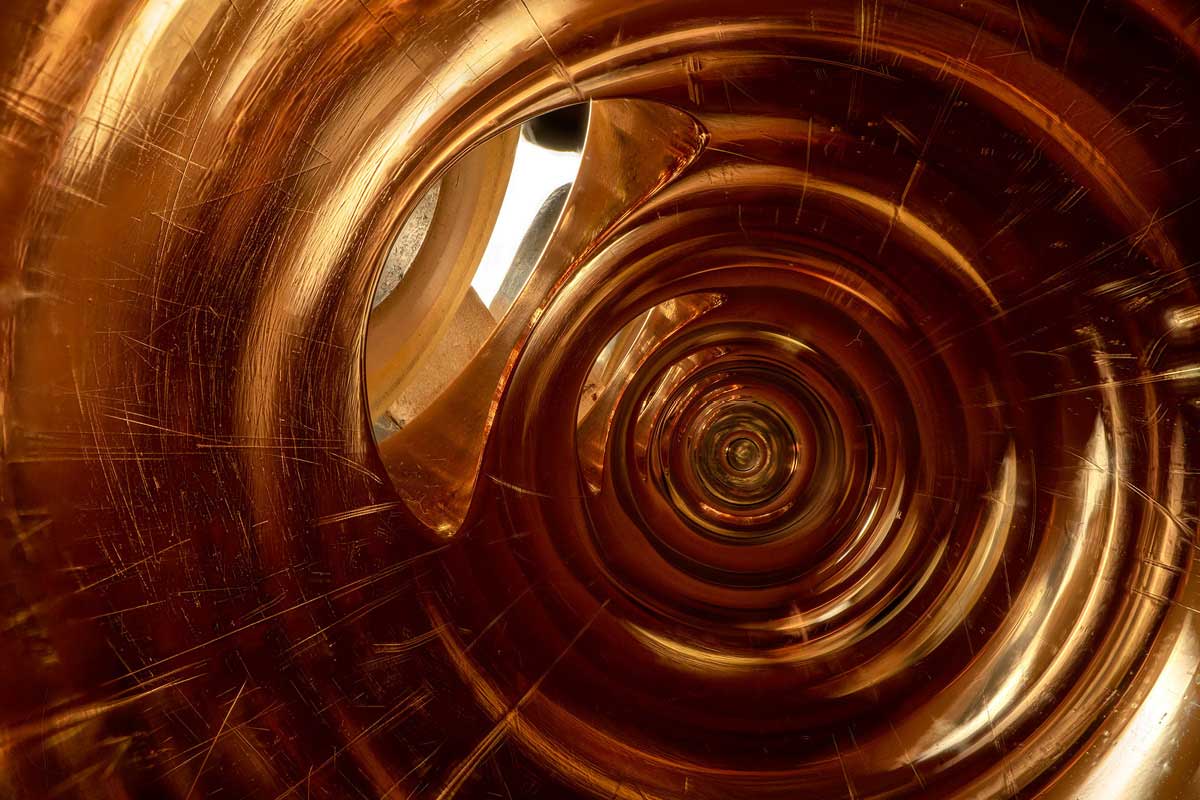
The interior of a Burkart Elite flute in 14K rose gold. Photo © Charles Brooks
Brooks uses specially adapted medical endoscopes, probe lenses and custom-built equipment to photograph an instrument through its natural openings. What appears to be a single photograph is actually a composite of dozens, sometimes hundreds or even a thousand individual images, assembled using specialist software.
The process can take up to 12 hours for a single image and patience is more than a virtue; it’s an absolute necessity, Brooks says.
“As a musician you understand that good things don’t come straight away. Sometimes you have to work long and hard to get it right.”
Among his more recent subjects is a Stradivarius violin, an experience he describes as fascinating less for its spectacular appearance than for the historical significance of the instrument. Made in the early 18th century, it represents the model from which countless subsequent violins have taken their cues.
“It’s like looking at the original, looking at the blueprint,” he says. “And just the kind of mystique of thinking, ‘wow, I’m looking in something that was made in 1715, and has been through all these famous hands and all this history’.”
Working with Orchestra Victoria has provided another source of discoveries. Brooks has been exploring the orchestra’s instrument collection, including some objects that present rather different photographic challenges.
A pair of Zildjian cymbals, for example, offered no conventional interior to investigate. Instead, he positioned them close together and photographed through the narrow space between them, creating the impression of a moment suspended just before the two surfaces collide.
The resulting image captures the metallic landscape and reflected light of the cymbals, transforming a familiar percussion instrument into something almost cosmic.
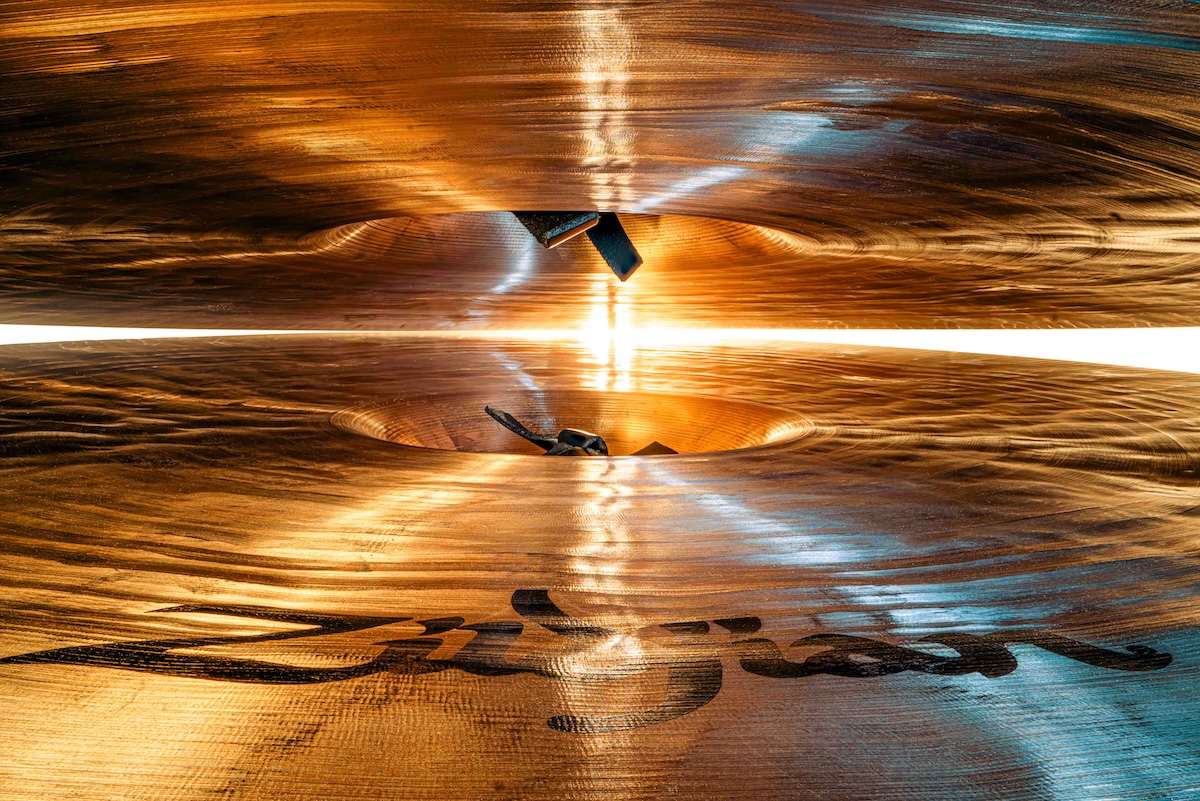
Zildjan concert cymbals. Photo © Charles Brooks
Brooks’ work has also taken him in unexpected directions, including a collaboration with the Australian Nuclear Science and Technology Organisation (ANSTO), which saw him photographing the insides of its particle accelerator. There, he found an unexpected connection between scientific machinery and musical instruments.
The accelerator’s enormous structure contains a narrow passage through which electrons travel. To Brooks, its underlying principles suggested a remarkable comparison.
“It’s essentially a giant flute!” he says. “It’s doing the same thing as a flute is, except it’s doing it at the speed of light instead of the speed of sound.”
The project has also grown into a substantial publishing enterprise. Brooks has recently released a large-format book featuring around 130 pages of photographs, with individual instruments given expansive double-page spreads alongside information about their histories and the photographic process. The first print run of 6,000 copies sold through a Kickstarter campaign, and a second edition is now in the works.
As for what comes after Immersive Light and Art, Brooks has no shortage of possibilities. “I think I can continue doing this basically as long as there are instruments,” he says. “And there are a lot of instruments in the world.”
Architecture in Music opens at Immersive Light and Art, Adelaide on 13 November, continuing until 5 December. Information and bookings here.
Guitarist Slava Grigoryan and cellist Sharon Grigoryan will perform live at the exhibition on 26 November.




Comments
Log in to start the conversation.