Mendelssohn’s Violin Concerto begins with extraordinary immediacy. Think of it as an Olympic high dive.
After the briefest of orchestral breaths, the solo violin enters with its unforgettable lyrical theme – a phrase full of longing and urgency. Playing it in front of a packed concert hall is not for the faint of heart.
For the American violinist Benjamin Beilman, however, that do-or-die immediacy is one of the great attractions of the work.
“You warm up backstage, you take a nice bow, you meet the concertmaster, and then about a second and a half after the orchestra begins, you go. You can’t get cold.”
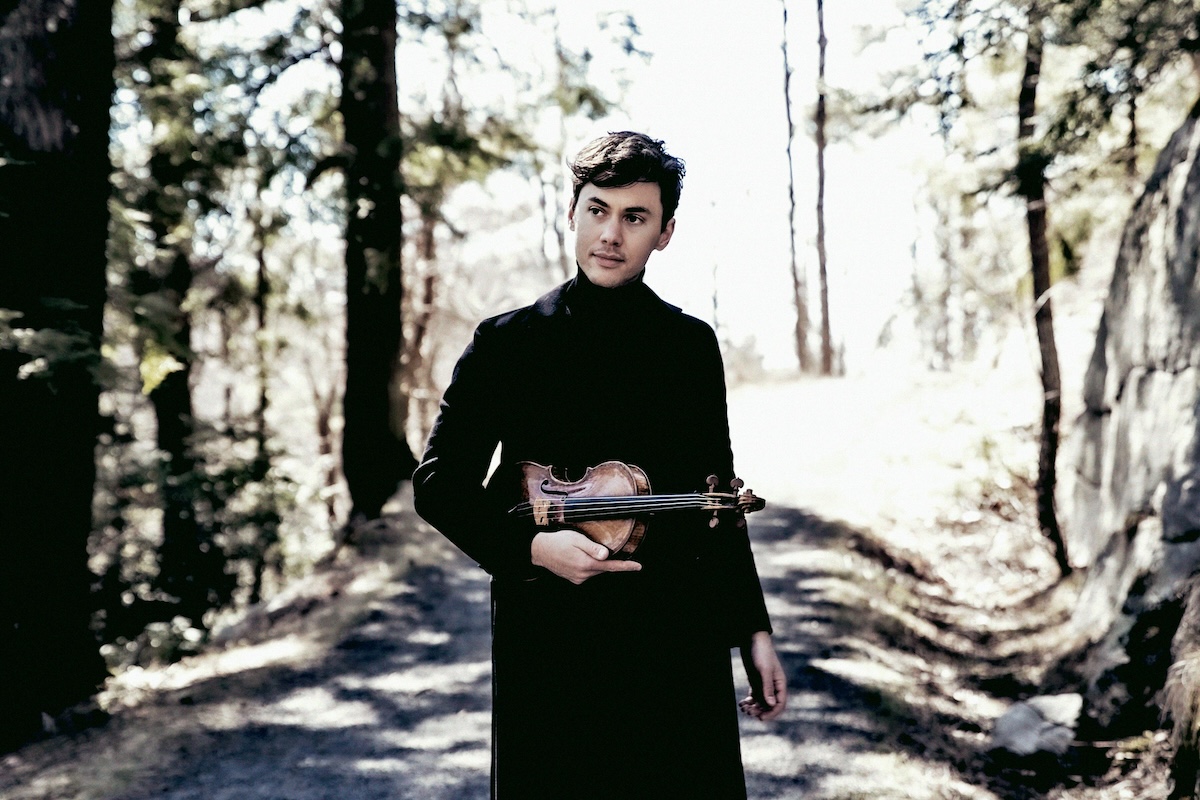
Benjamin Beilman. Portrait supplied
Beilman is returning to Australia to perform Mendelssohn’s Violin Concerto with acclaimed Norwegian conductor Tabita Berglund, in a program that places the concerto alongside two works connected by a fascinating musical conversation: Schubert’s famously unfinished Symphony No. 8 and Passacaglia by Norwegian composer Ludvig Irgens-Jensen.
Beilman made his official Australian debut in October 2016, embarking on a nationwide recital tour with pianist Andrew Tyson under Musica Viva. Shortly after, he made his Australian concerto debut with the Sydney Symphony Orchestra performing Jennifer Higdon’s Violin Concerto. Those performances played a part in Beilman’s establishing himself as one of the most compelling violinists of his generation.
Praised by The Washington Post as “mightily impressive”, he combines technical brilliance with a searching musical curiosity – qualities perfectly suited to Mendelssohn’s concerto, a work that balances Classical elegance and rigour with the emotional freedom of the emerging Romantic era.
“It’s one of those concertos given to young performers,” Beilman says. “It’s so often the debut piece for a young violinist, and I think that makes sense because there’s a freshness and an innocence and an agility to it.”
Beilman first encountered the concerto, like many violinists, as a teenager.
“I came to it when I was about 12, and it’s woven in and out of my history ever since,” he says. “But I think there’s something new I’m discovering now that I’m no longer a debutant. I’m in my mid-30s now and a new father. I have a very different perspective now on innocence and childlike awe.”
That sense of wonder is central to his interpretation. Mendelssohn’s concerto is often admired for its seamless structure and its seemingly effortless beauty, but beneath the surface lies a remarkable emotional sophistication.
“I don’t find I have to do any special moves to make it make sense to people,” Beilman says. “Mendelssohn is so adept at weaving this structure underneath. People understand the impetuousness of the opening, a kind of passion, which then gives way to this incredibly beautiful, innocent, almost chorale-like section. It’s perfection, basically.”
The second movement brings another kind of intimacy, which Beilman describes almost as a lullaby, before the finale fizzes with energy.
“The third movement is just as nimble and as light and as bubbly as one could possibly get,” he says. “But in terms of what I tell myself before I walk on stage, it’s very much: allow yourself to be as impassioned as possible without ever breaking that very thin membrane that allows everything to float – kind of fairy Midsummer Night’s Dream-esque – above.”

Benjamin Beilman and the West Australian Symphony Orchestra in 2023. Photo © Daniel James Grant
Beilman will be playing the piece on a violin with a remarkable history: the 1740 Guarneri del Gesù known as the “Ysaÿe”.
The instrument was created in Cremona by Giuseppe Guarneri, one of the greatest violin makers of all time, and was famously played by Belgian virtuoso Eugène Ysaÿe, as well as later by figures including Isaac Stern (who, incidentally, played Ysaÿe in a 1953 Hollywood biopic, Tonight We Sing) and Itzhak Perlman.
Beilman has played the instrument for almost four years after coming to it from a Stradivarius.
“I always thought I would be a Stradivarius player, kind of in my persona,” he says. “But after coming back to this instrument – and I played on several del Gesùs before – there’s nothing quite like this. This is just so much easier.”
The difference, he explains, is not simply about sound, but about the relationship between player and instrument.
“Stradivarius – the tone is angelic, it’s golden, it’s beautiful. Some of the most beautiful sounds you’ve ever heard. But it will not be played in a way that is not conducive to what it tells you to do. Whereas Guarneri del Gesùs welcome the occasional physical playing style.”
“And the meeting period was much quicker for this violin because the instrument is just of such exceptional quality and calibre that you very quickly discover you can do new things,” he says.
After Ysaÿe’s ownership (“At his funeral it was displayed in front of his casket on a red velvet pillow. The violin itself has this incredible story,” Beilman says), it passed through the hands of other major musicians before becoming one of Isaac Stern’s primary concert instruments from the 1960s, resulting in numerous historic recordings.
Beilman has listened to many of them.
“I guess I was searching for what sounds were possible,” Beilman says. “And having someone like Stern playing Mendelssohn or Barber or whatever is just the best example you can get.”
Alongside Mendelssohn, Beilman reunites with conductor Tabita Berglund, whom he previously worked with in Vienna performing Sibelius’s Violin Concerto.
“From the first meeting, all throughout rehearsals and the concerts, I became her biggest fan,” he says. “I think she’s a force of nature, and I can’t wait to tackle this kind of music with her too.”
The program also explores the intriguing link between Schubert and Irgens-Jensen. Schubert’s Unfinished Symphony remains one of the most beloved incomplete masterpieces in classical music, its haunting opening and soaring melodies continuing to captivate audiences nearly two centuries after it was written.
Irgens-Jensen’s Passacaglia was composed as part of a competition seeking a companion work to complete Schubert’s unfinished symphonic vision. It offers a fascinating response: a piece shaped by respect for the past while revealing the voice of a distinctive Norwegian composer.
For Beilman, the challenge and appeal in Mendelssohn’s concerto never wears thin. Endlessly renewable, it reveals new possibilities every time it is performed.
“It has this freshness and innocence,” he says. “But the more you live with it, the more you discover beneath that surface. That’s what makes it such a great piece: it feels effortless, but there is so much life inside it.”
Benjamin Beilman performs Mendelssohn’s Violin Concerto with the Sydney Symphony Orchestra in the Concert Hall, Sydney Opera House on 9 July (7pm), 10 July (7pm), 2026 and 11 July (2pm).
He also performs Mendelssohn’s Violin Concerto with the West Australian Symphony Orchestra at Winthrop Hall, Perth on 3 and 4 July.

Comments
Log in to start the conversation.