No matter what your taste, there will be music by Alex Turley that you’ll probably enjoy. For those who lean contemporary, the Melbourne-based composer has penned orchestral arrangements for two different upcoming Melbourne Symphony Orchestra concerts – smouldering, 70s soul works for powerhouse vocalist Emma Donovan on 10 July, and the beat-driven, cinematic pop stylings of Vera Blue on 11 July.
“I love the craft of arranging. It’s so interesting to work with artists from different worlds, and Emma and Vera are poles apart. They’re two of Australia’s best vocalists, and each is a master of their own unique style,” Turley tells Limelight.
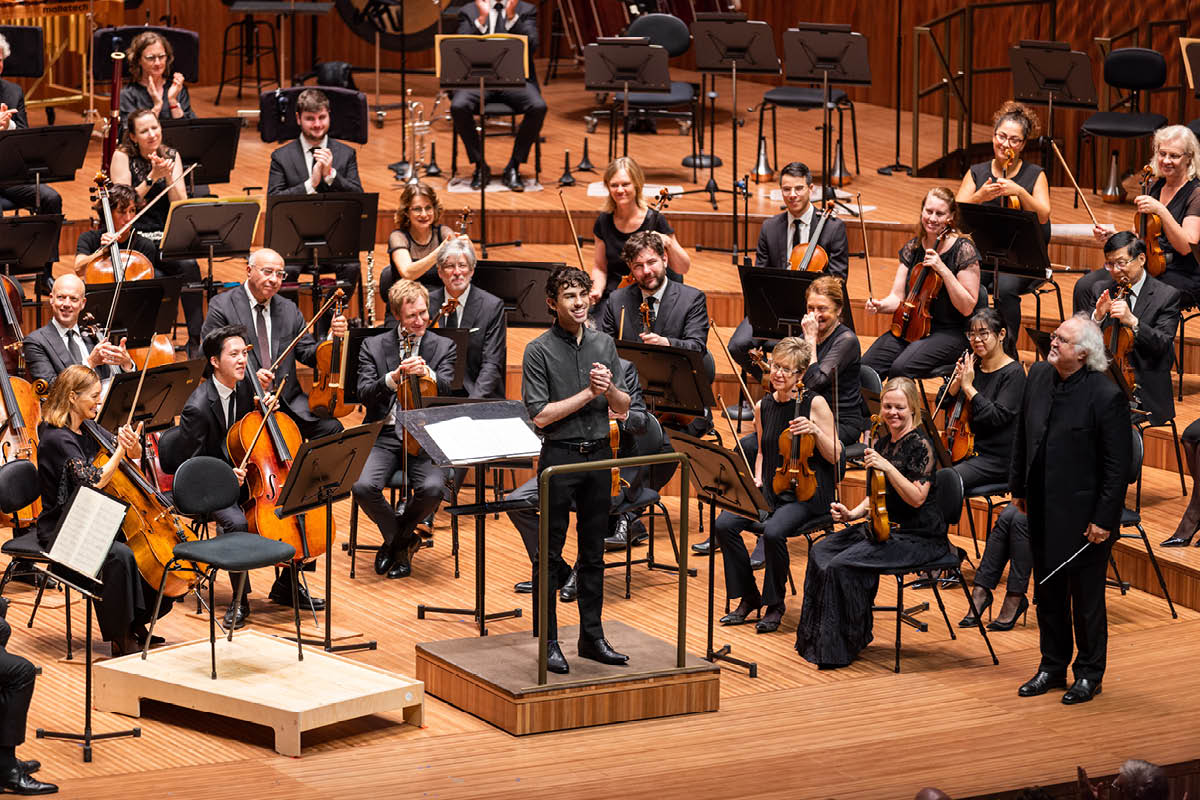
Alex Turley and the Sydney Symphony Orchestra. Photo © Craig Abercrombie
“With an arrangement, my priority is to give the orchestra a score that makes them look good. I want to show off the very best things that I love about orchestral music to people who might not be familiar with it. So that’s where I kind of go with it. “
For those who lean classical, however, there’s Turley’s Sonata for Violin and Piano, which will be aired in Adelaide and Brisbane in August and in Melbourne in November. His Animalia (a “portfolio of polystylism”) will also be performed by the Sydney Symphony Orchestra in a family concert in September.
“Each movement is a campy reference to some kind of style – the Saltwater Crocodile movement is this scary, Penderecki-style sound mass composition. I’m writing two new movements for this SSO concert – a new quokka and a new plankton movement.”
And what do plankton sound like?
“Actually, I’m calling it Plankton Bossa Nova,” he laughs. “I love Bossa Nova, and I had this cheeky idea to pair water-based texture effects with Antônio Carlos Jobim-style orchestration to represent the dance of plankton rising up and down between the ocean floor and the surface.”
As for the new stuff, audiences at this year’s Australian Festival of Chamber Music will also be able to see a world premiere work from Turley on 31 July: Substratum, a work for flautist Joshua Batty and a string quartet that’s inspired by the composer’s only visit to the festival’s new home of Cairns-Gimuy.
“I think my strongest memory of that trip is when I did a guided hike through a part of the Daintree Rainforest,” Turley says. “It has just the most incredible diversity of plants and animals that I didn’t even know we had because it’s so vastly different from the landscapes that I’m familiar with, growing up in Sydney and Perth. It’s a completely different world to Perth. “
Substratum means an underlying layer beneath a surface level; a foundation that supports all else above it; Turley’s work turns its attention to the incredible web of interactions that happen in the darkest, densest part of the rainforest.
“I’m thinking about the forest floor; dead leaves and plants biodegrading and feeding the rainforest. Like these interactions of roots and fungi and undergrowth, I want the flute to weave in and out of the music.”
In Substratum, Turley is “pushing harmony further” than he’s pushed it before.
“I love harmony; I think that the harmonic choices that you make are 99 percent responsible for what people feel when they listen to music. I’m trying to capture the character of this spooky, dimly-lit, but really lively forest floor.”

Alex Turley. Photo © Forrest Research Foundation
The basis of Substratum is hexatonic harmony – six-note chords, out of which Turley builds “complex dissonances and beautiful clashes” across the different layers in the work.
“Thinking about strata, I’ve tried to build these different layers. I’ve got a lot of very wide major/minor chords, where the minor bit is down low and the major bit is up high in the range, so it pulls that dissonance apart a little bit.”
Flute’s already familiar to Turley. In September, his quintet with flute, Syntax Error sees its world premiere with the Australian Ensemble, written as a part of his 2024 Layton Fellowship. Last October, his flute concerto written for Sally Walker was premiered by the Geelong Symphony Orchestra. Anyone who heard those, though, might be surprised to hear something “completely different” than what AFCM audiences will hear later in the month.
“When you write a concerto for someone, it’s like you’re designing them an outfit,” he laughs. “I feel like I’m a fashion designer and this flautist has to walk the red carpet. I want to write a piece for this person so it can be something they’re going to love for themselves. I try to capture something of the personality of the person who I’m writing for; to get a sense of their musical personality and the kind of music they respond well to.”
For his own tailor-made piece, flautist Batty lodged a request. He wanted the composer to avoid touching on flute cliches. Nothing overly dainty or whimsical: ”no magic, no fairies, no nymphs”.
“He wants darkness, he wants mystery, he wants depth and soul. I’ve seen him perform a lot, and I think he’s someone who’s suited to a lot of complexity. There’s that particular late 20th-century harmony that I feel just works for him, which touches on those complex dissonances I’m trying to create.”

Joshua Batty at the 2025 Coriole Music Festival. Photo © Jamois
With a string quartet, “you can give virtuosic and soloistic writing to four players, and you can trust that each of them will bring personality to what they’re doing,” Turley explains. “That’s truly one of my favourite musical things; when you write something for someone and they bring so much to it through all of their micro-choices that they make. When you strip it all away, you can just find so much character.”
Turley’s never written a string quartet before (commissioners, take note), but it’s “such a bucket list” item for him. Orchestral arranging has been a portal to honing his orchestral skills. Substratum gives him the opportunity to venture into the form.
“One day, I’m going to write a string quartet. Substratum isn’t just a testing piece, but here, I get to try out all of these string quartet techniques. I’m learning how to write it as I’m going. It’s such a musical cliché, but you really always keep learning.”
The world premiere of Alex Turley’s Substratum is presented on 31 July in A Tropical Winter’s Journey at the Australian Festival of Chamber Music.
Emma Donovan and the Melbourne Symphony Orchestra perform on 10 July at Hamer Hall. Vera Blue x MSO is on 11 July at Hamer Hall.

Comments
Log in to start the conversation.