




This welcome encounter between a precociously gifted organist with a global career and one of the great pipe organs of the world, is less “Organ Recital” and more “Anna Lapwood Slays the Organ.” The megastar bursts onto the stage like a rock star, for her introductory comments. The audience erupts.
In this programme, Lapwood, already an MBE at 30, fuses her classical training and brilliant intellect with cinematic music, attracting new fans to this ancient and complex instrument. She cuts a diminutive figure, now seated at the Grand Organ, designed and built by Sydneysider Ronald Sharp, high above the Concert Hall of the Sydney Opera House. Completed in 1979, the instrument is the world’s largest mechanical action organs, featuring 10,244 pipes and five manuals.
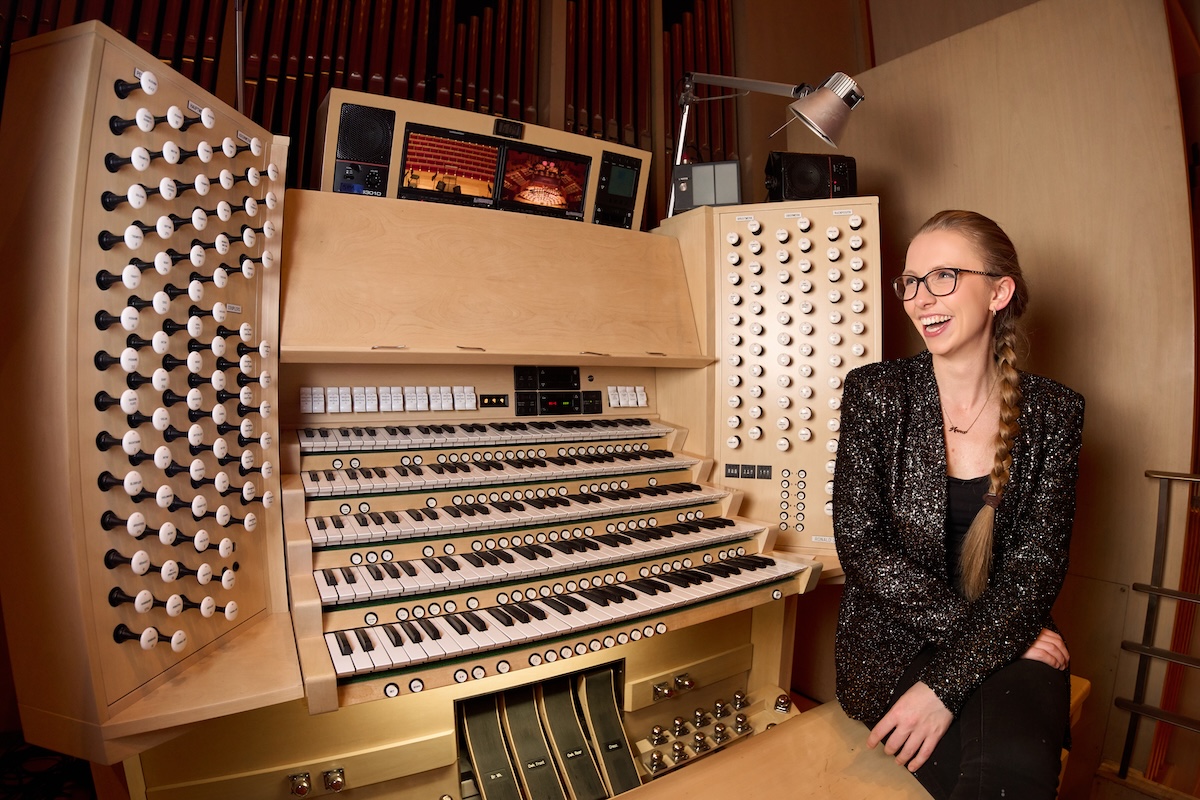
Anna Lapwood at the console of the Sydney Opera House Concert Hall Grand Organ. Photo © Jay Patel
Charismatic, bouncing with excitement and passion, and dressed in her trademark sequinned jacket which catches every nuanced movement from afar, Lapwood unleashes the full majestic power of the Grand Organ in all its soloistic glory. Accompanied by bubbly insights, anecdotes and dedications, she launches into some of the music which she loves best. Lapwood has the gift of establishing a deeply personal connection with her audience who respond in spades.
Accompanied by mood-matched lighting design, the recital focuses on classics by living composers of the 20th and 21st century, most with strong filmic connections, many arranged for the organ by Lapwood herself. It is a major element of her approach, drawing younger audiences to the potential and versatility of the organ. The organ is “the best narrator of stories” and the reason for her choosing “film-adjacent” music she explains, eschewing the word “soundtrack.”
The experimental and orchestral sounds of Hans Zimmer are perfect for reinvention by Lapwood. There is barely a whisper from this 15m-high beast as she opens with Chevaliers de Sangreal from The Da Vinci Code. Haunted by softly chiming bells, the repeated theme swells over shifting harmonies, steadfast pedal points and rippling arpeggios, building to its thunderous climax before ebbing away to a thread of sound.
Lapwood pairs Academy Award-winning composer Rachel Portman’s Flight with Olivia Belli’s Limina Luminis. Originally written for violin and piano, Portman’s arrangement of Flight for organ solo features a languid melody soaring over an arpeggiated bass. The minimalist influence of Glass and Einaudi are evident in Belli’s Limina Luminis (Boundaries of Light). We are the astronaut journeying through space, ascending toward light and enlightenment, awed by the miracle of the universe. Belli’s spiralling cross rhythms underlie the cantus firmus-style melody, growing in grandeur, then pausing for breath before a hushed glimpse of our fragile earth from outer space.
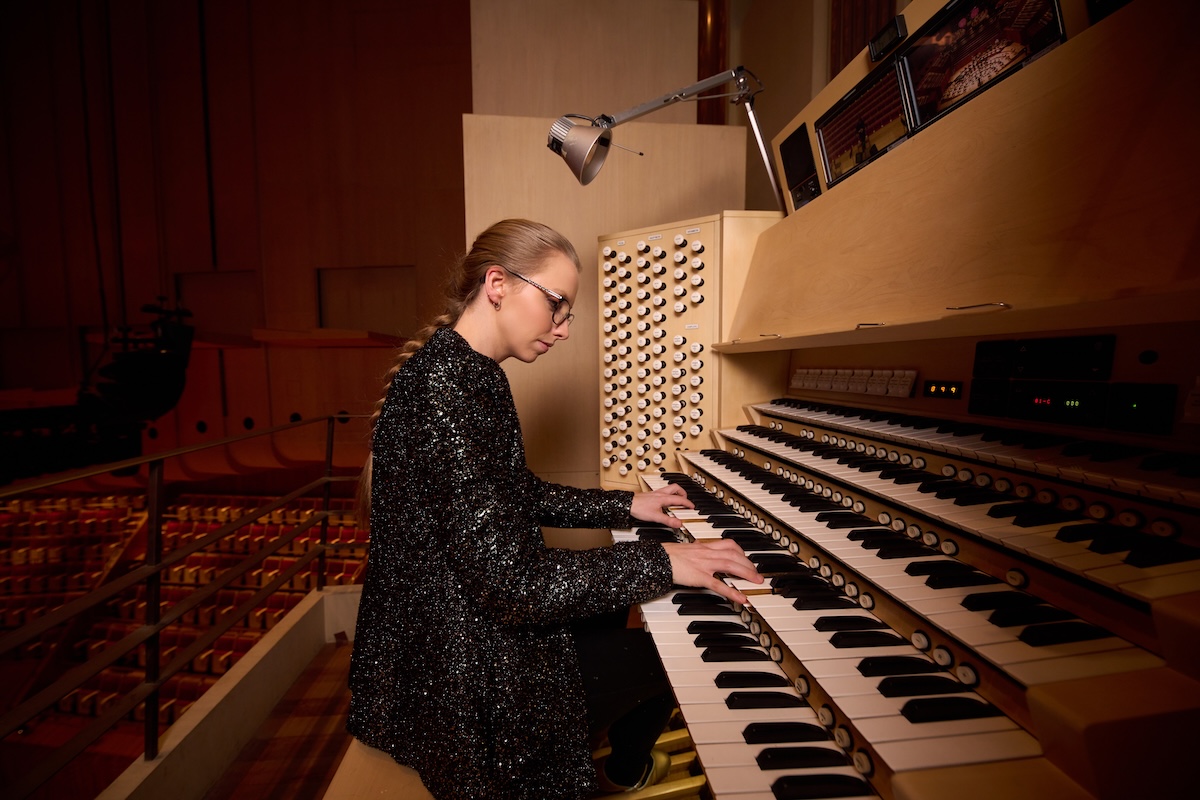
Anna Lapwood at the console of the Sydney Opera House Concert Hall Grand Organ. Photo © Jay Patel
There’s more Academy Award-winning music in a preview of excerpts from Lapwood’s transcription (by ear!) of Howard Shore’s The Lord of the Rings Organ Symphony, which she will premiere in its entirety in May in New Jersey, USA, on the world’s largest pipe organ boasting 33,112 pipes. Tolkien’s tale and Shore’s original score are ripe for the protean potential of the organ in this magnificent and vividly pictorial writing.
Lapwood boldly undertakes an uproarious quick-fire account of the story behind the nine movements and its many leitmotifs, referencing Wagner, that other composer of “Ring’ Music. Not content to work all four limbs at the organ, Lapwood also adds the vocalise herself in an attractive, clear, straight-toned soprano voice.
Lapwood’s arrangements of John Williams’ Star Wars: The Phantom Menace: Duel of the Fates and Zimmer’s Cornfield Chase from Interstellar, complete the journey into cinematic space. The former, fuller in texture, chordal and unsettling; the latter, an atmospheric cameo, complemented by a sea of pin-point phone lights.
Ludovico Einaudi has been criticised for a too-narrow style. Lapwood’s audience, like the millions who stream his music, are oblivious to such barbs. Experience deftly packs many ideas into an engaging three-minute morsel.
Toccata, the fourth of 10 Pieces for Organ by 19th century French composer Eugène Gigout was the piece that inspired Lapwood to become an organist, and an opportunity for her to vaunt her classical technical brilliance. I craved more.

Anna Lapwood at the console of the Sydney Opera House Concert Hall Grand Organ. Photo © Jay Patel
Finally, her take on Zimmer’s Pirates of the Caribbean Suite. The swashbuckling themes, the sea shanties and characterisations take us to the heart of piratical shenanigans on the high seas. Lapwood’s credentials as a choral conductor come to the fore as she coaches the entire audience who eagerly join in the chorus.
Lapwood has demystified and popularised the grand organ. Not long ago, the organ provided the soundtrack to silent movies. Now firmly in today’s cinemas and concert halls, it has a new lease on life and repertoire. The short bites of compelling music have a stylistic similarity but are easy to engage with and well-suited to dissemination on social media. As Lapwood observed, “performance should be joy,” and joy was indeed what she brought to the evening, along with her boundless effervescence, 1000-watt smile and gilt-edged musical pedigree.
Anna Lapwood performs in recital in the Sydney Opera House Concert Hall on 28 March and Max Richter: A Universe of Sound 25-28 March.



Comments
Log in to start the conversation.