A brace of massive orchestral works written 60 years and a few hundred kilometres apart and reflecting the stark cultural and social differences between Tsarist Russia and Stalin’s Soviet Union were featured in Donald Runnicles’ latest tour as Sydney Symphony’s Principal Guest Conductor.   

The performance of Shostakovich’s First Violin Concerto in the first half saw the much-anticipated return of Greek virtuoso Leonidas Kavakos, who last appeared with the SSO in 1998.
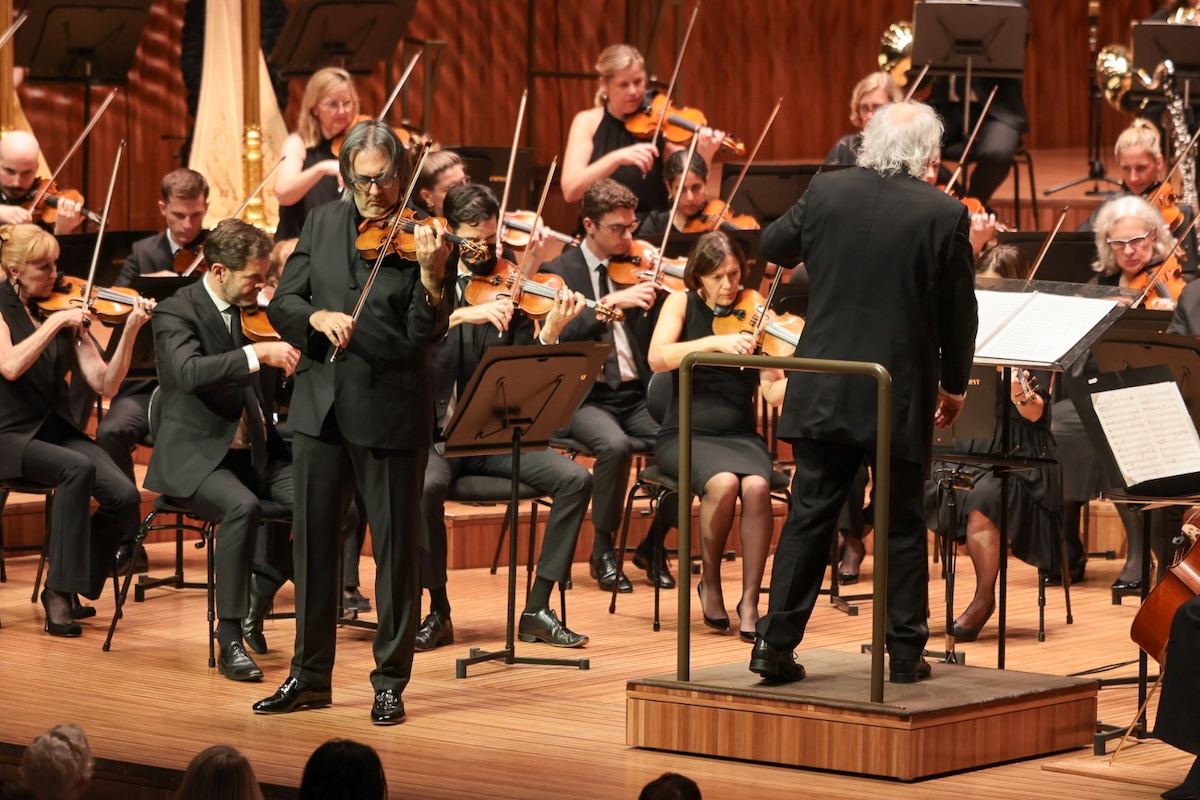
Leonidas Kavakos, Donald Runnicles and the Sydney Symphony Orchestra. Photo © Sydney Symphony Orchestra

Introducing the work, Runnicles said it was rarely performed “mainly because it is so difficult to play”.

Kavakos brought all his innate artistry and intelligence to bear in the slow, quiet nocturnal opening movement. Each note, each tone on his rich-voiced Stradivarius 1734 Willemotte – built when the luthier was 90 years old! – was carefully placed over the weaving harmonics of two harps, Matthew Wilkie’s bassoon and the quietly insistent basses, making for a spellbinding unfolding much like a ruminative Shakespearean soliloquy.

Shostakovich wrote the concerto for the great Ukrainian violinist David Oistrakh whose famous long singing lines inspired both the Nocturne – no virtuoso embellishments, just pure expression, shadings and nuance – and the Passacaglia third movement.

Oistrakh said of his first encounter with this music: “The concerto is not readily grasped by the violinist. I recall that a clear perception of it came to me slowly and not without difficulty. I became more and more interested in the work as the days went by, until finally I found myself wholly under the spell of the music.”

Irony is never far away with this composer who laboured under the terrors of Stalinist Russia and it explodes in the faster movements. The Scherzo fizzles and spits like a Catherine Wheel with whirling figures from bass clarinet and flutes while Kavakos demonstrates his peerless technique with brittle explosive pizzicato, rapid bowing and skipping athletic runs.

The heart of the work is the sinister Passacaglia with the violin’s impassioned Jewish melodies keening over the relentless ground bass, dying away to a lengthy cadenza which pulls out a bagful of virtuosic tricks. This leads us straight into the Burlesque grand finale which, with its madcap explosion of colour and rhythm, reminds us that Shostakovich started his career as a cinema pianist playing soundtracks for silent movies.  

Although the concerto was written between 1947-48 Shostakovich waited until Stalin’s death before publishing it for fear of falling foul of the authorities.

Leonidas Kavakos, Donald Runnicles and the Sydney Symphony Orchestra. Photo © Sydney Symphony Orchestra

Peter Ilyich Tchaikovsky was also constrained by his times, although for him it was because of society’s aggressive condemnation of homosexuality.

His Fifth Symphony, which was performed in the second half of the concert, has a motto which recurs throughout the four movements, leading to endless attempts ever since to “crack the code” and find a hidden narrative.

Ollie Leppäniemi’s clarinet introduced the theme in the first movement and various soloists, notably young German guest hornist Jan Breer and Principal Oboe Shefali Pryor, featured in the lovely noble second movement.

Runnicles gave the balletic third movement plenty of air and bounce, conducting with deft brush strokes.

The strings under Concertmaster Andrew Haveron were neatly co-ordinated for the crescendo of the final movement, for which both woodwinds and brass were in sparkling form. 


Sydney Symphony Orchestra presents Tchaikovsky’s Fifth Symphony in the Concert Hall, Sydney Opera House, until 18 April.

Contribute to Limelight and support independent arts journalism.