




It’s a pleasure to hear the elite musicians of the Orchestra of the Antipodes in a performance of their own, playing music contemporaneous to the operas they have presented with Pinchgut Opera over nearly two and a half decades.
The orchestra is an essential part of the historically informed productions that have become the company’s hallmark. Artistic Director Erin Helyard has curated a program of music by J S Bach, Georg Philipp Telemann and Johann Friedrich Fasch – composers whose lives are inextricably linked and intersect on several planes, yet retain a distinct and contrasting voice.
While Bach is synonymous with the Baroque, Telemann developed the Classically influenced galant style which was taken up by Fasch, who, unpublished during his lifetime, modelled his music in the idiom of his ‘most beloved’ friend Telemann.

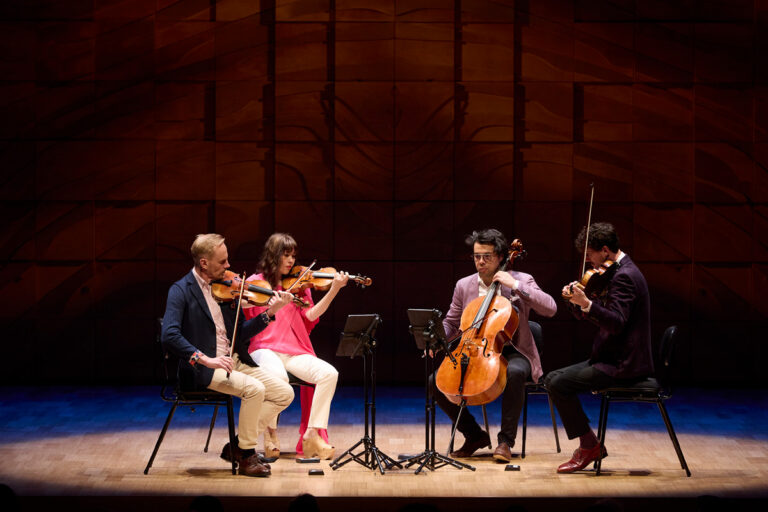
Erin Helyard leads The Orchestra of the Antipodes: Bach & Telemann. Photo © Anna Kucera
From the Ruckers double harpsichord, Helyard directs the ensemble of seven specialists, playing one to a part, led by violinist Matthew Greco. Comprising violinists Annie Gard and Rafael Font who plays the rare tenor viola, violist Karina Schmitz, cellist Anton Baba, Simon Martyn-Ellis playing theorbo/gallichon and Pippa Macmillan playing the violone, their instruments range in time from Gard’s 1626 Amati, to artisanal contemporary replications.
The program is an opportunity to hear the tenor viola, this one a 2010 copy of an Amati brothers instrument made by Sydney-based Master Luthier Simon Brown. Also on show is the company’s latest acquisition, a Slovenian 2017 gallichon, an early 18th century bass lute, replicating a 1694 Viennese model by Andreas Barr.

The Orchestra of the Antipodes: Bach & Telemann. Photo © Anna Kucera
Telemann composed numerous sonatas for string ensembles of up to seven parts. The ensemble presents four of his sonatas. The first, Sonata à 4 in A major is excellent listening, a charming three-movement appetiser for the more engaging sonatas which follow.
The Sonata à 5 in E minor, the Sonata à 6 in G minor and Sonata à 6 in B-flat major are pure Telemann. Written in the four-movement slow-fast-slow-fast format popular in German chamber music of the time, these sonatas feature Font playing the tenor viola, its burnished tones filling the niche between alto viola and cello. The soundscape is distinct, with the deeper timbre of the lower strings balanced beautifully by the crystalline lines of the violins.
The first and third movements of this trio of sonatas meander through variously measured tempi from Adagio to Grave. The second and fourth movements are cleverly written Allegro fugues.
Fasch’s gentle Concerto in D minor, is his only known piece for the lute, expertly performed on the gallichon by Simon Martyn-Ellis. Played standing and worn with a cross-body strap, the muted strings allow the delicacy of the gallichon’s plucked sound to cut through.
Pinchgut afficionados will be familiar with the delights of Matthew Greco’s musicianship, his filigreed cadenzas and solo moments. Here he is featured in Bach’s Violin Concerto in A minor, BWV 1041, a perennial favourite, one of only two surviving solo violin concertos by Bach.
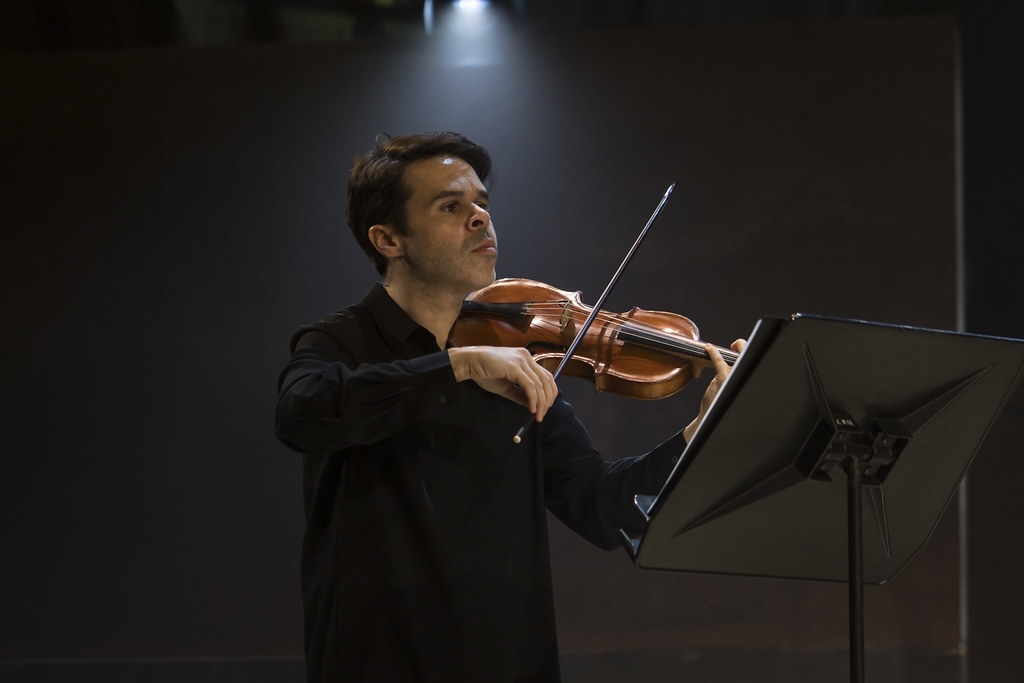
Matthew Greco. Photo © Anna Kucera
Greco’s playing is lithe and assured. He achieves a sound on his 1760 German violin that is ambrosial. The opening Allegro is measured; the middle movement Andante is lyrical and deftly avoids any hint of sentimentality. The final Allegro assai is vibrant and carefree. Greco’s owns the piece with his personal style and distinctive virtuosic touches.
The highlight of the evening is J S Bach’s Harpsichord Concerto in D minor (BWV 1052), one of seven which he wrote. Helyard captivates with a virtuosic solo performance. The opening Allegro is dramatic with a disciplined metric in the heady, toccata-like passages spinning into a moody Adagio, closing with a jubilant Allegro. The focus on the soloist can detract from the exemplary skills demanded from the ensemble. The Orchestra of the Antipodes doesn’t disappoint. It might have been best to close on this intoxicating performance, but we are let down more gently with the last of the Telemann sonatas.
Helyard crams a wealth of information into a single sheet of program notes, welcome background to this peek into the soundscape of 18th century central Germany through the works of three important composers and rare instruments.
Pinchgut Opera presents Scarlatti’s The First Murder, 23-31 May, at the Roslyn Packer Theatre, Walsh Bay, Sydney.




Comments
Log in to start the conversation.