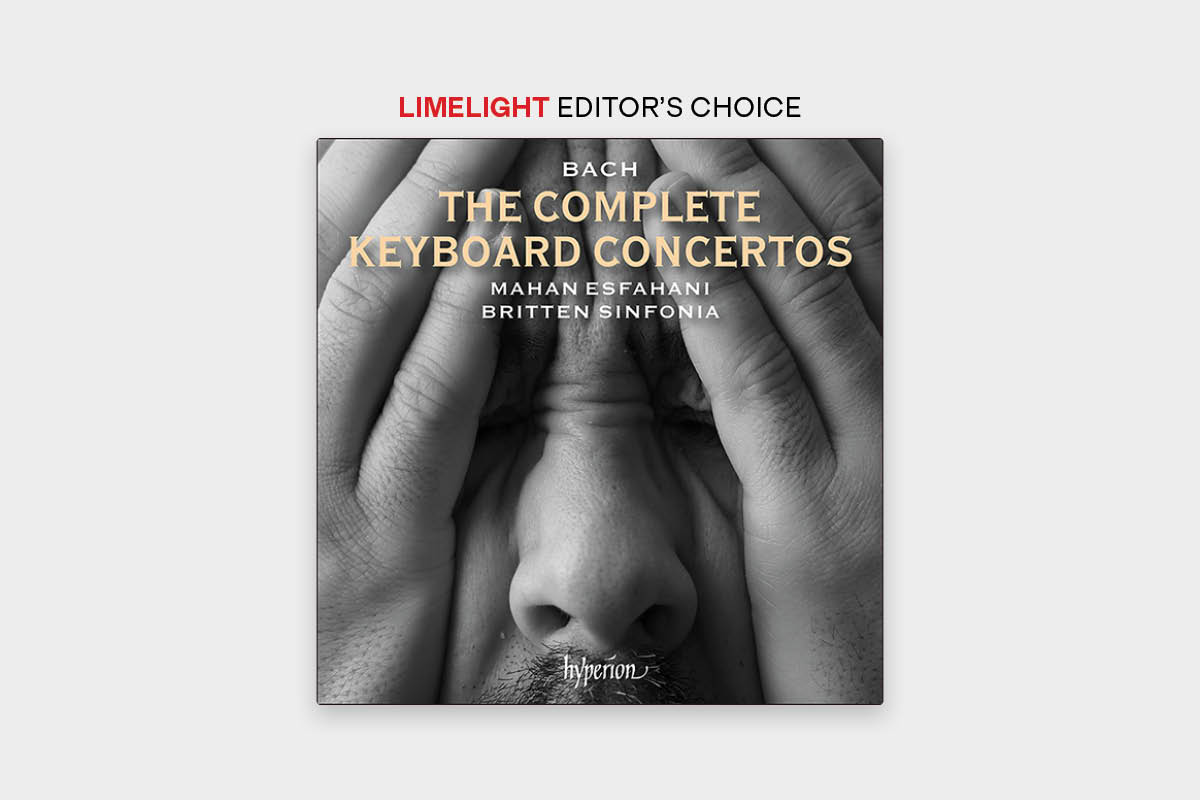
Depending on how you feel about mixing modern and period instruments, you might interpret Mahan Esfahani’s cover portrait with his face buried in his hands (after Messerschmidt, whose work adorns the covers of Esfahani’s previous Bach releases) as either a despair or a eureka moment. Both are certainly possible. After hearing these performances, I’m firmly in the latter camp.
For his latest release, the Prague-based harpsichordist has brought together all of Bach’s single-harpsichord concertos: the seven of BWV1052–1058, Esfahani’s own completion of the fragmentary BWV1059, and the Triple Concerto BWV1044 – which his booklet note provocatively argues is not Bach’s at all, but a product of the Bach circle.
In period fashion, Esfahani does direct the excellent Britten Sinfonia one player to a part, with the bass shared between cello and double bass and Lynda Sayce’s theorbo discretely filling out the continuo. It’s an intimate yet fulsome, balanced sound which as Esfahani points out is perhaps best appreciated on disc. Jacqueline Shave leads from a 1672 Amati; Michala Petri and Ian Wilson supply the recorders for the Brandenburg-derived BWV1057; Peter Facer’s oboe colours BWV1059. Esfahani’s harpsichord is a double-manual 2018 Ollikka after a Berlin Mietke c.1700.
But let’s get back to this provocative move to use modern strings. Esfahani in his notes defends his choice as “neither an error of judgment nor a wilful picking and choosing from the past,” but the work of an artist living in his own present. The interpretations, he insists, proceed from Bach’s text rather than from period equipment.

On the evidence of the performances here, I think the claim holds. This is Bach of rhetorical vigour and collaborative imagination, the harpsichord set within the ensemble as an equal voice rather than pitted against it.
The D minor concerto BWV1052 – which his note singles out as the cycle’s most audacious – is sinewy and propulsive, its unison ritornello partaking of a satisfying coup d’archet quality, its Adagio a veritable lamento over a seemingly implacable bass. Throughout, perhaps it’s fair to say the strings sing rather than speak.

Elsewhere, the F minor Arioso floats suggestively over pizzicato strings – a lovely contrast to the cantabile sweetness of E major BWV1053’s Siciliano. Petri and Wilson’s recorders frolic like dolphins in BWV1057’s fugal finale. The reconstructed BWV1059 is the curio, with left-hand writing and oboe countermelodies of Esfahani’s own devising framing an improvised slow movement that, following Leonhardt and citing Berio’s Rendering, leaves its central absence audibly open.

While very different both sonically and stylistically, these accounts stand up well when compared with benchmarks such as Pinnock’s English Concert, Rousset’s L’Oiseau-Lyre cycle and Suzuki’s fine BIS recordings. Not to mention Steven Devine with the Orchestra of the Age of Enlightenment and Francesco Corti with Il Pomo d’Oro.

Yes: it really is a crowded field, but Esfahani and the Britten Sinfonia have something genuinely new to say about the music. Purists may bristle. But, adapting a remark from Rupert Dawall, Esfahani writes that in this context, modern instruments seem less to age the harpsichord than to set it free. ‘Nuff said.

Listen on Apple Music

Composer: Bach
Works: Complete Keyboard Concertos
Performers: Mahan Esfahani hpscd, Britten Sinfonia
Label: Hyperion CDA68481/2 (2CD)

Contribute to Limelight and support independent arts journalism.