The connotation of something described as Bohemian is the unusual, with an alternative take on the norm. This perfectly describes the Australian Romantic & Classical Orchestra, which has returned to tour Queensland with Bohemian Dreams – beginning with this concert at Plant Empire, a plant- and art-filled warehouse in the industrial area of Tennyson in Brisbane.
The orchestra’s historically informed performances (HIP) present music, often by popular late 18th- and 19th-century composers who were the fashionable titans of their time but are now seldom played. Co-Artistic Director, co-founder and clarinettist Nicole van Bruggen described how the Bohemian Dreams concert has been simmering since the 1990s, when she questioned why some of the most in-vogue composers of the time, such as Giovanni Punto and Franz Krommer, are unknown, whereas contemporaries Mozart and Schubert are revered.
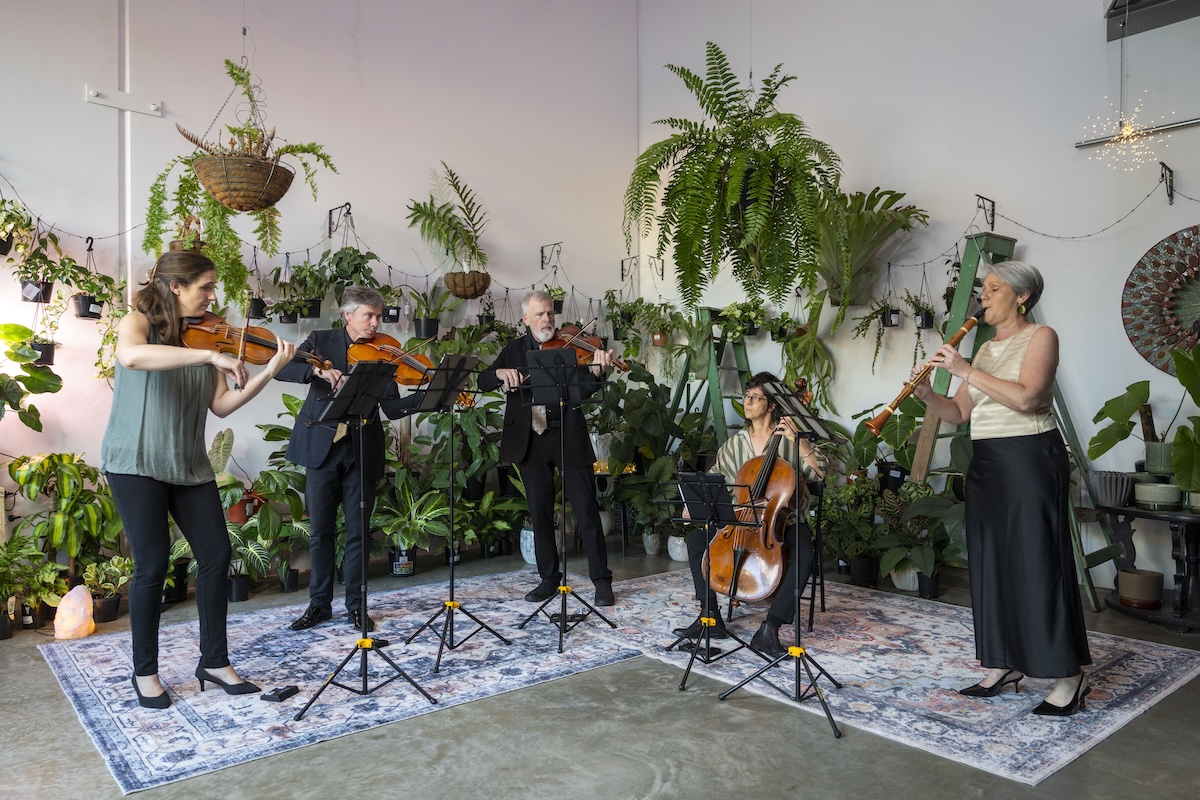
Australian Romantic & Classical Orchestra: Bohemian Dreams at Plant Empire Brisbane. Photo © Glenn Hunt
ARCO’s HIP concerts reflect a more genuine experience, with Emma Gregan playing an 18th-century valveless natural horn replica by Paxman, which frankly looked like it had been recovered from a Vinnies store!
It was fascinating when Gregan explained how the crook, the curled tube, is replaced to change the key, and how her right hand uses the Hampel method (after Anton Joseph Hampel) to manipulate the hand inside the bell to alter the pitch, enabling a full chromatic scale without a single key being pressed.
The horn is mellow and fruity, mimicking the call of a hunting horn during the Allegro maestoso of Punto’s Horn Quartet. Punto was the archetypal Bohemian, born as the son of a serf as Jan Václav Stich on Count von Thun’s Bohemian estate, before running away to reinvent himself with an Italian pseudonym in Italy. He was chased away by the Count, who threatened to have his front teeth knocked out so he couldn’t play the horn, to become one of the most innovative and virtuosic horn players that you have never heard of.
Despite Gregan’s diminutive size, her ugly horn packed a punch in Mozart’s Horn Quintet, which was quintessentially Mozart, being technically demanding for the horn player, with an unusual quartet of violin, two violas and a cello.
The other instruments were likewise contemporary for the period, using gut strings, which needed tuning between some movements but sounded richer and more resonant for the small inconvenience. The horn fanfares were accurate and magical in the Rondo, galloping alongside the strings for a photo finish.
Van Bruggen’s replica Theodor Lotz 1788 clarinet excelled in the now rarely performed Clarinet Quintet by Franz Krommer, which also used two violas instead of two violins, and Natasha Kraemer’s divine original 1743 English cello. The oaky, musty-sounding clarinet burbled along to psycho-sounding strings from violinist Holly Piccoli and violists Stephen King and Darrin McCann.
The frantic Allegro had the notes bouncing about like a mother desperately dressing her kids for the school run, as the clarinet bombarded the strings until closing with a delicious sigh as the car miraculously pulled away from the school gates on time.
The music of Bohemia was best celebrated with Michael Haydn’s (younger brother of Joseph) Divertimento, with all six musicians oom-pah-pahing over a twiddly clarinet, worthy of any beer tent.
Australian Romantic & Classical Orchestra presents Bohemian Dreams at St Paul’s Cathedral, Rockhampton on 28 August, St Luke’s Performance Centre, Bundaberg on 29 August, and in the Brolga Theatre, Maryborough on 30 August.

Comments
Log in to start the conversation.