


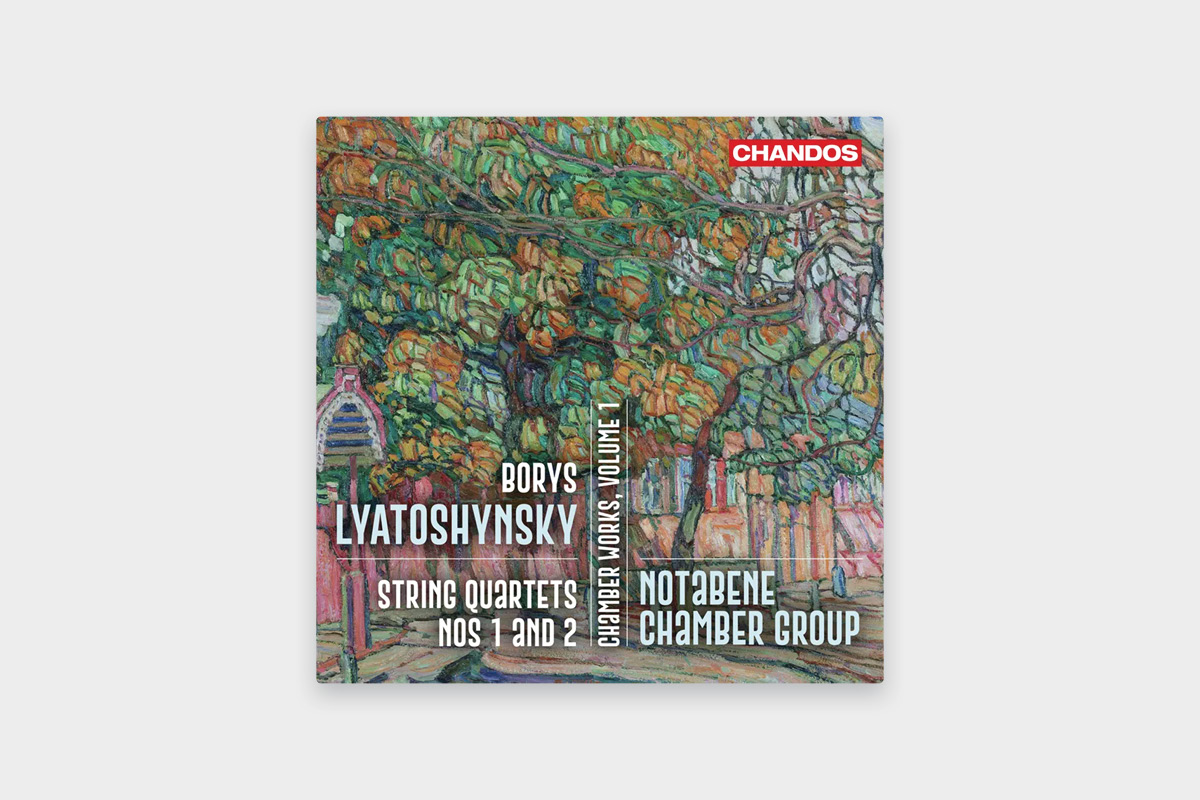
In 1914 Abram Manevych painted A City View. Autumn, the canvas on this disc’s cover. Its Kyiv trees boil over in thick, swirling strokes, while the church and low houses beneath retain their old outlines. It is hard not to think of the 20-year-old Borys Lyatoshynsky a year later. In December 1915, at his parents’ house in Okhtyrka, where war had carried his father’s college, he wrote a string quartet whose inherited four-movement frame had to contain material already pressing against its walls.
That tension between inherited order and what it must contain runs through the D minor Quartet, Op. 1. Lyatoshynsky dedicated it to Reinhold Glière, whose influence Iryna Tukova’s booklet note finds in the “methods of harmonic and polyphonic development”. It appears immediately, as the main theme sounds in octaves across all four instruments; NotaBene give the gesture gravity without ponderousness. Ukrainian and Russian folk song shapes much of the melodic material, and the players let it breathe and swing, keeping the Allegro scherzando e leggiero light-footed.
The Lento ma non troppo is a long, dark-hued song receding into silence. In the finale, Lyatoshynsky gathers earlier themes and sets them against one another in counterpoint: a student already treating the quartet as a single argument about its materials’ origins. Tukova rightly identifies this thematic unity as a hallmark of the mature composer.
Seven years and a revolution separate that argument from the A major Quartet, Op. 4 (1922, revised 1926). Harmony is more fluid, textures denser, and folk inflections so absorbed into the melodic lines that Lyatoshynsky no longer seems to quote them. Tukova cites a letter to his wife – “I am even afraid of my own love; it seems to me greater and stronger than myself” – and reads the work through it. Biography is a seductive key to music, and usually the wrong one, yet the first movement’s ardent, rising main theme makes her reading difficult to dismiss.
The quartet’s centre of gravity is the eight-minute Intermezzo. Molto lento. NotaBene hold its shimmering opening with such patience that inner voices surface through the haze like figures resolving in an old photograph. The third movement rustles past in under four minutes, peopled with Tukova’s “nocturnal phantoms”. The finale’s questioning, declamatory theme builds to a Maestoso close that feels organic rather than imposed.
Such patience is the source of the ensemble’s authority. Andrii Pavlov, Maksym Grinchenko, Ihor Zavhorodnii and Artem Poludennyi are soloists of Kyiv’s National House of Music, where they recorded in April 2025, during the fourth year of full-scale war. They play the dance-derived material with idiomatic snap but never let it become picturesque, bringing equal sensitivity to slow movements in which Lyatoshynsky’s lyricism turns inward and darkens. They understand the folk and inward elements as aspects of one voice, so neither quartet sounds like a student exercise or curiosity.
This first volume of NotaBene’s complete survey of Lyatoshynsky’s chamber music was made with the Liatoshynsky Foundation. If the series maintains this standard, these works should find a place in the wider quartet repertoire, well beyond Ukraine.
Composer: Borys Lyatoshynsky
Works: String Quartets Nos. 1 & 2
Performer: NotaBene Chamber Group
Label: Chandos








Comments
Log in to start the conversation.