The Bach Akademie Australia’s Collegium Musicum is a snapshot of musical life in early 18th century Leipzig, when the university city was a vibrant hub for publishing and trade, teeming with ideas, enterprise and curiosity.
The Collegium Musicum comprised students and amateur musicians who played together regularly, often unrehearsed, at informal venues like the city’s coffee houses. There was no additional audience fee and the musicians likely played gratis, grateful for the opportunity to perform.
Georg Philipp Telemann, a law graduate from Leipzig University, founded his group of around 40 students, the Telemannische Collegium Musicum in 1702. Johann Friedrich Fasch founded a second collegiate in 1708 when he too was a student at Leipzig. J.S. Bach took over Telemann’s group from 1729 to 1737, and again from 1739 to the 1740s. Many of his most famous works were heard here, the student ensembles augmented by members of Bach’s growing family.
With customary verve and technical aplomb, the nine-strong BAA is directed from the violin by its irrepressible Artistic Director Madeleine Easton in this program of music by Telemann, Bach and Fasch – with a nod to Vivaldi from whose music Bach drew inspiration.
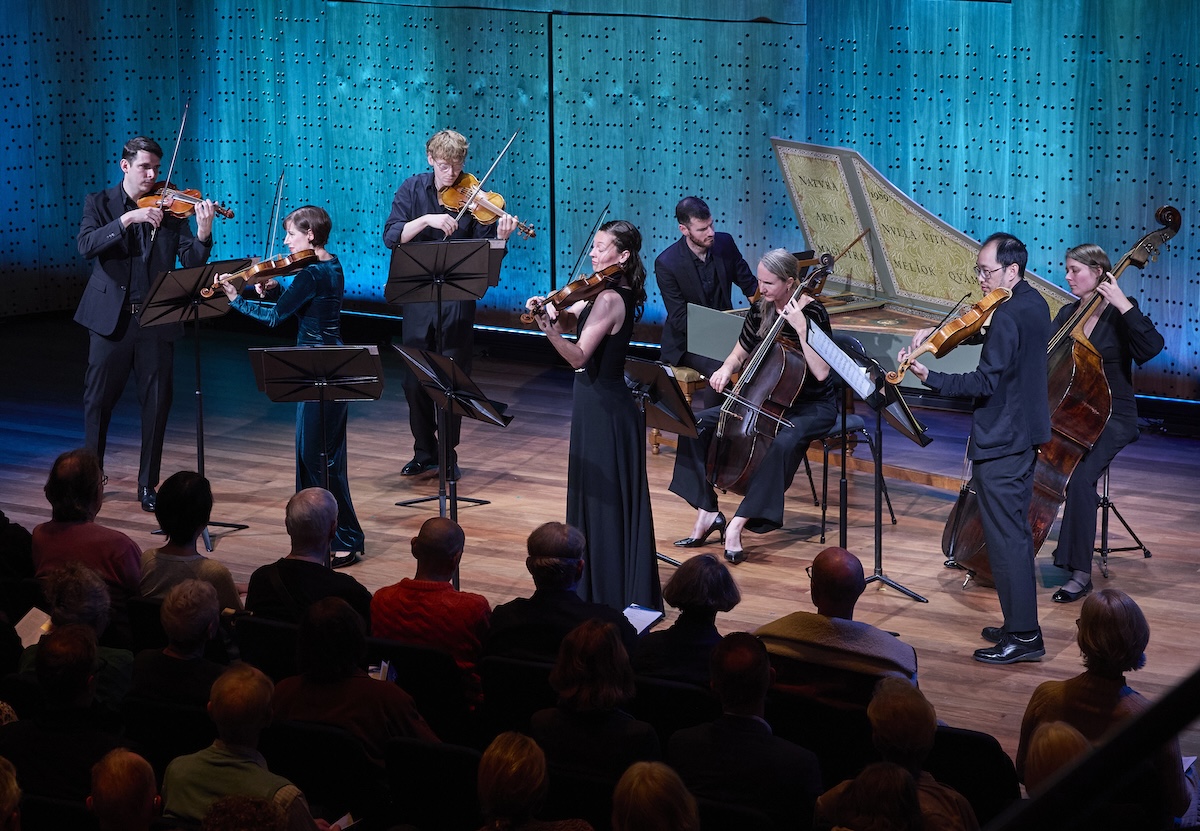
Bach Akademie Australia: Collegium Musicum. Photo © Keith Saunders
Tafelmusik was a form of popular light entertainment played at banquets. Telemann wrote three sets published in 1733. The concert opens with the Overture, in E minor, to the first of these. Stately and in the French style, it is well articulated and lightly ornamented to spin out the sound, giving way to an exuberant Vite in which two solo flutes played by Mikaela Oberg and Jessica Lee, then violins, Easton and Rafael Font begin their virtuosic imitative dialogue.
The Conclusion in E minor, TWV 50:5 to this first set, closes the end of the first half. ‘Breathtaking’ in more ways than one, it demands considerable virtuosity and control, especially from the flautists who skip their way above the tightly held ensemble.
Vivaldi’s Trio Sonata in D minor, RV 63 (La Folia) states the elegant 16-bar Sarabande, followed by 19 brief variations. All in the in the same ¾ time signature and key of D minor, there is the risk of a pervasive sameness. However, distinctive individual flights of ornamentation and infusions of colours and moods into Vivaldi’s imaginative exploration of the theme, grab and hold the interest.
Nathan Cox performs the bustling Allegro from Bach’s Concerto in F major, BWV 978, arranged for solo harpsichord from Vivaldi’s Violin Concerto in G major, RV 310, a small but important piece, which illustrates Vivaldi’s influence on Bach. Not often heard in solo, it was a pleasure to hear his rendition, adorned with careful placement and polished phrasing.

Bach Akademie Australia: Collegium Musicum. Photo © Keith Saunders
Despite Fasch’s connections with some of Leipzig’s most significant musicians, mystifyingly, his genius went unrecognised and he remained unpublished and in debt in his lifetime. His four-movement Sinfonia in G minor is a thoroughly engaging example of the bridge between the Baroque and later galant styles.
A spirited rendition throws up Fasch’s contrasting colours, sunny disposition and innovative harmonies. The declamatory opening chords are a wake-up call to the ‘new’ style’ he was offering. The highlight is the third movement Alla breve, a cleverly constructed, constantly evolving fugue.
Telemann’s Violin Concerto in A major, (‘The Frogs’) is creative and funny. Simone Slattery is the soloist in this and who knew she could ‘ham it up’ with such entertaining silliness, while also playing so brilliantly? Peeling off after the opening bars of the first movement, she embarks on her high-octane journey of onomatopoeic bariolage, double stops and triplets.

Bach Akademie Australia: Collegium Musicum. Photo © Keith Saunders
Transcribing an organ sonata with its demands on hands and feet over three lines of music, might seem at first glance to simplify the piece. Not so with J.S. Bach’s Trio Sonata in F major arranged for flute, violin and harpsichord from his Organ Sonata No.1 in E flat major, BWV 525. It is well-suited to a trio formation for its three equally important parts, with Cox at the harpsichord and cellist Anthea Cottee sharing the bass line. But despite the concession of transposition to a more trio-friendly key, its demands are considerable and we are treated to an impressive show of instrumental writing and technical mastery.
It is intensely comforting to settle in to listening to a familiar masterpiece, no matter how often heard. Bach’s Concerto in D minor for two violins, BWV 1043 is one such classic. Easton and Slattery make a formidable and intimate partnership, the two playing off each other in this intricate intertwining of the two violins. The sweetness of tone achieved in the rhapsodic middle movement Largo is a fine contrast to the faster outer movements in what is a truly exhilarating experience.
For more information on Bach Akademie Australia in 2026, visit bachakademieaustralia.com.au

Comments
Log in to start the conversation.