Ash Flanders’ new play, Commentary, commissioned and presented by State Theatre Company South Australia, is very Adelaide.
It takes the city’s cultural ecosystem of festivals, film schools, and universities, and turns it into a darkly comic meditation on who gets to tell the story and whose story is it anyway?
These themes are very much of the moment, and this is a classic case of art imitating life imitating art.
At the centre of the story is Nick, played by Gyton Grantley, a once-promising filmmaker turned academic whose controversial debut feature, Low, is being resurrected for a retrospective at the Adelaide Film Festival.
Low won a Silver Bear at the Berlin Film Festival, the highlight of Nick’s not-too-successful career. The film’s co-creator, Nick’s former best friend Hamish, is disgraced and presumed dead and Low carries with it allegations around abuse and exploitation.
Asked to record a director’s commentary, Nick discovers that the past can be a dangerous place.

Gyton Grantley in Commentary. Photo © Matt Byrne
The theatrical conceit here of recording a commentary, or a podcast, is neatly handled and enables the script to move backwards and forwards through time and memory, correcting, contradicting, and reframing itself.
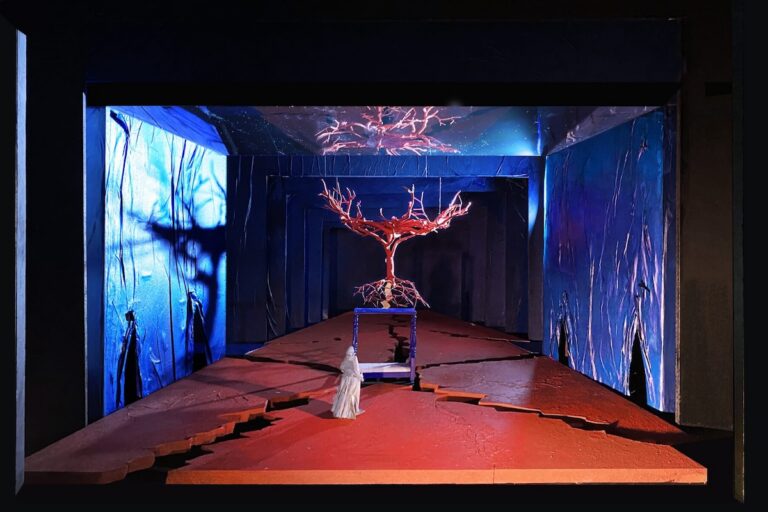
Petra Kalive’s direction makes the most of this instability, with Matilda Woodroofe’s design and Dan Thorpe’s sound and video work creating a space that moves smoothly between home and studio. The production easily communicates the visual language of contemporary cultural life and feels real and accessible.
Flanders’ script leans heavily into the self-importance, and self-obsession, that comes with a creative life and it’s from here that most of the comedy is derived. There were many chuckles of recognition from the opening night audience. Nick’s attempts to retain control of his own mythology are both funny and tragic, becoming increasingly uncomfortable as the story unfolds.
Not surprisingly, the women around him, his wife and lovers, colleagues, friends and students, see things a little differently.

Gyton Grantley and Kate Cheel in Commentary. Photo © Matt Byrne
The strength of Commentary is its portrayal of memory as an untrustworthy witness, those ‘unreliable memoirs’ as Clive James so aptly put it many years ago. Through Nick, we see memory and truth as being selective, self-serving, and susceptible to revision with each retelling. Does Nick even believe it himself? We can’t really know.
There is plenty here to admire. It is a substantial new work that feels very much of its place and time. That might mean it doesn’t travel well, but every city has a similar arts ecosystem and these are issues that are flooding the zeitgeist. Flanders also resists the temptation to offer a simple moral verdict, preferring to stay in the murky territory of selective recollection. This is to the play’s credit. That said, it does sometimes fall victim to its own conceit. As the revelations accumulate, the storyline becomes less clear and the narrative resonance gets a little clouded.

Shardae Santos and Gyton Grantley in Commentary. Photo © Matt Byrne
There is a similar issue with the performances. Grantley gives Nick a practised charm and polished evasiveness but this can sometimes feel a little too knowing, a little too performative. The result is undeniably a vibrant performance but a little more naturalism could bring us closer to the characters and more empathetic to their emotional journeys.
Even so, Commentary is an ambitious and worthwhile addition to the local repertoire that will likely get better with a little careful nurturing. It’s funny, assured, and aware of the contradictions at its heart.
At a time when artistic reputations are made, celebrated, and destroyed in the public domain, it seems entirely of its moment.
Commentary is at the Dunstan Playhouse until 5 September.

Comments
Log in to start the conversation.