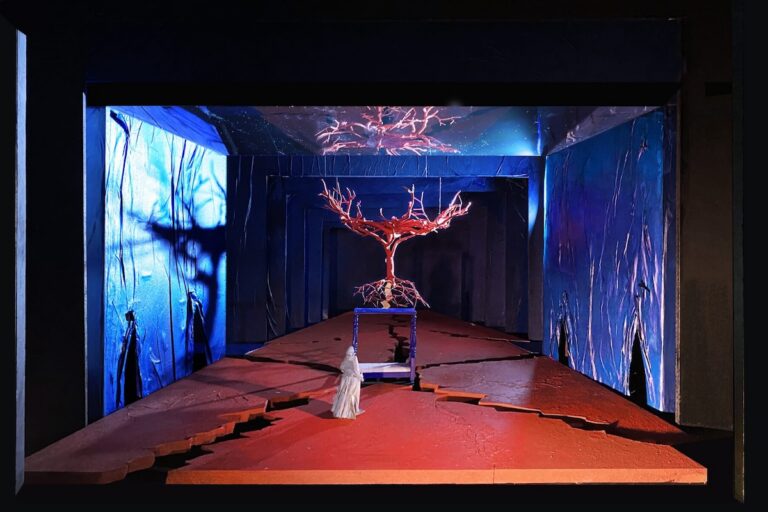
When the composer Thomas de Hartmann moved with his wife Olga to a deserted house in Garches, near Paris, during the Second World War, he found a 1768 copy of Jean Racine’s plays in, of all places, the hen house. He began to read Esther, which tells the story from the Hebrew Bible in which the eponymous queen reveals her hidden Jewish identity to the Persian king, risking her life, in order to save the Persian Jews from annihilation. 

De Hartmann was immediately struck by the similarities between the story and the Holocaust, and the events unfolding around him. “Oh, this time which we are living through, is it not the time of Purim (the biblical episode of Esther and Mordecai)? I began to be enticed to write a musical tragedy on the text of Racine,” he noted in his memoir.

The result was De Hartmann’s 1946 opera-oratorio Esther, much of it written during wartime, often by candlelight, as the excellent booklet notes by Evan A MacCarthy note, and orchestrated in New York, where Thomas and Olga later moved. Although the orchestral dances from Act III were excerpted and performed in his lifetime, the work was never performed complete during it. An abridged version was recorded in 1976. Now Esther has been recorded in its entirety for the first time by Pentatone, allowing us to experience a powerful work from a distinctive 20th-century voice. 

The performance is masterminded brilliantly by conductor Kirill Karabits, who is also Ukrainian, like De Hartmann. More importantly, Karabits has form with this repertoire, thanks to his Voices from the East series with the Bournemouth Symphony Orchestra (BSO) focusing on forgotten 20th-century Eastern European composers, and is also a fine opera conductor. That shows in his grip of the dramatic pacing, keeping the tension up throughout and not letting even the baggier episodes lag, but also in the superb orchestral playing he elicits. The score is replete with interesting colours and instrumental combinations, relished by the BSO, and its changing styles and moods – whether brooding, serene, noble or triumphant – all come across vividly.

The entire cast is wonderfully committed to the project, and soprano Corinne Winters is clear, lithe and powerful in the title role as the courageous queen, drawing us into the dilemma she faces, even if at times her voice sounds a little pushed. She’s pitted against the horrifically antisemitic Aman, who hopes to convince the king to kill the Jews, and is chillingly played by tenor Bernard Richter. Built up as a fearsome monarch, Yuriy Yurchuk impresses as the king, who unexpectedly turns tender and benevolent when his wife courageously reveals his secret. Olga Bezsmertna and Andrew Foster-Williams are strong as Elise and Mordecai, while baritone Edwin Crossley-Mercer is superb as Hydaspe.  

Yet perhaps the most thrilling vocal element comes from The Grange Festival Chorus, prepared by William Vann, which gives its all. De Hartmann uses choruses to wonderful effect, whether evoking the fragile beauty and stirring song of the Daughters of Zion or the final triumphant outburst for the opera’s happy ending. It’s a recording well worth spending time with.

Listen on Apple Music

Composer: De Hartmann
Work: Esther
Performers: Corinne Winters s, Yuriy Yurchuk t, Andrew Foster-Williams bar, Grange Festival Chorus, Bournemouth Symphony Orchestra/Kirill Karabits
Label: Pentatone PTC5187424 (2CD)

Contribute to Limelight and support independent arts journalism.