When Mahler told Sibelius that “a symphony must be like the world. It must embrace everything” he probably didn’t reckon that conductors would never be able to stop at recording just a handful of his symphonies: they had to embrace them all. With the release of Symphonies 6, 7, 8 and 9, Semyon Bychkov and the Czech Philharmonic have now reached their own “natural culmination” of a project deeply rooted in Prague’s soil.
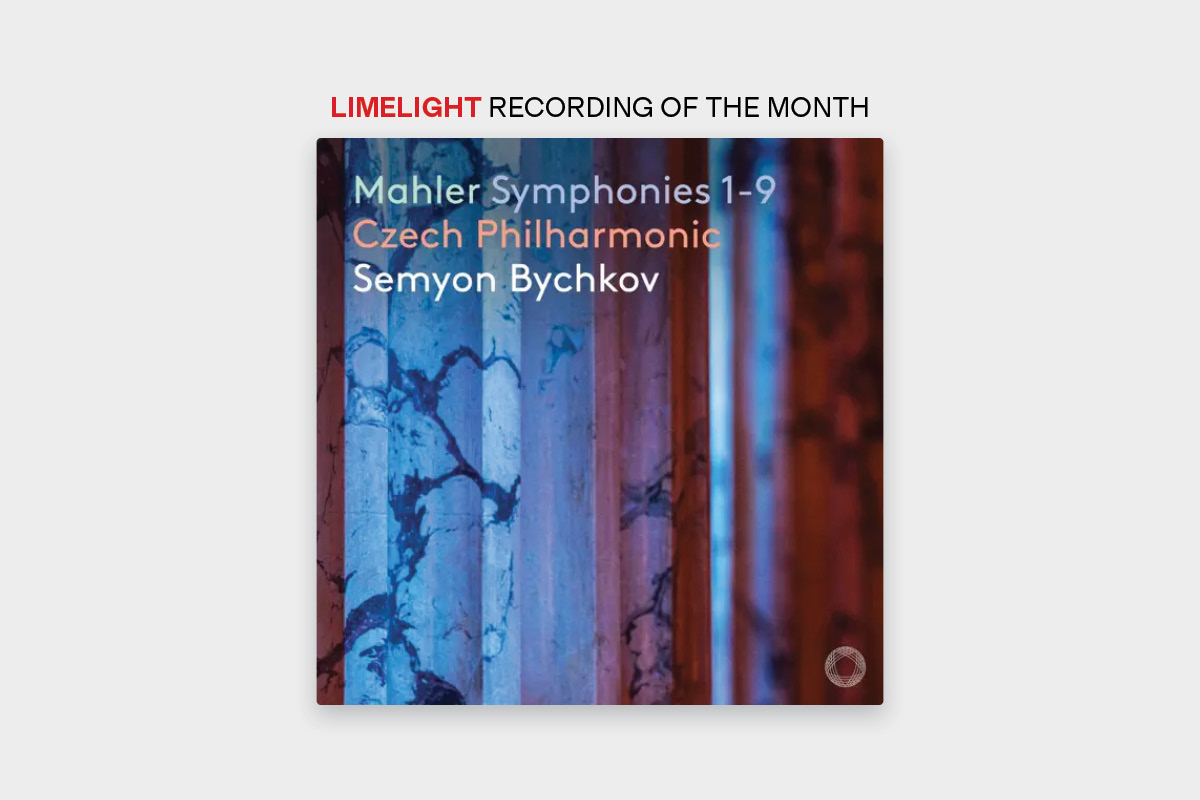
As the booklet note in the beautifully produced complete set, which brings the above recordings together with those of the previously released symphonies 1, 2, 3, 4 and 5, reminds us, the relationship between this ensemble and Mahler is not merely professional but ancestral. Mahler himself conducted the premiere of his Seventh Symphony in Prague in 1908, and Bychkov’s cycle follows in the formidable footsteps of Václav Neumann’s 1980s survey.

Recorded in the marvellous acoustics of the Rudolfinum’s Dvořák Hall, the full cycle captures what the booklet describes as a “Mitteleuropean heritage” preserved in the orchestra’s “open-textured” strings and “vestigially vibrant” woodwinds.
Much has been made of Bychkov’s “forensic” approach to the scores – a term often applied to his meticulous attention to Mahler’s complex markings. This is particularly evident in the later symphonies which are the focus of this review.

From the opening march to the devastating hammer blows of the finale, Bychkov’s account of the “Tragic” Sixth Symphony is as tightly argued as Mahler’s conception of it. Fatalistic, yes; but with the orchestra successfully evoking the beating heart imprisoned within the classical architecture.
Elegance comes to the fore in the Seventh Symphony, the so-called “rogue” work over which Prague can claim some ownership. Bychkov’s phrasing, especially in the exquisitely rendered Nachtmusik movements, where the Czech winds evoke a tenebrous beauty, is unfailingly gorgeous. Perhaps too much so: one only has to listen to Paavo Järvi and the Tonhalle-Orchester Zürich – who are still traversing the symphonies – to feel the absence of risk and rusticity.

The centrepiece of this final batch of recordings completing the cycle is undoubtedly the Eighth Symphony, the “Symphony of a Thousand”. Bychkov manages his massive forces with a rare transparency. The choral contributions – featuring the Prague Philharmonic Choir and the Czech Philharmonic Choir Brno – are magnificent, raising a wall of sound in the “Veni, Creator Spiritus” that is truly sublime.
The vocal soloists, led by superb soprano Sarah Wegener and tenor David Butt Philip, are no less impressive – witness the lyrically potent transition into the second movement’s setting of Goethe’s Faust. Throughout, Bychkov ensures that even in the greatest climaxes, the “Mahler rhythm” endures.

It is perhaps in the Ninth Symphony that Bychkov’s combination of sensitivity and suavity comes to the fore, with a reading that allows the Czech Philharmonic strings in particular to sing sublimely. This is the apotheosis of resignation rather than the celebration of struggle.
I have already mentioned Järvi, whose accounts of symphonies 1, 5 and 7 have been so justly celebrated. Those used to the more emotionally supercharged readings of, say, a Bernstein or a Tennstedt, may be disappointed with Bychkov’s readings, which are closer to the precision and clarity of Boulez’s, or closer again to the chamber-like transparency of Abbado’s later recordings with the Lucerne Festival Orchestra.

Listen on Apple Music

Composer: Gustav Mahler
Works: Symphonies Nos. 1 to 9
Performer: Czech Philharmonic Orchestra/Semyon Bychkov
Label: Pentatone PTC5187490 (11CD)

Contribute to Limelight and support independent arts journalism.