This revival of Death of a Salesman has toured on and off again and up and down Australia’s east coast since 2024. It’s a strong ensemble work, with Anthony La Paglia performing the titular Salesman, led by director Neil Armfield.
The show’s poster is awash with superlatives from half a dozen five-star reviews including one from Limelight. It’s a tall order to add anything meaningful to the critical conversation around this production.
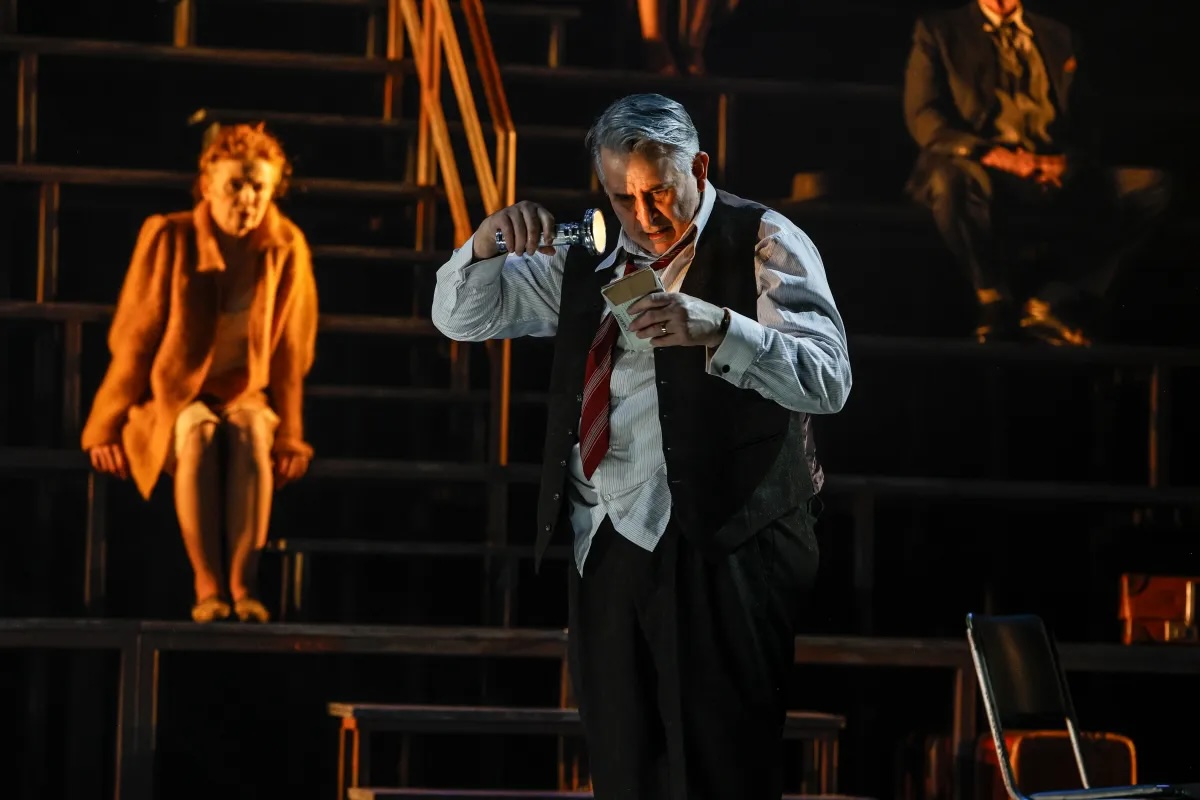
Alison Whyte and Anthony LaPaglia in Death of a Salesman. Photo © Jeff Busby
There are some positives so good they’re worth adding to the pile of praise. The looming bleachers of Ebbet’s Field that replaces the kitchen of the kitchen sink drama is a stroke of design genius by Dale Ferguson. It’s a character in and of itself, never letting the Loman family nor the audience forget the expectations Willy Loman’s son Biff has failed to meet.
The way Armfield moves the cast between reality and Willy’s hallucinations is a master class in directing and the choice to keep the cast on stage, in the bleachers watching Willy, adds to the rising anxiety Willy – and all of the Loman family – feel, across the two act play.

Josh Helman and Anthony LaPaglia in Death of a Salesman. Photo © Jeff Busby
As for the production’s weaknesses, there’s just one; Armfield’s use of music joins a frustrating theatre trend of spoon feeding audiences what to feel or pay attention to. For example; dramatic music begins to play when Willy observes “a man is worth more dead than alive”. It’s the sonic version of a wink and a nudge, of ‘this is important and will come back later’ flashing in neon lights above the stage. Sure, the play premiered in 1949 and death is in the title but does it have to be so obvious?
Theatre goers may remember Belvoir’s infamous 2012 revival that cut the last scene of the play (until the Miller estate insisted on its restoration). In comparison to this interpretation, that asked audiences to infer that Willy wasn’t as well liked as he said he was rather than show it in a sparsely attended funeral, Armfield’s choice of sound design shows how creatives’ expectations of their audiences is dwindling in the era of AI slop that is purportedly dumbing us down.
Arthur Miller, the playwright of Death of a Salesman is lauded by many for fearlessly exposing how the American state and society operates. In the program notes, Armfield suggests this helps audiences understand how the world has come to our present moment of “collapse”.
But 17 years after writing this play about the consequences of a man hiding from the truth – including a broken relationship with his son – Miller institutionalised his own disabled son Daniel at only a week old and then pretended Daniel never existed for the rest of his life.
This ableism, and undoubtedly more -isms, means Miller’s work is none too exposing. Instead of more revivals, and this one will be a tough act to follow anyway, theatre makers could look to works like Fall, that tells Daniel’s story, for more expansive depictions of life past, present and future.
Death of a Salesman plays at Her Majesty’s, Melbourne until 22 August. It then plays the Lyric Theatre, QPAC, Brisbane (28 August–6 September) and Adelaide Festival Theatre 26 September–4 October.


Comments
Log in to start the conversation.