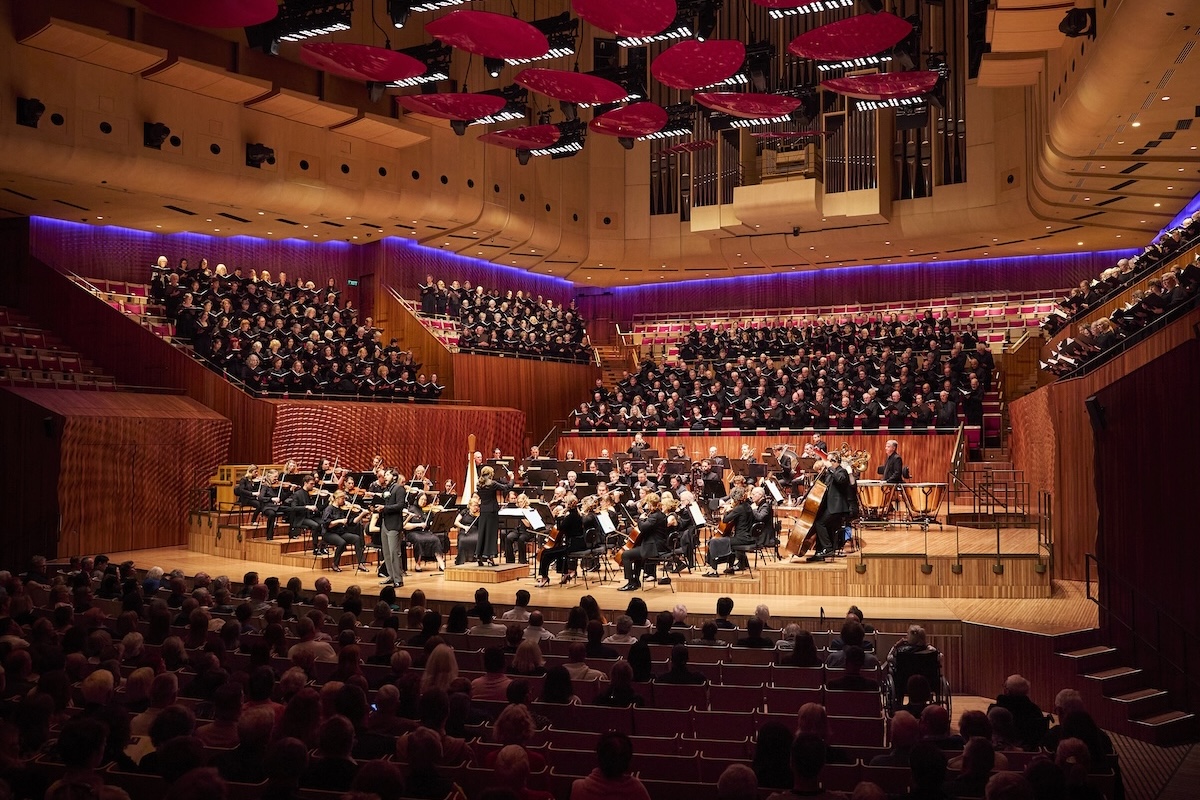
Although Maurice Duruflé’s Requiem is mostly consoling rather than confronting, there were nevertheless some magnificent fortississimo moments – the Domine Jesu Christe and Libera me sections especially – when the 400 voices of Sydney Philharmonia Choirs, the large orchestra and David Drury pulling out the stops of the Opera House organ pinned the audience back in their seats.

Duruflé’s Requiem & Poulenc’s Gloria (Sydney Philharmonia Choirs). Photo © Keith Saunders
The Vichy government commissioned the French organist-composer in 1941 to write a symphonic poem. What they got instead was his first choral work, incorporating some of the Gregorian chants from his earlier organ works. He used Fauré as his model, dropping the Dies Irae and incorporating Libera me and In Paradisium from the Burial Service.
His score for orchestra and organ combines Debussyan harmony with plainsong influences most effectively, with solos for mezzo-soprano and baritone in some sections. Australian Helen Sherman’s rich mezzo was perfect for the Pie Jesu, nestling on a bed of the Sydney Philharmonia Orchestra’s cellos led by Anthea Cottee.
She was equally compelling in Libera me, with conductor Elizabeth Scott releasing the safety valve as the SPC’s Festival Chorus, 60-strong orchestra and organ climbed to a thunderous climax.

Elizabeth Scott conducts Duruflé’s Requiem & Poulenc’s Gloria. Photo © Keith Saunders
Baritone Samuel Dale Johnson’s recent seasons with Deutsche Oper Berlin held him in good stead for his dramatic solo “Hostias et preces tibi”, and he was to get a more prominent role in the second half with the world premiere of Carl Vine’s Time’s Fell Hand, a setting of Shakespeare’s Sonnet 64.
Duruflé ends the work, like Fauré, peacefully with In Paradisium, although his is mistier, with less of the older work’s bubbly, floating quality.

Meechot Marrero and Sydney Philharmonia Choirs. Photo © Keith Saunders
The choir and orchestra were also in superb form for the other major choral work, Francis Poulenc’s Gloria, the opening section of which was a burst of joie de vivre with an infectious beat. In this 28-minute work, he lives up to his famous reputation for being “something of the monk and something of the street urchin”.
The choir follows the solo soprano for much of it, and young Puerto Rican Meechot Marrero, now based in Sydney, made an immediate impact with her sweet, even timbre and control of dynamics. She proved perfect for the slow solos, with their demanding tonal leaps and the magical whispered “amen” that closes the work.

Samuel Dale Johnson and Sydney Philharmonia Choirs. Photo © Keith Saunders
The choir was impeccable in the “lively and joyful” block-harmony choruses that intersperse this radiant work, and the orchestra, under concertmaster Fiona Ziegler, was on song for a score that ranges from the exuberant and festive to the serene and sacred.
Vine’s moving work opens darkly with muted gongs and brass, as befits a poem about the loss of loved ones, death and the relentless march of time. The choir mainly echoes the baritone’s lines, sung with great expression and lyricism by Johnson.
Shakespeare’s description of the ocean taking over the shore brings a change of mood, with whirling passages from the winds. After a tense pause, brass, percussion and the pulse of plucked basses accompany Johnson’s despairing repeated lines: “This thought is as a death, which cannot choose / But weep to have that which it fears to lose”, for the climax of the piece.
For more information on Sydney Philharmonia Choirs, visit sydneyphilharmonia.com.au

Comments
Log in to start the conversation.