Rarely, a classical music concert transcends its program and instead becomes enveloping: where the individual pieces matter much less than the whole experience.

Such was the case with this extraordinary collaboration between the Australian Chamber Orchestra, Norwegian jazz trumpeter Arve Henriksen and Norway’s premiere early music vocal ensemble Trio Mediæval. Pure sound that was breathtaking in its grandeur and in its most delicate sensitivity. An assembly of modern and ancient works that spoke to the human experience of music and its evocation of stark winter landscapes.
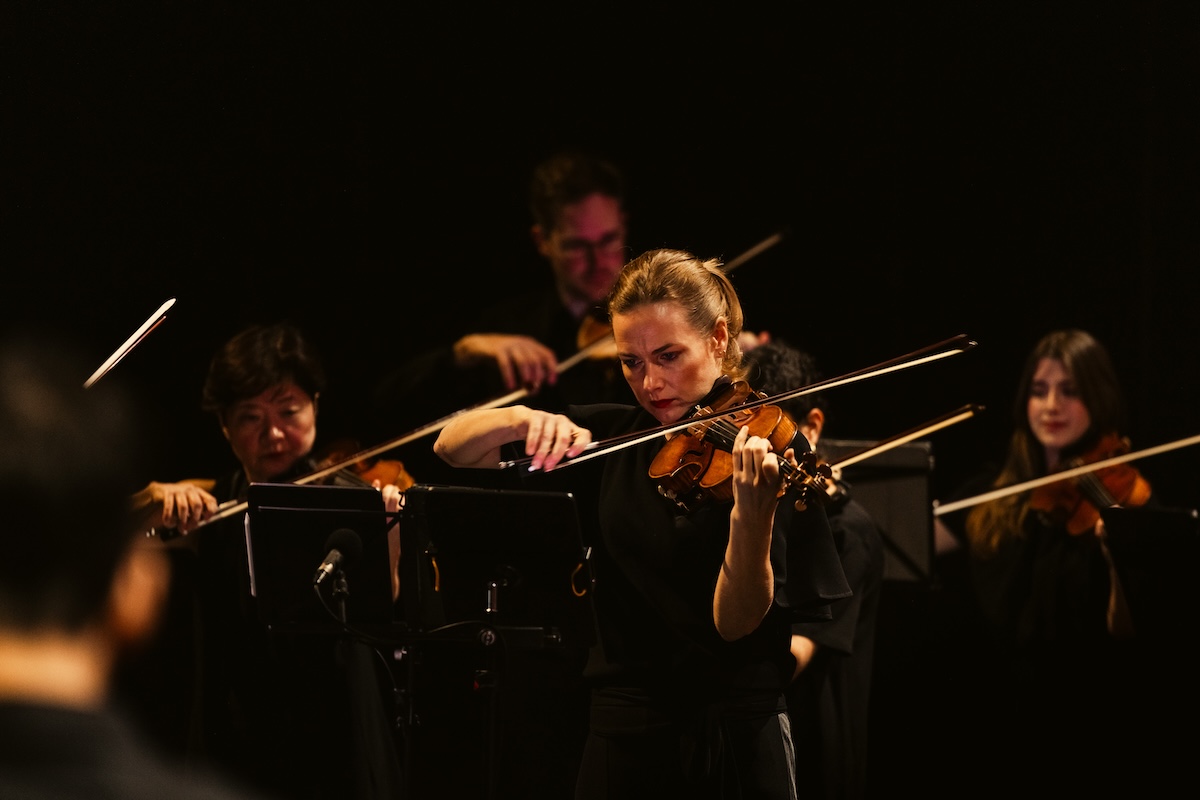
Australian Chamber Orchestra: From Winter’s Stillness. Photo © Charlie Kinross

Matching and combining the work of contemporary modernist and ‘polystylistic’ composers with arrangements of songs over a thousand years old was not in the least bit awkward, shocking or grating. Contrasting musical techniques and sound types were shown to compare across centuries and styles (for instance, demonstrating the use of the Dorian scale in both ancient songs and modern jazz).

The opening work, The Plume of Ash/Acceptance was composed and directed by Arve Henriksen as he played the solo trumpet line. Inspired by the eruption of Iceland’s Eyjafjallajökull volcano in 2010, improvised and free-form utterances from the strings transitioned to long, more ordered exhales from the trumpet in pairs of rising fifths, with Henriksen gesturing with calm subtlety how he wanted the orchestra to follow him.

ACO Director Richard Tognetti took over leading the orchestra (with body and bow) for the rapid, syncopated Half Wolf Dances Mad in the Moonlight by Terry Riley, featuring cellos and double basses playing on their own in one especially effective passage.

Trio Mediæval and Australian Chamber Orchestra: From Winter’s Stillness. Photo © Charlie Kinross

The three stunning voices of Trio Mediæval (Anna Maria Friman, Ditte Marie Bræin and Jorunn Lovise Husan) joined the orchestra, solo trumpet and Simon Tedeschi on modified upright piano for the three-movement composition Kellamäng (Bells), composed for Arve Henriksen and Trio Mediæval by Estonian composer Tõnu Kõrvits (to poems by Doris Kareva). At times, Henriksen’s two trumpets sounded like a fourth human voice, blending in spellbinding phrases with the singers.

To finish the first half, an arrangement of a traditional Norwegian song Det lisle bånet (The little child) displayed the purity of early music singing techniques (using almost no vibrato) and simple harmonies.  Then a heart-wrenchingly beautiful arrangement of Fljótavik by the Icelandic band Sigur Ròs – both jazzy and meditative – finished to a perfectly silent auditorium.

Arve Henriksen. Photo © Charlie Kinross

Intriguingly, the second half was arranged around a full performance of Alfred Schnittke’s Concerto Grosso No. 1, but with movements performed alternately between medieval traditional hymns. The Schnittke concerto mixes styles and effects with absolute abandon (hence his own characterisation of his oeuvre as polystylistic).

It is hugely intimidating technically. Yet the ACO players embraced it with flair and determination. The interspersed hymns provided reflection (and to some, maybe relief) against the acidic harshness of the Schnittke (with the exception of the Rondo, with its folkish violin solos, which is perhaps more accessible).

Australian Chamber Orchestra: From Winter’s Stillness. Photo © Charlie Kinross

In the hymns, Trio Mediæval emphasised the effectiveness and skill involved in very precise unison singing, with only subtle harmonies used to augment, highlight and conclude certain phrases. Henriksen introduced yet more range with his trumpet: vocalising through the pipes and using the valves to create a mechanical vibrato.

Still, only the most sceptical traditionalist could have failed to be moved by the final movement of the Schnittke: intense and foreboding but played at the extremes of pianissimo by the strings with jolting, rhythmic punctuation from the piano. It left the audience hardly daring to breathe lest the mesmeric sounding of the final note be prematurely interrupted.   


Australian Chamber Orchestra performs From Winter’s Stillness at City Recital Hall, Sydney 1, 4, 5  and 7 August; Queensland Performing Arts Centre, Bribane 3 August, and Sydney Opera House 9 August.
Contribute to Limelight and support independent arts journalism.