It’s not too often that one finds a full house at Hamer Hall on a cold Thursday evening. But such is the case when the Melbourne Symphony Orchestra offers a program pairing Czech classics with the Australian premiere of a new piano concerto performed by international guest artist Kirill Gerstein.
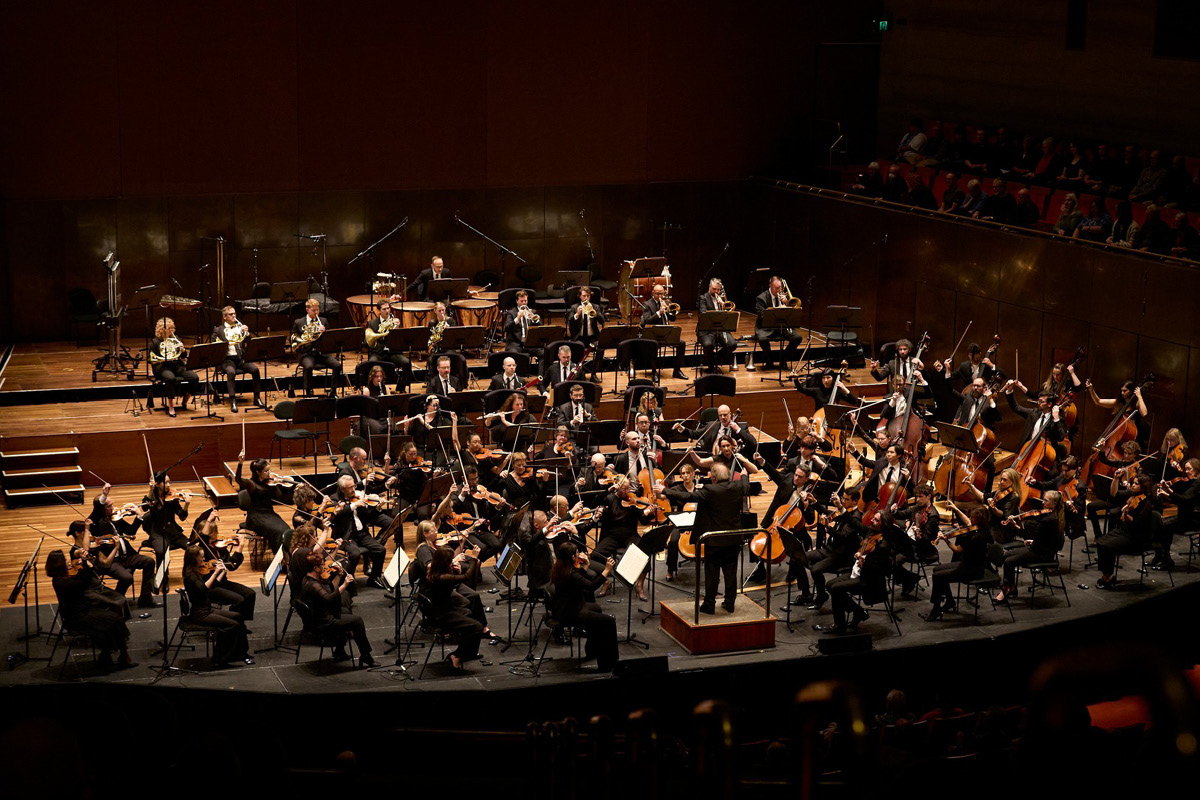
Melbourne Symphony Orchestra. Photo © Laura Manariti
Opening with Smetana’s well-loved symphonic poem Vltava (The Moldau) from Má vlast, two murmuring flutes begin the scenic course of the river through forest, meadow and mountain. The stereophonic effect of Smetana’s orchestration was beautifully captured, with shimmering violin and harp moments. Yet one wondered whether the hunting calls and village festival scenes might have benefited from greater rhythmic vitality. Conductor Jaime Martín’s measured tempo seemed to produce a sense of reverence befitting Smetana’s ode to his homeland, though at the cost of some programmatic immediacy.
Francis Coll’s Piano Concerto, co-commissioned by the MSO, presented a starkly different musical world. A protégé of British composer Thomas Adès, Spanish-born Coll’s bold musical language draws inspiration from visual art—he grew up surrounded by paintings in his father’s frame shop. Both Coll and Russian-American pianist Gerstein, whom the work was composed for, proved unafraid to push musical boundaries. A champion of new music, Gerstein (who also premiered Adès’s Piano Concerto in 2019) demonstrated his versatility, equally at home with contemporary and classical music.

Kirill Gerstein and the MSO. Photo © Laura Manariti
An immediate burst of activity from both piano and orchestra set an exhilarating tone to the vibrant and intricately detailed work, as Gerstein and the MSO navigated the first movement’s pointillistic gestures. An engaging playfulness was seen in Gerstein’s approach to the cascading note clusters, at times played with his fists like a dance across the keyboard.
The second movement (Paisaje) offered contemplative respite. Expansive soundscapes created by string tremolos and orchestral swells gradually receded, leaving Gerstein in solemn solitude exploiting the piano’s darker lower register with considerable sensitivity.
The finale (Rag) returned to frenzied virtuosity, opening with scattered piano chords accompanied by percussive Bartók pizzicatos in the lower strings. The jazz inflections and big-band textures enriched its colourful palette, paying homage to Gerstein’s own self-taught jazz background.

Jaime Martín, Kirill Gerstein and the MSO. Photo © Laura Manariti
Gerstein’s encore, Ligeti’s Arc-en-Ciel Etude, provided a thoughtful contrast to the Concerto’s frenetic energy. It echoed the Concerto’s exploration of colour and light through sound, yet achieved through contemplative restraint rather than overt virtuosic display.
The concert concluded with a spirited reading of Dvořák’s Seventh: one of the composer’s most compelling, yet surprisingly underperformed symphonies. From the striking minor-key opening with brooding lower strings, Martín shaped the work with architectural clarity.
The second movement revealed Brahmsian echoes, its horn chorale providing warm lyricism against the movement’s pastoral serenity. The characteristic exuberance of a Czech folk dance in the third movement was well-captured, the strings traversing their full range with agility. The concluding major chord arrival, announced by the trombones, carried thrilling dramatic weight.

Comments
Log in to start the conversation.