




John McCabe (1939–2013) maintained a considerable presence on the British music scene as a composer, pianist, and writer on music, but since his death his own music has had few recordings. It is therefore a pleasure to welcome the arrival of this new release of his previously unrecorded Cello Concerto and Third Symphony. An earlier recording of his Symphony No. 2, made in 1973 with the City of Birmingham SO under Louis Frémaux, was long unavailable. \
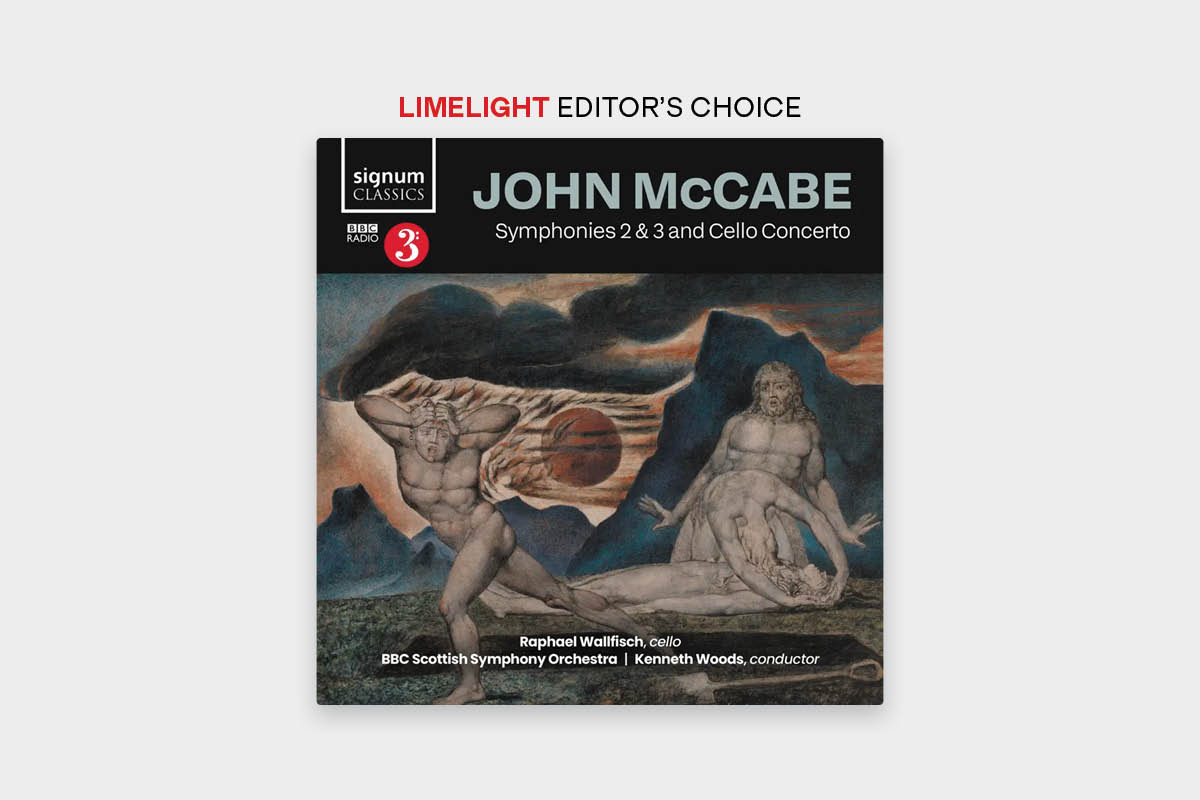
According to the composer, his Second Symphony was inspired by Sam Peckinpaw’s 1969 Western, The Wild Bunch, but the music is not as graphic as the movie. Any violence in McCabe’s symphony is nascent, with skittering woodwinds and ominous brass chords providing a constant ‘on the edge’ sensation. (Even more so in Frémaux’s tense performance.) Over the symphony’s Bartókian five-movement arc, jittery nervous passages alternate with quiet brooding, which is how the piece ends. McCabe’s colourful orchestral palette is a notable feature.
That also applies to the ruminative Cello Concerto of 2007. Listen to the delicate use of the vibraphone in the central Adagio. This 25-minute concerto, subtitled “Songlines”, represents a life’s reminiscence with the cello as protagonist. Its continuous three-movement form is episodic, but themes and motifs consistently evolve. The resplendent coda of the finale is a genuine summing up, after which the solo cello line ascends to the heights for a final reflective moment before it is abruptly cut off for good: A dramatic ending to a work full of exquisite ideas.
I have been a fan of McCabe’s music ever since I first heard his Fourth Symphony, Time and the River. In that work, his ability to develop musical material set something of a template for English symphonic thinking in the 21st century. His similar Symphony No. 3 (1978), in three continuous movements, is subtitled “Hommages”. The homages in question are to McCabe’s two most loved composers, Haydn and Nielsen. (He recorded the complete piano output of both.) He does not indulge in stylistic imitation, but there are factors connecting them. A light touch to the scoring and pacing suggests Haydn, while the important role played by woodwinds brings Nielsen to mind. The first movement approaches a Nielsen-like climax, although it is nowhere near as intense or prolonged. The final movement, marked Fugue and Variations, remains very much a product of McCabe’s symphonic style, devoid of classical pastiche. (The variations are more Nielsen than Haydn, but are McCabe above all.) Like pop songs of the 1950s, the symphony ends with a fade-out – a snare drum figure retreating into oblivion. Performances and recording quality are terrific.
Is there a cello concerto that Raphael Wallfisch has not mastered? He plays here with his customary thoughtfulness and understanding. Conductor Kenneth Woods is always in his element with modern symphonic writing, and the Scottish orchestra is its usual reliable self. Mostly, however, it is John McCabe’s music that endures. Thirteen years after the composer’s death, he still speaks to us as contemporaries.
Composer: McCabe
Works: Symphonies Nos. 2 & 3, Cello Concerto.
Performers: Raphael Wallfisch vc, BBC Scottish Symphony Orchestra/Kenneth Woods
Label: Signum SIGCD1007






Comments
Log in to start the conversation.