


Ever wondered what Léo Delibes was doing when he wasn’t writing Lakmé? Best known today for the melodious ballet Coppélia, the French composer actually wrote some 20 operas of which 19 (18 if you count the occasionally heard Le Roi l’a dit) have sunk without trace. Several of them, however, were well received in their day, and if this premiere recording of Jean de Nivelle is anything to go by, are well worth rediscovering.
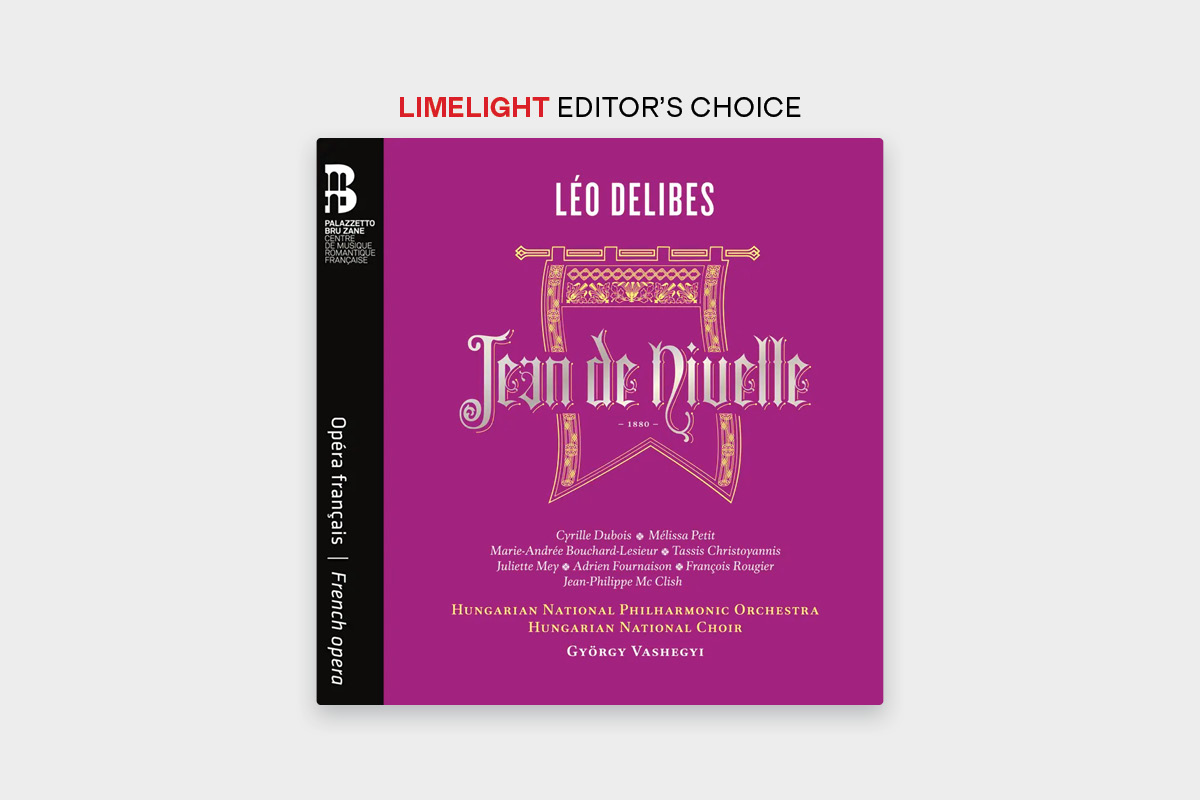
The work premiered at the Opéra Comique in 1880 where critics admired its lyrical charm and – perhaps surprisingly – the libretto by Edmond Gondinet and Philippe Gille. I say surprisingly, for although the quality of the text is perfectly acceptable, the storyline is something of a mess. Indeed, it’s hard to care a great deal for this slice of medieval history with its antihero and bickering lords and peasant women.
The real Jean de Nivelle became a byword for double-dealing and failure in filial duty. Summoned by his father to assist Louis XI against Charles the Bold, Duke of Burgundy, Jean switched sides, was duly disinherited and branded for all time as “a dog”. In order to pad out the scanty historical plot, Delibes opera becomes ridiculously convoluted. Jean is first discovered disguised as a peasant having fled the court to avoid an arranged marriage. Arlette, a village maiden, was supposed to marry Thibaut, the son of her aunt, the spiteful Simone (described in the libretto as “a hag”) but Arlette is now in love with Jean. Over the course of three lengthy acts, we meet a succession of rival lords, one of whom falls for and attempts to ruin Arlette. At first reconciled with his father, Le Comte de Charolais, in the end Jean decides to quit the battlefield and start a new life with Arlette.
Musically it’s a curiosity, part comedy, part tragedy. It’s presented here with the composed recitatives that quickly supplanted the original spoken dialogue, thus emphasising its affinity with grand opera, all of which make the comic characters feel a trifle out of place. Nevertheless, the score is strong, especially in terms of melody and orchestral colour. There are some catchy arias and ensembles and some attractive writing for choruses of peasants and nobles. The Hungarian National Philharmonic Orchestra and Choir lap it up, while György Vashegyi’s reading of Delibes’ generally up-tempo score is pacy and full of character.
Amid a strong cast, Cyrille Dubois brings a light, plangent tenor to the title role. Jean isn’t the most likeable of fellows, endlessly vacillating and fundamentally untrustworthy despite a certain moral compass, but Dubois is a most engaging singer and his lyric instrument draws you in, even if the character lacks a “big” aria (those are reserved for the two women).
Mélissa Petit makes a feisty fist of Arlette, her flexible soprano rich and creamy but with plenty of firepower at the top. Her ballad, Dans le moulin du grand meunier, may feel like a tryout for Lakmé, which is three years down the track, but she delivers it with great panache. The other major role is Simone, sung with Azucena-like authority by mezzo-soprano Marie-Andrée Bouchard-Lesieur. Her Ballade de la Mandragore is a real earworm. Among the rest of the cast, an imposing Tassis Christoyannis stands out as Jean’s father, with Adrien Fournaison, François Rougier and Jean-Philippe McClish flavorsome as rival lords and Juliette Mey sweet-toned as the page, Isolin.
Another winner then from Bru Zane, whose notes are as ever exemplary. Sumptuously recorded, it deserves repeated listening, even if it’s unlikely to find its way to a stage near you anytime soon.
Composer: Lèo Delibes
Work: Jean de Nivelle
Performers: Cyrille Dubois t, Mélissa Petit s, Marie-Andrée Bouchard-Lesieur ms, Hungarian National Philharmonic Orchestra and Choir with György Vashegyi
Label: Bru Zane BZ1066 (3CD & Book)








Comments
Log in to start the conversation.