




It’s a hackneyed phrase, “never been more relevant”, yet it’s true of Lord of the Flies, William Golding’s 1954 novel about the tension between civility and chaos.
With the world currently slipping into might-is-right tribalism, selfishness and ignorance, the British writer’s dystopian tale feels disturbingly resonant as it unfolds in this new Theatre Works production.
With Nigel Williams’s 1995 adapted stageplay, a committed, accomplished cast of 11 young actors, and humble but effective stagecraft, director Steven Mitchell Wright reinvigorates this school reading list staple with the electric immediacy of good theatre.
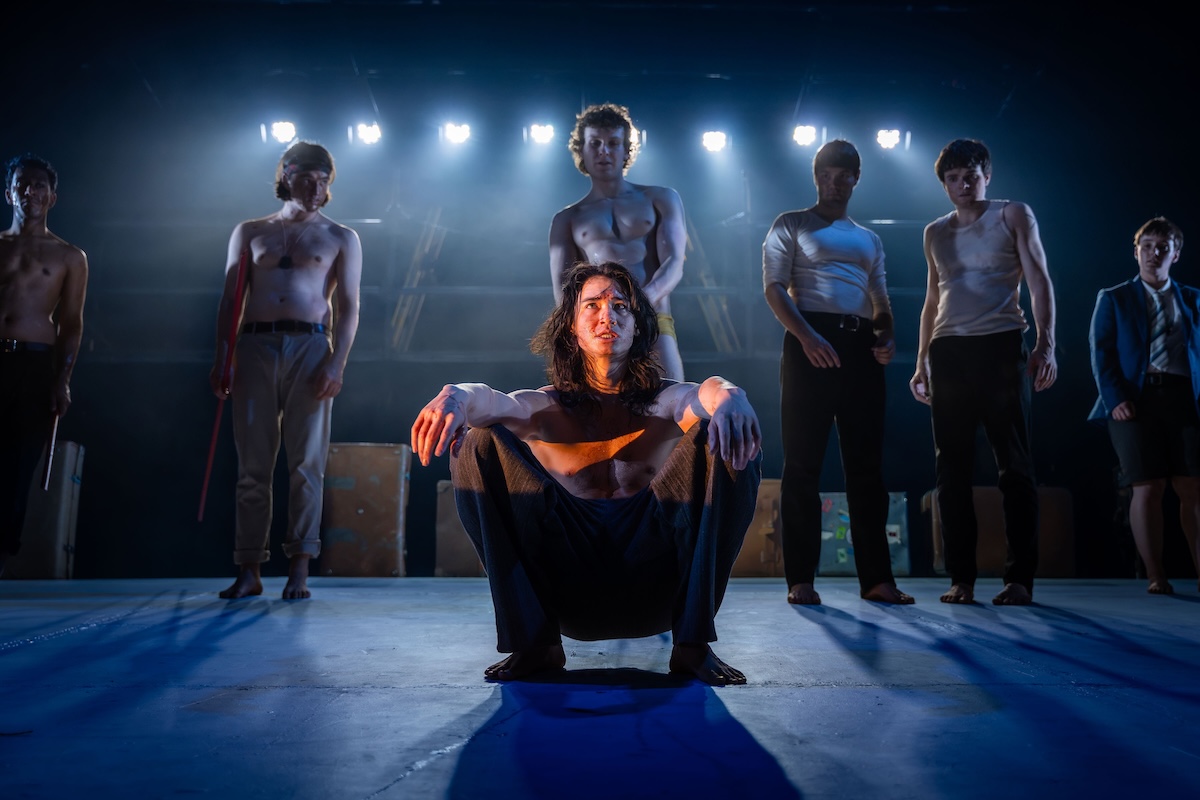
Sean Yuen Halley and company in Lord of the Flies. Photo © Matthew Chen
A dark, realist inversion of 1857 children’s adventure novel The Coral Island, Lord of the Fliessees several schoolboys marooned after their plane crashes. Ralph, who they elect “chief”, and intelligent, bespectacled Piggy try to bring order and hope to their situation.
However, as Jack’s self-importance becomes megalomania, most of the boys join him in hunting pigs, obsessing over a mysterious “beast” and mindless, reactionary behaviour that turns deadly.
Over nearly three hours (including interval), we watch the boys’ descent into barbarity on a quasi playground within Theatre Works’s black box. A dominant, steeply raked white stage is backed by an elevated structure of pipes, clamps and ladders.
Between these spaces, which effortlessly represent different locations through dialogue and line of sight, is a narrow, unseen netherworld serving both practical and dramatic purposes.
This uncredited set design (perhaps the creation of Wright, who has design experience) is occasionally enhanced by vintage luggage, scraps of plastic or a prop pig.
It’s often atmospherically transformed by Ben Hughes’s lighting – from gloomy red washes to stark white flashes – as well as Jack Burmeister’s sound, whose drama is more effective because it’s employed with restraint.

Alvin Prassad, Will Bastow and Sam Finn Gudgeon in Lord of the Flies. Photo © Matthew Chen
This Lord of the Flies’ heavy lifting is done by the cast. This energetic ensemble is almost always on the move (including in cleverly stylised moments such as the plane crash) yet always perfectly placed. Collectively and often individually, they defy expectations of having little or no professional acting experience.
With naturalism and understatement, Angus Leighton takes Ralph from unassuming leader to a reluctant one with diminishing options. The slightly whiny frustration and anxiety of Oliver Cowen’s Piggy conveys a short lifetime of being bullied and ignored.
As Jack, Sean Yuen Halley offers a believable metamorphosis from smug posh prefect, incredulous he’s not “chief”, to fierce autocrat; his wild-eyed bloodlust near the finale is chilling.
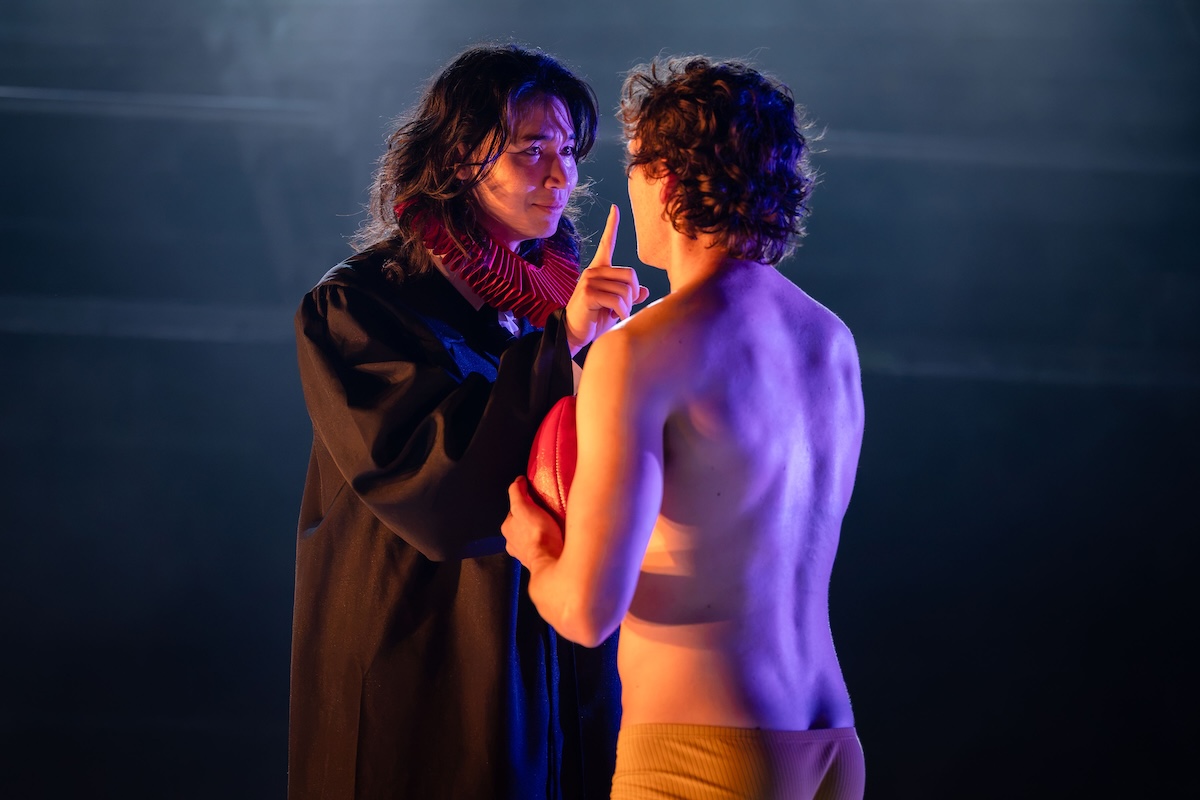
Sean Yuen Halley and Angus Leighton in Lord of the Flies. Photo © Matthew Chen
With limited dialogue, the supporting cast still manage to become distinct characters through physicality and voice, including Darcy Crawford as innocent, impressionable junior schoolboy Percival. Sam Gudgeon turns the small role of Simon into a tragic portrait of a sensitive boy on the spectrum.
Uncredited costuming sees the cast initially dressed in a mishmash of boyhood clothes, before spending the second act in underpants – perhaps with the addition of body paint or random garments retrieved from the luggage.
This visual representation of the boys’ removal from and abandonment of civilisation is underscored by switching from various English accents to a neutral Australian one; this is an odd choice, suggesting we’re a nation of inferior colonials.
It’s one of very few slight missteps in this bold independent production, which is a rarity in the current cost-cutting environment of short plays and small casts. The lamentably short season ought to sell out, so snap up a ticket while you can – if you’re willing to confront the possibility that humans are savage at heart.
Lord of the Flies is at Theatre Works, Melbourne, until 2 October.




Comments
Log in to start the conversation.