Let’s begin with the main point: this set of performances is a knockout.

Czech composer Bohuslav Martinů (1890–1959) relocated to the United States during the Second World War. Already in his 50s, he had a secure reputation as a composer but had never attempted a symphony. His First, in 1942, was commissioned by Serge Koussevitsky, conductor of the Boston Symphony Orchestra, and the following five appeared one per year after that. The run of annual symphonies was interrupted in 1946, when the composer fell from a balcony and suffered a fractured skull. No. 6 was again composed for Boston, this time with conductor Charles Munch, in 1951–53. Martinů became an American citizen in 1952 but spent his final years in Switzerland.
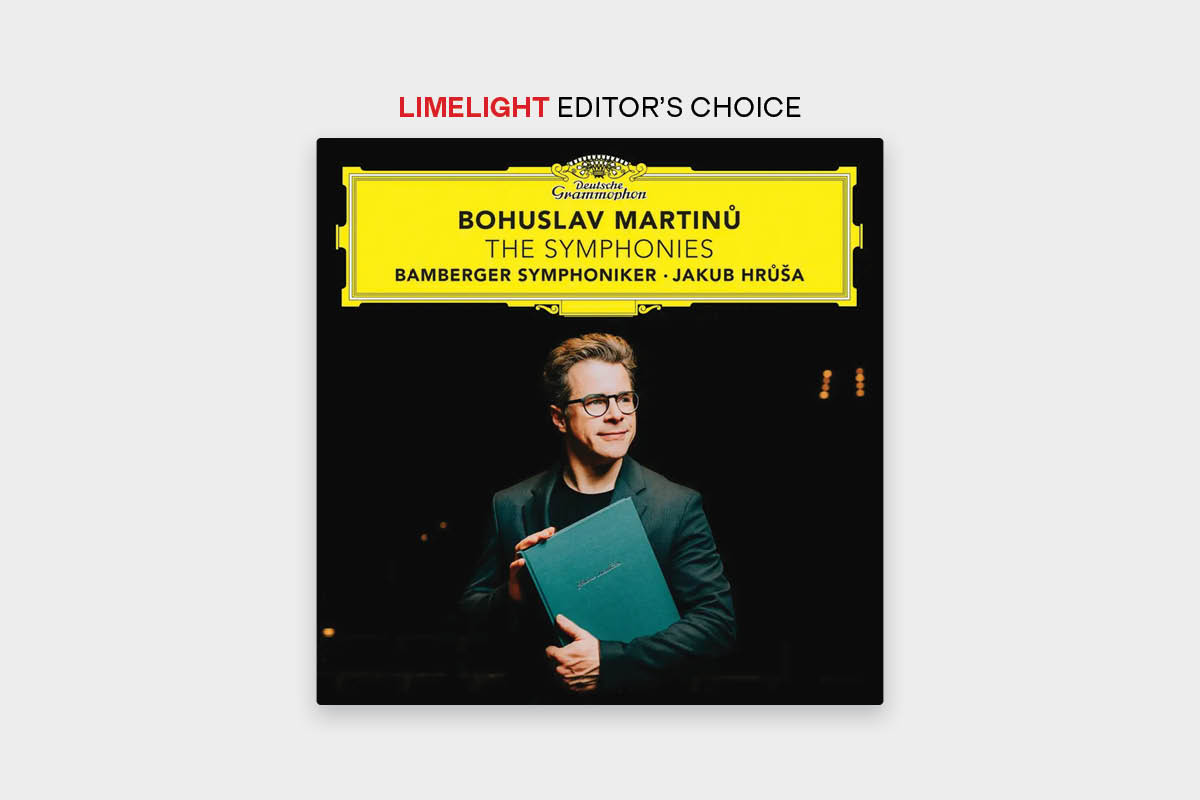
The first five symphonies employ a regular four-movement form in Nos. 1, 2, and 4, and three movements in Nos. 3 and 5. They all contain Martinů’s fingerprints: chugging rhythms, often syncopated; soaring violin lines, frequently doubled at the third or sixth, rich brass chording, and percussive accents. Symphonies 2 and 4 are lighter in spirit, while the Third and particularly Fifth are darker and dramatic. 

Another feature is his tendency to give heartfelt, lyrical themes to the cellos, for instance in the third movements of No. 3 and No. 6. The latter work, originally titled “Fantasies Symphoniques” is not like the others: it is episodic and organic in form, knitted together by a recurring musical motif. Here, the composer is more focussed on orchestral colour than before. In his prolific output, the Sixth is one of Martinů’s masterpieces.

Jakub Hrůša is arguably the best Czech conductor working today. You can hear how well he knows and loves this music. The chugging rhythms are never monotonous: with Hrůša they are vital, sharply etched, and provide momentum. His shaping of phrases brings them to life, and above all he clarifies busy textures so that important melodic details are not lost. He had been Chief Conductor of the Bamberg Symphony for ten years, another telling fact: they know what he wants and give it to him. Beyond technique, Hrůša and his musicians express the abundant joy and also Martinů’s ever-present homesickness for Czechoslovakia with clear understanding. You can sample both in the exuberant Scherzo of Symphony No. 4.

There have been excellent Martinů symphony cycles before, such as the strong, refined survey by the BBC Symphony Orchestra under the late Jiří Bělohlávek (Onyx, 2011), and stunning recordings of individual symphonies in the past from Karel Ančerl, Martin Turnovský, Rafael Kubelík and others. Munch and the Boston Symphony recorded the Sixth a year after they had premiered it in 1955, and that RCA disc is iconic. Yet, comparing Munch with Hrůša, I prefer the new performance. Munch is tremendously exciting, as he always was, but pushes the music too hard. Hrůša paces it more subtly yet never lacks drive. The DG/BR Klassik sound quality is greatly superior to Munch (though not to Bělohlávek). 

This release now sets a new standard in this repertoire and is urgently recommended.

Listen on Apple Music

Composer: Martinů
Works: Symphonies Nos. 1-6
Performers: Bamberg Symphony Orchestra/Jakub Hrůša
Label: DG 4867810 (3CD)

Contribute to Limelight and support independent arts journalism.