


Mozart wrote many works for violin and keyboard, beginning as a child. Between the ages of six and nine, arguably with the help of his father, Mozart produced 10 sonatas for keyboard and violin: K6 through to K9, and K26 through to K31.
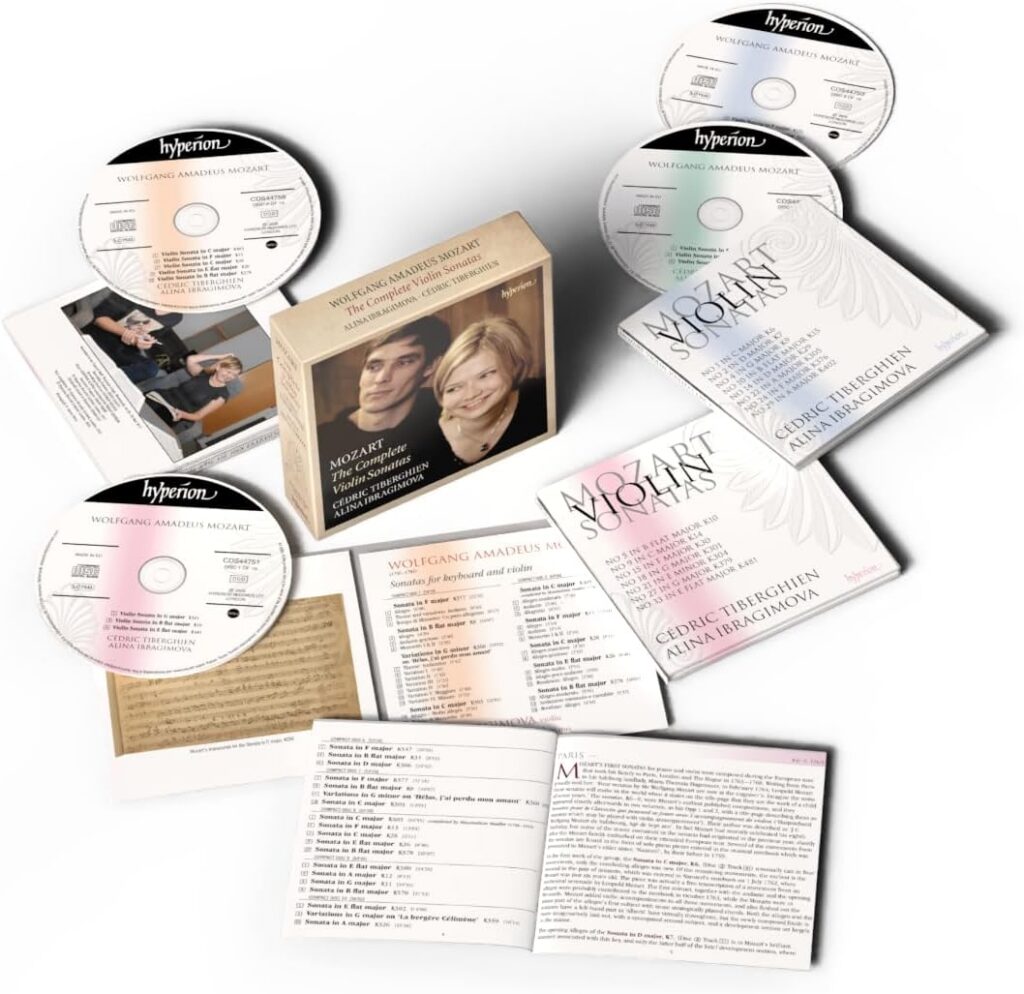
The remaining 16 so-called “mature” sonatas were written between 1778 and 1788. While most violin duos have concentrated on the mature works, in this compilation Alina Ibragimova and Cédric Tiberghien cover the entire output.
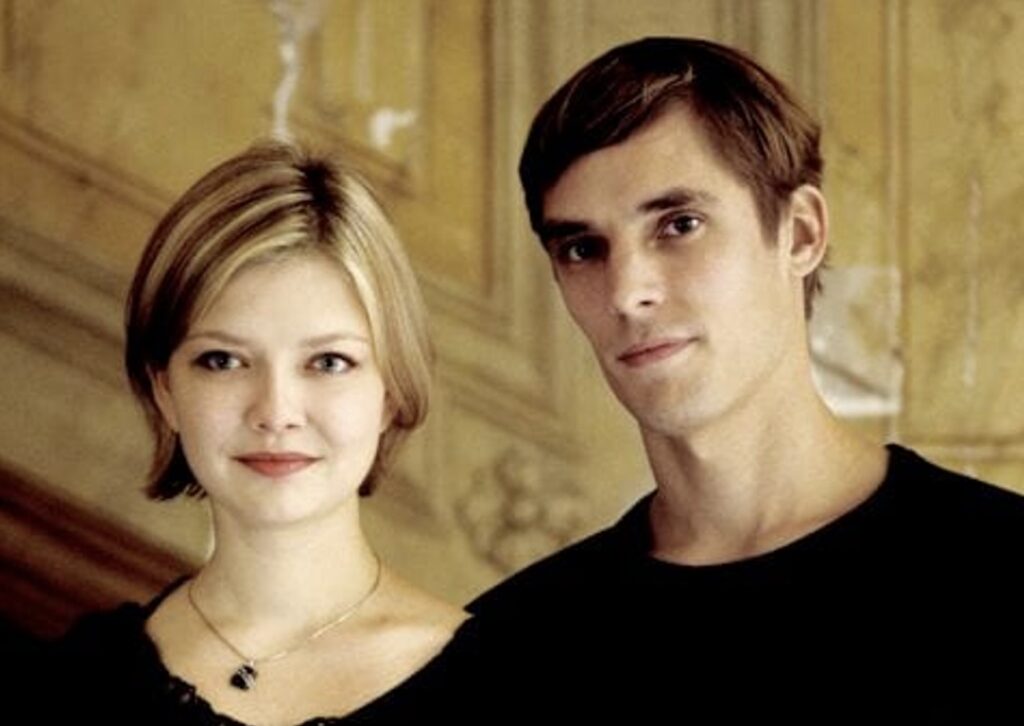
Alina Ibragimova and Cédric Tiberghien. Photo © Eva Vermandel
These recordings were released as single or double CDs between 2016 and 2018. Most of the works, while billed as violin sonatas, were originally described by the composer as Sonatas for Fortepiano and Violin, in that order. The young prodigy Mozart played both, but keyboard was his primary instrument. Understandably, the keyboard has as much to do than the violin, if not more, in terms of carrying the musical argument. In the early sonatas, such as Sonata in C, K6, the keyboard does all the work, with the violin either doubling it or providing harmonies and decorative additions.
There is nothing else remotely immature about the early works, however. They are packed with musical ideas, showing the young composer at his most light-hearted and technically accomplished. I would not want to be without the concluding Rondo finale of K6: it showcases this duo at their most spirited and bubbly.
As with the original releases, Tiberghien and Ibragimova do not play these pieces in chronological order, but generally sandwich an early work in between two later ones, giving each disc a program with plenty of contrast. For example, they follow the Sonata in Bb major, K10 (which closes with a spry minuet) with Sonata in E-flat, K481. In the later work, you notice how much more independent the violin part has become from the piano: unison playing has been replaced with echoing phrases, for example.
This set has the advantage of being absolutely complete. It also includes two sets of variations and the Sonata in C, K403, reputedly completed by Anton Stadler. (Stadler, a close friend of Mozart, was a clarinet and basset-horn virtuoso; Mozart’s popular clarinet Concerto was written for him.) Another advantage is the partnership of Ibragimova and Tiberghien, who have recorded fine albums of Ravel, Schumann, Schubert and others. Their tightness of ensemble is impressive… but I have a nit to pick, nevertheless.
Ibragimova’s playing is influenced by historically informed practices: She is precise, with a light touch in bowing, and uses little or no vibrato. Her legato is minimal. While her intonation is immaculate, the result strikes me as underpowered: not under-inflected, so much as lacking the singing quality that brings Mozart to life. Her approach would sit well alongside a great fortepianist like Kristian Bezuidenhout, but Tiberghien is not that: he is a full-blooded concert pianist, playing a modern Steinway. Despite their expressive affiliation, there is a stylistic discrepancy here that you don’t hear from older duos in this repertoire.
While received opinion claims Mozart was too prettified in 20th-century performances, I don’t find that at all. In the great duo recordings, Mozart’s music is grounded, propulsive and open-hearted, and his melodies are treated with a cantabile lyricism. I am thinking particularly of the poise of Arthur Grumiaux with the great Mozartean pianist Clara Haskil (Philips), who recorded K301, 304, 376 and 378; the warmth of Henryk Szeryng with pianist Ingrid Haebler (Philips), and the power of Christian Ferras with pianist Pierre Barbizet (Decca), whose joyful 1956 performance of the Violin Sonata in A, K305 remains unmatched. In all these cases, the relationship between piano and violin is ideally balanced. If this is Romantic rather than Classical Mozart, to me it projects the heart and pulse of the music in a truthful, unexaggerated way.
For an alternative set of the major sonatas, I would recommend Frank Peter Zimmermann and Alexander Lonquich (Warner), who are also evenly matched. That is a personal opinion: this Hyperion set still has a lot to offer, including completeness, a high standard of musicianship, and good quality sound.
Mozart
Complete Violin Sonatas
Alina Ibragimova v, Cédric Tiberghien p
Hyperion CDS4475160 (10CD)







Comments
Log in to start the conversation.